

geometric classification schemes (Turner and
Weiss, 1963; Fleuty, 1964; Ramsay, 1967; Hudleston, 1973; Twiss and Moores, 1992). For example,
structural geologists identify the line or curve
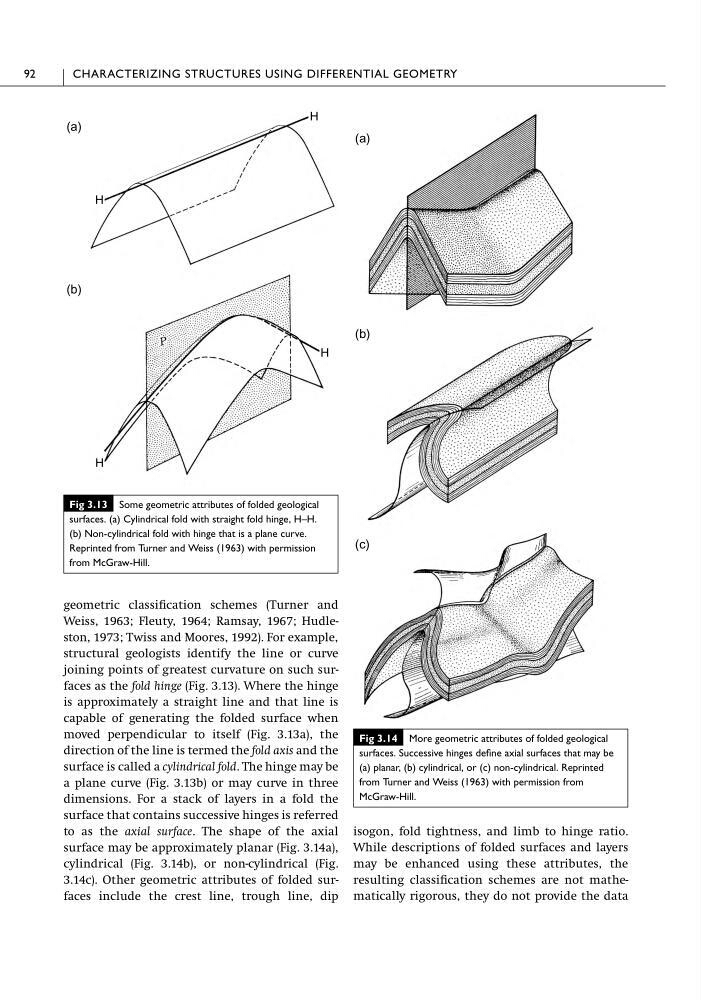
joining points of greatest curvature on such surfaces as the fold hinge (Fig. 3.13). Where the hinge
is approximately a straight line and that line is
capable of generating the folded surface when
moved perpendicular to itself (Fig. 3.13a), the
direction of the line is termed the fold axis and the
surface is called a cylindrical fold. The hinge may be
a plane curve (Fig. 3.13b) or may curve in three
dimensions. For a stack of layers in a fold the
surface that contains successive hinges is referred
to as the axial surface. The shape of the axial
surface may be approximately planar (Fig. 3.14a),
cylindrical (Fig. 3.14b), or non-cylindrical (Fig.
3.14c). Other geometric attributes of folded surfaces include the crest line, trough line, dip
isogon, fold tightness, and limb to hinge ratio.
While descriptions of folded surfaces and layers
may be enhanced using these attributes, the
resulting classification schemes are not mathematically rigorous, they do not provide the data
92
CHARACTERIZING STRUCTURES USING DIFFERENTIAL GEOMETRY
Fig 3.13 Some geometric attributes of folded geological
surfaces. (a) Cylindrical fold with straight fold hinge, H–H.
(b) Non-cylindrical fold with hinge that is a plane curve.
Reprinted from Turner and Weiss (1963) with permission
from McGraw-Hill.
(a)
(b)
H
H
H
H
Fig 3.14 More geometric attributes of folded geological
surfaces. Successive hinges define axial surfaces that may be
(a) planar, (b) cylindrical, or (c) non-cylindrical. Reprinted
from Turner and Weiss (1963) with permission from
McGraw-Hill.
(a)
(b)
(c)
(a)
(b)
Weiss, 1963; Fleuty, 1964; Ramsay, 1967; Hudleston, 1973; Twiss and Moores, 1992). For example,
structural geologists identify the line or curve
joining points of greatest curvature on such surfaces as the fold hinge (Fig. 3.13). Where the hinge
is approximately a straight line and that line is
capable of generating the folded surface when
moved perpendicular to itself (Fig. 3.13a), the
direction of the line is termed the fold axis and the
surface is called a cylindrical fold. The hinge may be
a plane curve (Fig. 3.13b) or may curve in three
dimensions. For a stack of layers in a fold the
surface that contains successive hinges is referred
to as the axial surface. The shape of the axial
surface may be approximately planar (Fig. 3.14a),
cylindrical (Fig. 3.14b), or non-cylindrical (Fig.
3.14c). Other geometric attributes of folded surfaces include the crest line, trough line, dip
isogon, fold tightness, and limb to hinge ratio.
While descriptions of folded surfaces and layers
may be enhanced using these attributes, the
resulting classification schemes are not mathematically rigorous, they do not provide the data
92
CHARACTERIZING STRUCTURES USING DIFFERENTIAL GEOMETRY
Fig 3.13 Some geometric attributes of folded geological
surfaces. (a) Cylindrical fold with straight fold hinge, H–H.
(b) Non-cylindrical fold with hinge that is a plane curve.
Reprinted from Turner and Weiss (1963) with permission
from McGraw-Hill.
(a)
(b)
H
H
H
H
Fig 3.14 More geometric attributes of folded geological
surfaces. Successive hinges define axial surfaces that may be
(a) planar, (b) cylindrical, or (c) non-cylindrical. Reprinted
from Turner and Weiss (1963) with permission from
McGraw-Hill.
(a)
(b)
(c)
(a)
(b)