

away from the curve on its concave side toward
the z-axis (Fig. 3.8a). Unlike the tangent vector, t,
the curvature vector, k, is not generally a unit
vector and here it has a magnitude given by � that
is a constant related to the radius, a, and the pitch,
b, of the helix. For the circle in the (x, y)-plane (Fig.
3.8b), the curvature vector and scalar curvature
are found from (3.22) by letting b go to zero:
(3.23)
By substitution, notice that the curvature vector
for the circle varies with the parameter t as:
(3.24)
This curvature vector is orthogonal to the circle
and directed toward the center of the circle (Fig.
3.8b). It is not a unit vector unless a � 1. The scalar
curvature is inversely proportional to the radius
of the circle.
A positive scalar quantity called the radius of
curvature, �, is motivated by (3.23) and is defined
for an arbitrary parametric representation of a
curve, c(t), as the reciprocal of the scalar curvature
(Lipschutz, 1969, p. 63):
(3.25)
From (3.23) we have � � a, so the radius of curvature of a circle is the radius of that circle. For the
circular helix (Fig. 3.8) the geometric relationship
is not so obvious, but using (3.22) we see that the
radius of curvature is a constant everywhere
along the helix with a value � � (a
2 � b
2 )/a. The
radius of curvature for the circular helix is the
radius of a circle that is tangent to the helix and
lies in the plane defined by the unit tangent vector
and the curvature vector. In general, for an arbitrary curved line, the radius of curvature is a function of the parameter t, and therefore must be
calculated for every point along the curve. For any
straight line or segment of a straight line, and also
for any point of inflection along a curve the radius
of curvature is infinite because the scalar curvature is zero.
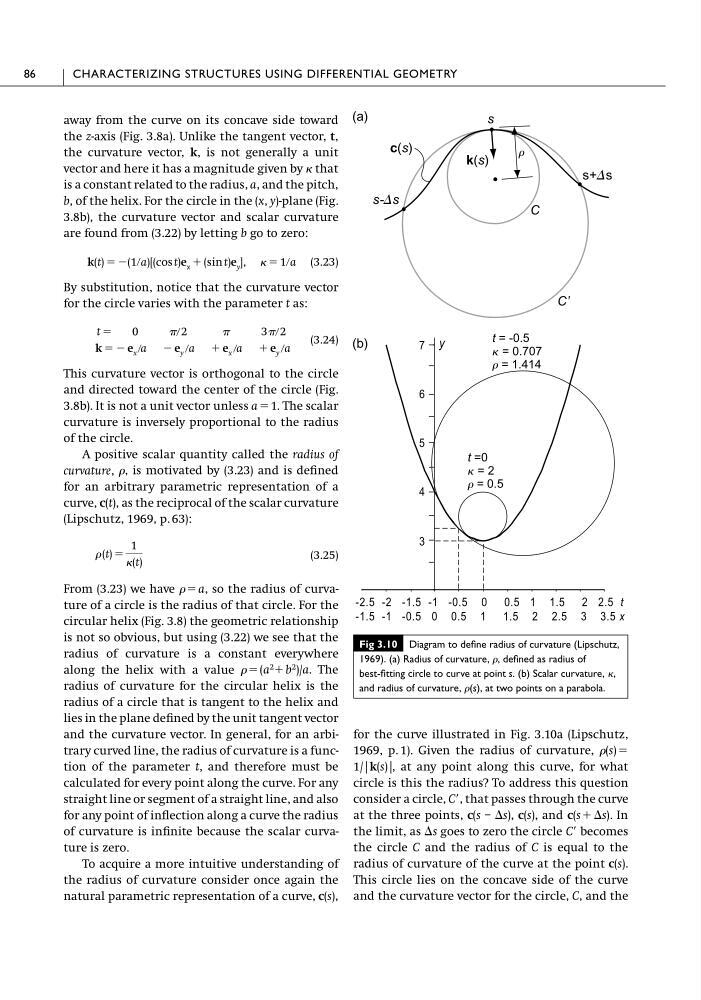
To acquire a more intuitive understanding of
the radius of curvature consider once again the
natural parametric representation of a curve, c(s),
� (t) �
1
�(t)
t �
k �
0
� e x �a
��2
� e y �a
�
� e x �a
3��2
� e y �a
k(t) � �(1�a)[(cos t)e x � (sin t)e y ], � � 1�a
for the curve illustrated in Fig. 3.10a (Lipschutz,
1969, p. 1). Given the radius of curvature, �(s) �
1/|k(s)|, at any point along this curve, for what
circle is this the radius? To address this question
consider a circle, C�, that passes through the curve
at the three points, c(s – �s), c(s), and c(s ��s). In
the limit, as �s goes to zero the circle C� becomes
the circle C and the radius of C is equal to the
radius of curvature of the curve at the point c(s).
This circle lies on the concave side of the curve
and the curvature vector for the circle, C, and the
86
CHARACTERIZING STRUCTURES USING DIFFERENTIAL GEOMETRY
Fig 3.10 Diagram to define radius of curvature (Lipschutz,
1969). (a) Radius of curvature, �, defined as radius of
best-fitting circle to curve at point s. (b) Scalar curvature, �,
and radius of curvature, �(s), at two points on a parabola.
(b)
(a)
s
C’
C
3
4
5
6
7 y
-2.5 -2 -1.5 -1 -0.5 0 0.5 1 1.5 2 2.5 t
-1.5 -1 -0.5 0 0.5 1 1.5 2 2.5 3 3.5 x
s+⌬s
k(s)
c(s)
s-⌬s
t =0
= 2
= 0.5
t = -0.5
= 0.707
= 1.414
the z-axis (Fig. 3.8a). Unlike the tangent vector, t,
the curvature vector, k, is not generally a unit
vector and here it has a magnitude given by � that
is a constant related to the radius, a, and the pitch,
b, of the helix. For the circle in the (x, y)-plane (Fig.
3.8b), the curvature vector and scalar curvature
are found from (3.22) by letting b go to zero:
(3.23)
By substitution, notice that the curvature vector
for the circle varies with the parameter t as:
(3.24)
This curvature vector is orthogonal to the circle
and directed toward the center of the circle (Fig.
3.8b). It is not a unit vector unless a � 1. The scalar
curvature is inversely proportional to the radius
of the circle.
A positive scalar quantity called the radius of
curvature, �, is motivated by (3.23) and is defined
for an arbitrary parametric representation of a
curve, c(t), as the reciprocal of the scalar curvature
(Lipschutz, 1969, p. 63):
(3.25)
From (3.23) we have � � a, so the radius of curvature of a circle is the radius of that circle. For the
circular helix (Fig. 3.8) the geometric relationship
is not so obvious, but using (3.22) we see that the
radius of curvature is a constant everywhere
along the helix with a value � � (a
2 � b
2 )/a. The
radius of curvature for the circular helix is the
radius of a circle that is tangent to the helix and
lies in the plane defined by the unit tangent vector
and the curvature vector. In general, for an arbitrary curved line, the radius of curvature is a function of the parameter t, and therefore must be
calculated for every point along the curve. For any
straight line or segment of a straight line, and also
for any point of inflection along a curve the radius
of curvature is infinite because the scalar curvature is zero.
To acquire a more intuitive understanding of
the radius of curvature consider once again the
natural parametric representation of a curve, c(s),
� (t) �
1
�(t)
t �
k �
0
� e x �a
��2
� e y �a
�
� e x �a
3��2
� e y �a
k(t) � �(1�a)[(cos t)e x � (sin t)e y ], � � 1�a
for the curve illustrated in Fig. 3.10a (Lipschutz,
1969, p. 1). Given the radius of curvature, �(s) �
1/|k(s)|, at any point along this curve, for what
circle is this the radius? To address this question
consider a circle, C�, that passes through the curve
at the three points, c(s – �s), c(s), and c(s ��s). In
the limit, as �s goes to zero the circle C� becomes
the circle C and the radius of C is equal to the
radius of curvature of the curve at the point c(s).
This circle lies on the concave side of the curve
and the curvature vector for the circle, C, and the
86
CHARACTERIZING STRUCTURES USING DIFFERENTIAL GEOMETRY
Fig 3.10 Diagram to define radius of curvature (Lipschutz,
1969). (a) Radius of curvature, �, defined as radius of
best-fitting circle to curve at point s. (b) Scalar curvature, �,
and radius of curvature, �(s), at two points on a parabola.
(b)
(a)
s
C’
C
3
4
5
6
7 y
-2.5 -2 -1.5 -1 -0.5 0 0.5 1 1.5 2 2.5 t
-1.5 -1 -0.5 0 0.5 1 1.5 2 2.5 3 3.5 x
s+⌬s
k(s)
c(s)
s-⌬s
t =0
= 2
= 0.5
t = -0.5
= 0.707
= 1.414