

180
Table 12.2 Socio-economic indicators of Indian cities (in percentage terms)
Indicators
2001
2011
Literacy rate
73.08
84.1
Urban sex ratio
841
929
Infant mortality rate
42
29
Population below poverty line
25.5
13.7
Household with safe drinking water
90
91.4
Household with electricity
91.6
97.9
Household with septic tank and flush
70.7
81.6
Source: Handbook of urban statistics (2019)
Table 12.3 Indicators selected for SDG India index
SDG global targets
Indicators selected for SDG India
index
National
target value
for 2030
12.1 By 2030, ensure access for all to
adequate, safe and affordable housing
1 Houses completed under
Pradhan Mantri Awas Yojana
for houses as a percentage of
net demand assessment for
houses
100
2 Percentage of urban
households living in slums
0
12.6 By 2030, reduce the adverse per capita
environmental impact of cities,
including by paying special attention to
air quality and municipal and other
waste management
3 Percentage of municipal
wards with 100% door to
door waste collection
100
4 Percentage of waste
processed
100
Source: SDG India Baseline Index (2018)
Urban areas face major challenges regarding provision of affordable housing and
basic infrastructure services. During census 2001–2011, although the population of
slum household percentage reduced 18.3 to 17.4, in absolute terms there was net
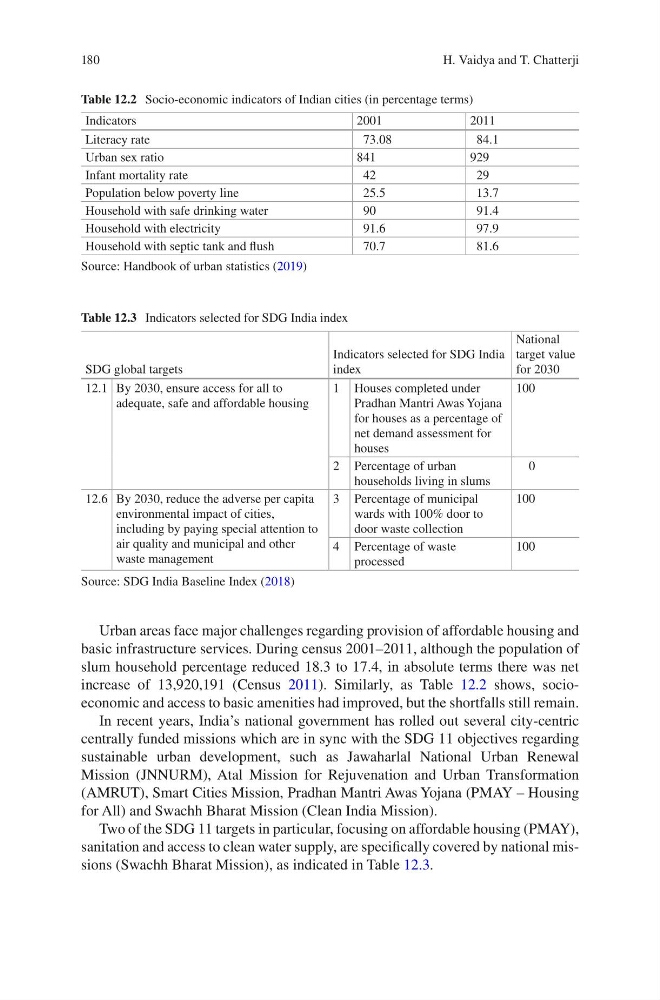
increase of 13,920,191 (Census 2011). Similarly, as Table 12.2 shows, socioeconomic and access to basic amenities had improved, but the shortfalls still remain.
In recent years, India’s national government has rolled out several city-centric
centrally funded missions which are in sync with the SDG 11 objectives regarding
sustainable urban development, such as Jawaharlal National Urban Renewal
Mission (JNNURM), Atal Mission for Rejuvenation and Urban Transformation
(AMRUT), Smart Cities Mission, Pradhan Mantri Awas Yojana (PMAY – Housing
for All) and Swachh Bharat Mission (Clean India Mission).
Two of the SDG 11 targets in particular, focusing on affordable housing (PMAY),
sanitation and access to clean water supply, are specifically covered by national missions (Swachh Bharat Mission), as indicated in Table 12.3.
H. Vaidya and T. Chatterji
Table 12.2 Socio-economic indicators of Indian cities (in percentage terms)
Indicators
2001
2011
Literacy rate
73.08
84.1
Urban sex ratio
841
929
Infant mortality rate
42
29
Population below poverty line
25.5
13.7
Household with safe drinking water
90
91.4
Household with electricity
91.6
97.9
Household with septic tank and flush
70.7
81.6
Source: Handbook of urban statistics (2019)
Table 12.3 Indicators selected for SDG India index
SDG global targets
Indicators selected for SDG India
index
National
target value
for 2030
12.1 By 2030, ensure access for all to
adequate, safe and affordable housing
1 Houses completed under
Pradhan Mantri Awas Yojana
for houses as a percentage of
net demand assessment for
houses
100
2 Percentage of urban
households living in slums
0
12.6 By 2030, reduce the adverse per capita
environmental impact of cities,
including by paying special attention to
air quality and municipal and other
waste management
3 Percentage of municipal
wards with 100% door to
door waste collection
100
4 Percentage of waste
processed
100
Source: SDG India Baseline Index (2018)
Urban areas face major challenges regarding provision of affordable housing and
basic infrastructure services. During census 2001–2011, although the population of
slum household percentage reduced 18.3 to 17.4, in absolute terms there was net
increase of 13,920,191 (Census 2011). Similarly, as Table 12.2 shows, socioeconomic and access to basic amenities had improved, but the shortfalls still remain.
In recent years, India’s national government has rolled out several city-centric
centrally funded missions which are in sync with the SDG 11 objectives regarding
sustainable urban development, such as Jawaharlal National Urban Renewal
Mission (JNNURM), Atal Mission for Rejuvenation and Urban Transformation
(AMRUT), Smart Cities Mission, Pradhan Mantri Awas Yojana (PMAY – Housing
for All) and Swachh Bharat Mission (Clean India Mission).
Two of the SDG 11 targets in particular, focusing on affordable housing (PMAY),
sanitation and access to clean water supply, are specifically covered by national missions (Swachh Bharat Mission), as indicated in Table 12.3.
H. Vaidya and T. Chatterji