

181
However, it is important to note here that under the multilevel governance structure of the Indian constitution, responsibilities for urban development mainly lie
with the state governments and urban local bodies. Roles and responsibilities of the
national government are limited – setting directions and providing funds. Direct
implementation responsibilities lie with the institutions and agencies associated
with urban local governance, including the elected municipal governments, city
development authorities and parastatal agencies under the state governments.
Elected municipal governments enjoy constitutional status with defined roles and
responsibilities vis-à-vis the state government, following the 74th Amendment Act
of 1992. Under the constitutional devolution, the municipal governments are mandated to perform 18 functions, which contribute towards urban sustainability.
Recently the Ministry of Housing and Urban Affairs (MoHUA) has developed a
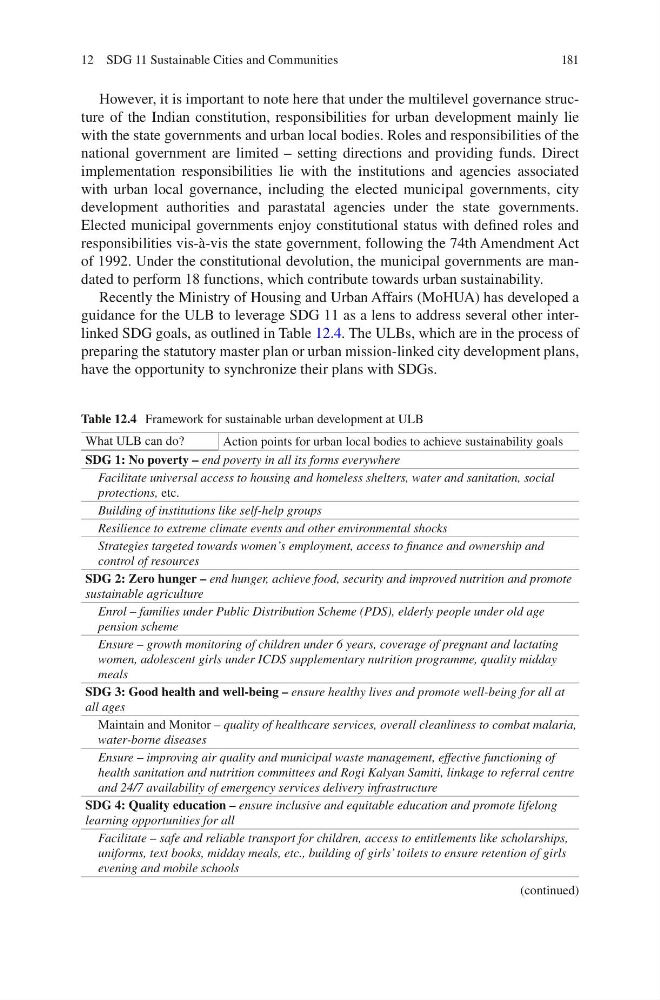
guidance for the ULB to leverage SDG 11 as a lens to address several other interlinked SDG goals, as outlined in Table 12.4. The ULBs, which are in the process of
preparing the statutory master plan or urban mission-linked city development plans,
have the opportunity to synchronize their plans with SDGs.
Table 12.4 Framework for sustainable urban development at ULB
What ULB can do?
Action points for urban local bodies to achieve sustainability goals
SDG 1: No poverty – end poverty in all its forms everywhere
Facilitate universal access to housing and homeless shelters, water and sanitation, social
protections, etc.
Building of institutions like self-help groups
Resilience to extreme climate events and other environmental shocks
Strategies targeted towards women’s employment, access to finance and ownership and
control of resources
SDG 2: Zero hunger – end hunger, achieve food, security and improved nutrition and promote
sustainable agriculture
Enrol – families under Public Distribution Scheme (PDS), elderly people under old age
pension scheme
Ensure – growth monitoring of children under 6 years, coverage of pregnant and lactating
women, adolescent girls under ICDS supplementary nutrition programme, quality midday
meals
SDG 3: Good health and well-being – ensure healthy lives and promote well-being for all at
all ages
Maintain and Monitor – quality of healthcare services, overall cleanliness to combat malaria,
water-borne diseases
Ensure – improving air quality and municipal waste management, effective functioning of
health sanitation and nutrition committees and Rogi Kalyan Samiti, linkage to referral centre
and 24/7 availability of emergency services delivery infrastructure
SDG 4: Quality education – ensure inclusive and equitable education and promote lifelong
learning opportunities for all
Facilitate – safe and reliable transport for children, access to entitlements like scholarships,
uniforms, text books, midday meals, etc., building of girls’ toilets to ensure retention of girls
evening and mobile schools
(continued)
12 SDG 11 Sustainable Cities and Communities
However, it is important to note here that under the multilevel governance structure of the Indian constitution, responsibilities for urban development mainly lie
with the state governments and urban local bodies. Roles and responsibilities of the
national government are limited – setting directions and providing funds. Direct
implementation responsibilities lie with the institutions and agencies associated
with urban local governance, including the elected municipal governments, city
development authorities and parastatal agencies under the state governments.
Elected municipal governments enjoy constitutional status with defined roles and
responsibilities vis-à-vis the state government, following the 74th Amendment Act
of 1992. Under the constitutional devolution, the municipal governments are mandated to perform 18 functions, which contribute towards urban sustainability.
Recently the Ministry of Housing and Urban Affairs (MoHUA) has developed a
guidance for the ULB to leverage SDG 11 as a lens to address several other interlinked SDG goals, as outlined in Table 12.4. The ULBs, which are in the process of
preparing the statutory master plan or urban mission-linked city development plans,
have the opportunity to synchronize their plans with SDGs.
Table 12.4 Framework for sustainable urban development at ULB
What ULB can do?
Action points for urban local bodies to achieve sustainability goals
SDG 1: No poverty – end poverty in all its forms everywhere
Facilitate universal access to housing and homeless shelters, water and sanitation, social
protections, etc.
Building of institutions like self-help groups
Resilience to extreme climate events and other environmental shocks
Strategies targeted towards women’s employment, access to finance and ownership and
control of resources
SDG 2: Zero hunger – end hunger, achieve food, security and improved nutrition and promote
sustainable agriculture
Enrol – families under Public Distribution Scheme (PDS), elderly people under old age
pension scheme
Ensure – growth monitoring of children under 6 years, coverage of pregnant and lactating
women, adolescent girls under ICDS supplementary nutrition programme, quality midday
meals
SDG 3: Good health and well-being – ensure healthy lives and promote well-being for all at
all ages
Maintain and Monitor – quality of healthcare services, overall cleanliness to combat malaria,
water-borne diseases
Ensure – improving air quality and municipal waste management, effective functioning of
health sanitation and nutrition committees and Rogi Kalyan Samiti, linkage to referral centre
and 24/7 availability of emergency services delivery infrastructure
SDG 4: Quality education – ensure inclusive and equitable education and promote lifelong
learning opportunities for all
Facilitate – safe and reliable transport for children, access to entitlements like scholarships,
uniforms, text books, midday meals, etc., building of girls’ toilets to ensure retention of girls
evening and mobile schools
(continued)
12 SDG 11 Sustainable Cities and Communities