

178
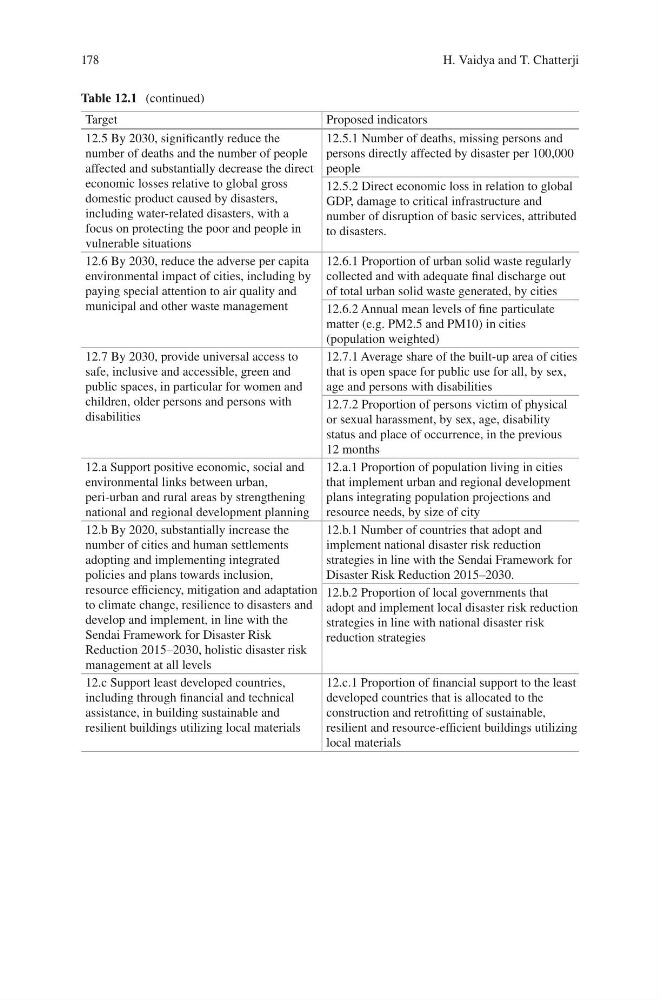
Table 12.1 (continued)
Target
Proposed indicators
12.5 By 2030, significantly reduce the
number of deaths and the number of people
affected and substantially decrease the direct
economic losses relative to global gross
domestic product caused by disasters,
including water-related disasters, with a
focus on protecting the poor and people in
vulnerable situations
12.5.1 Number of deaths, missing persons and
persons directly affected by disaster per 100,000
people
12.5.2 Direct economic loss in relation to global
GDP, damage to critical infrastructure and
number of disruption of basic services, attributed
to disasters.
12.6 By 2030, reduce the adverse per capita
environmental impact of cities, including by
paying special attention to air quality and
municipal and other waste management
12.6.1 Proportion of urban solid waste regularly
collected and with adequate final discharge out
of total urban solid waste generated, by cities
12.6.2 Annual mean levels of fine particulate
matter (e.g. PM2.5 and PM10) in cities
(population weighted)
12.7 By 2030, provide universal access to
safe, inclusive and accessible, green and
public spaces, in particular for women and
children, older persons and persons with
disabilities
12.7.1 Average share of the built-up area of cities
that is open space for public use for all, by sex,
age and persons with disabilities
12.7.2 Proportion of persons victim of physical
or sexual harassment, by sex, age, disability
status and place of occurrence, in the previous
12 months
12.a Support positive economic, social and
environmental links between urban,
peri-urban and rural areas by strengthening
national and regional development planning
12.a.1 Proportion of population living in cities
that implement urban and regional development
plans integrating population projections and
resource needs, by size of city
12.b By 2020, substantially increase the
number of cities and human settlements
adopting and implementing integrated
policies and plans towards inclusion,
resource efficiency, mitigation and adaptation
to climate change, resilience to disasters and
develop and implement, in line with the
Sendai Framework for Disaster Risk
Reduction 2015–2030, holistic disaster risk
management at all levels
12.b.1 Number of countries that adopt and
implement national disaster risk reduction
strategies in line with the Sendai Framework for
Disaster Risk Reduction 2015–2030.
12.b.2 Proportion of local governments that
adopt and implement local disaster risk reduction
strategies in line with national disaster risk
reduction strategies
12.c Support least developed countries,
including through financial and technical
assistance, in building sustainable and
resilient buildings utilizing local materials
12.c.1 Proportion of financial support to the least
developed countries that is allocated to the
construction and retrofitting of sustainable,
resilient and resource-efficient buildings utilizing
local materials
H. Vaidya and T. Chatterji
Table 12.1 (continued)
Target
Proposed indicators
12.5 By 2030, significantly reduce the
number of deaths and the number of people
affected and substantially decrease the direct
economic losses relative to global gross
domestic product caused by disasters,
including water-related disasters, with a
focus on protecting the poor and people in
vulnerable situations
12.5.1 Number of deaths, missing persons and
persons directly affected by disaster per 100,000
people
12.5.2 Direct economic loss in relation to global
GDP, damage to critical infrastructure and
number of disruption of basic services, attributed
to disasters.
12.6 By 2030, reduce the adverse per capita
environmental impact of cities, including by
paying special attention to air quality and
municipal and other waste management
12.6.1 Proportion of urban solid waste regularly
collected and with adequate final discharge out
of total urban solid waste generated, by cities
12.6.2 Annual mean levels of fine particulate
matter (e.g. PM2.5 and PM10) in cities
(population weighted)
12.7 By 2030, provide universal access to
safe, inclusive and accessible, green and
public spaces, in particular for women and
children, older persons and persons with
disabilities
12.7.1 Average share of the built-up area of cities
that is open space for public use for all, by sex,
age and persons with disabilities
12.7.2 Proportion of persons victim of physical
or sexual harassment, by sex, age, disability
status and place of occurrence, in the previous
12 months
12.a Support positive economic, social and
environmental links between urban,
peri-urban and rural areas by strengthening
national and regional development planning
12.a.1 Proportion of population living in cities
that implement urban and regional development
plans integrating population projections and
resource needs, by size of city
12.b By 2020, substantially increase the
number of cities and human settlements
adopting and implementing integrated
policies and plans towards inclusion,
resource efficiency, mitigation and adaptation
to climate change, resilience to disasters and
develop and implement, in line with the
Sendai Framework for Disaster Risk
Reduction 2015–2030, holistic disaster risk
management at all levels
12.b.1 Number of countries that adopt and
implement national disaster risk reduction
strategies in line with the Sendai Framework for
Disaster Risk Reduction 2015–2030.
12.b.2 Proportion of local governments that
adopt and implement local disaster risk reduction
strategies in line with national disaster risk
reduction strategies
12.c Support least developed countries,
including through financial and technical
assistance, in building sustainable and
resilient buildings utilizing local materials
12.c.1 Proportion of financial support to the least
developed countries that is allocated to the
construction and retrofitting of sustainable,
resilient and resource-efficient buildings utilizing
local materials
H. Vaidya and T. Chatterji