

177
increasing participation in urban governance, enhancing cultural and heritage preservation, addressing urban resilience and climate change challenges, better management of urban environments (pollution and waste management), providing access to
safe and secure public spaces for all and improving urban management through
better urban policies and regulations. Specific targets from other goals also fall
within its purview, such as equal access to resources by all people (Goal 1), halving
the number of road accident fatalities by 2030 (Goal 3), ensuring access to safe
water and sanitation for all (Goal 6), reducing waste generation (Goal 12) and
strengthening resilience and adaptive capacity to climate hazards (Goal 13).
In this scenario, SDG 11 can be seen as a comprehensive template to guide urban
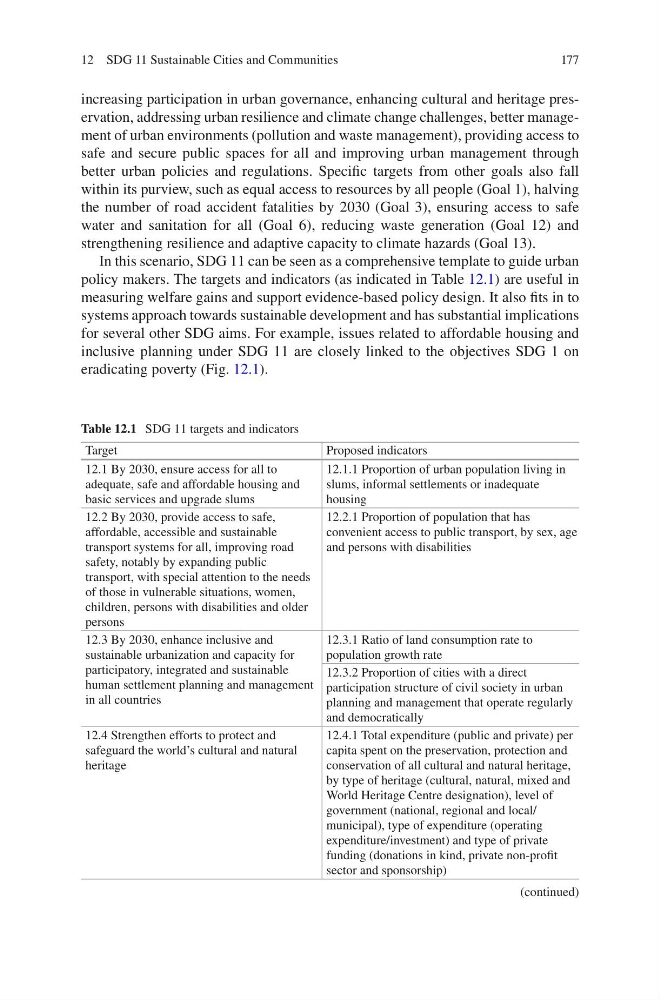
policy makers. The targets and indicators (as indicated in Table 12.1) are useful in
measuring welfare gains and support evidence-based policy design. It also fits in to
systems approach towards sustainable development and has substantial implications
for several other SDG aims. For example, issues related to affordable housing and
inclusive planning under SDG 11 are closely linked to the objectives SDG 1 on
eradicating poverty (Fig. 12.1).
Table 12.1 SDG 11 targets and indicators
Target
Proposed indicators
12.1 By 2030, ensure access for all to
adequate, safe and affordable housing and
basic services and upgrade slums
12.1.1 Proportion of urban population living in
slums, informal settlements or inadequate
housing
12.2 By 2030, provide access to safe,
affordable, accessible and sustainable
transport systems for all, improving road
safety, notably by expanding public
transport, with special attention to the needs
of those in vulnerable situations, women,
children, persons with disabilities and older
persons
12.2.1 Proportion of population that has
convenient access to public transport, by sex, age
and persons with disabilities
12.3 By 2030, enhance inclusive and
sustainable urbanization and capacity for
participatory, integrated and sustainable
human settlement planning and management
in all countries
12.3.1 Ratio of land consumption rate to
population growth rate
12.3.2 Proportion of cities with a direct
participation structure of civil society in urban
planning and management that operate regularly
and democratically
12.4 Strengthen efforts to protect and
safeguard the world’s cultural and natural
heritage
12.4.1 Total expenditure (public and private) per
capita spent on the preservation, protection and
conservation of all cultural and natural heritage,
by type of heritage (cultural, natural, mixed and
World Heritage Centre designation), level of
government (national, regional and local/
municipal), type of expenditure (operating
expenditure/investment) and type of private
funding (donations in kind, private non-profit
sector and sponsorship)
(continued)
12 SDG 11 Sustainable Cities and Communities
increasing participation in urban governance, enhancing cultural and heritage preservation, addressing urban resilience and climate change challenges, better management of urban environments (pollution and waste management), providing access to
safe and secure public spaces for all and improving urban management through
better urban policies and regulations. Specific targets from other goals also fall
within its purview, such as equal access to resources by all people (Goal 1), halving
the number of road accident fatalities by 2030 (Goal 3), ensuring access to safe
water and sanitation for all (Goal 6), reducing waste generation (Goal 12) and
strengthening resilience and adaptive capacity to climate hazards (Goal 13).
In this scenario, SDG 11 can be seen as a comprehensive template to guide urban
policy makers. The targets and indicators (as indicated in Table 12.1) are useful in
measuring welfare gains and support evidence-based policy design. It also fits in to
systems approach towards sustainable development and has substantial implications
for several other SDG aims. For example, issues related to affordable housing and
inclusive planning under SDG 11 are closely linked to the objectives SDG 1 on
eradicating poverty (Fig. 12.1).
Table 12.1 SDG 11 targets and indicators
Target
Proposed indicators
12.1 By 2030, ensure access for all to
adequate, safe and affordable housing and
basic services and upgrade slums
12.1.1 Proportion of urban population living in
slums, informal settlements or inadequate
housing
12.2 By 2030, provide access to safe,
affordable, accessible and sustainable
transport systems for all, improving road
safety, notably by expanding public
transport, with special attention to the needs
of those in vulnerable situations, women,
children, persons with disabilities and older
persons
12.2.1 Proportion of population that has
convenient access to public transport, by sex, age
and persons with disabilities
12.3 By 2030, enhance inclusive and
sustainable urbanization and capacity for
participatory, integrated and sustainable
human settlement planning and management
in all countries
12.3.1 Ratio of land consumption rate to
population growth rate
12.3.2 Proportion of cities with a direct
participation structure of civil society in urban
planning and management that operate regularly
and democratically
12.4 Strengthen efforts to protect and
safeguard the world’s cultural and natural
heritage
12.4.1 Total expenditure (public and private) per
capita spent on the preservation, protection and
conservation of all cultural and natural heritage,
by type of heritage (cultural, natural, mixed and
World Heritage Centre designation), level of
government (national, regional and local/
municipal), type of expenditure (operating
expenditure/investment) and type of private
funding (donations in kind, private non-profit
sector and sponsorship)
(continued)
12 SDG 11 Sustainable Cities and Communities