

113
Research findings show that capacity-building should focus on connecting nature
to people and sharing common ground to protect the environment. So far, the
environment is not given the right emphasis; hence many initiatives have been
undertaken so that human society and nature can thrive together. Capacitybuilding for sustainability has been backed by strong government policies in
Asian nations such China, Japan, and the Philippines (Ryan et al. 2010). However,
it is argued that despite strong government support, there is a lack of collaboration for capacity-building for sustainability if compared to other regions (Naeem
and Peach 2011).
Multiple stakeholders in the Japanese case are collaborating in building community capacity in sustainability. Led by the local government, the existing approach
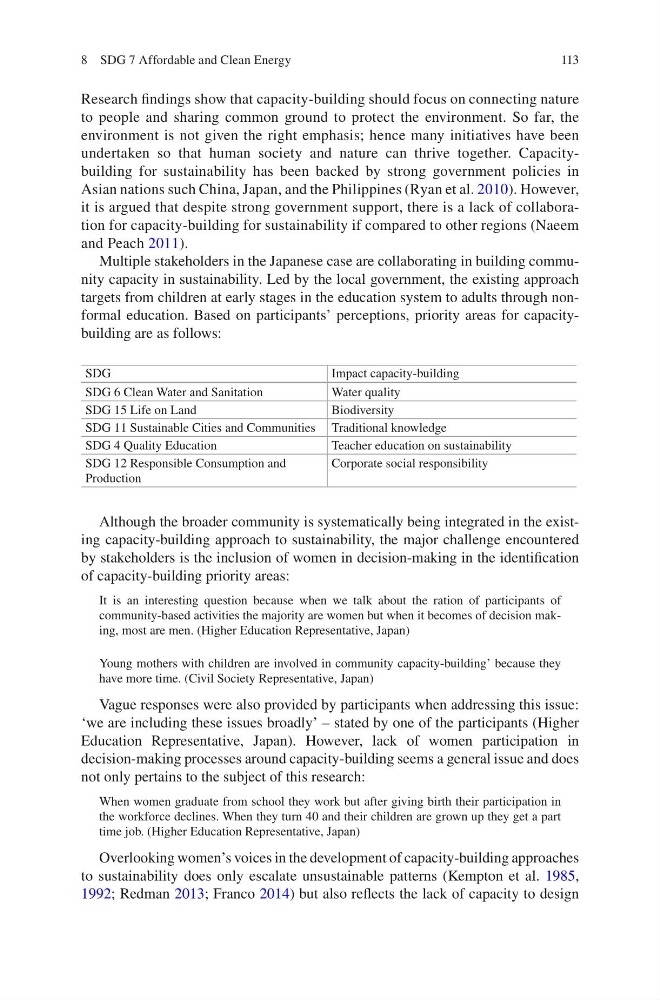
targets from children at early stages in the education system to adults through nonformal education. Based on participants’ perceptions, priority areas for capacitybuilding are as follows:
SDG
Impact capacity-building
SDG 6 Clean Water and Sanitation
Water quality
SDG 15 Life on Land
Biodiversity
SDG 11 Sustainable Cities and Communities Traditional knowledge
SDG 4 Quality Education
Teacher education on sustainability
SDG 12 Responsible Consumption and
Production
Corporate social responsibility
Although the broader community is systematically being integrated in the existing capacity-building approach to sustainability, the major challenge encountered
by stakeholders is the inclusion of women in decision-making in the identification
of capacity-building priority areas:
It is an interesting question because when we talk about the ration of participants of
community- based activities the majority are women but when it becomes of decision making, most are men. (Higher Education Representative, Japan)
Young mothers with children are involved in community capacity-building’ because they
have more time. (Civil Society Representative, Japan)
Vague responses were also provided by participants when addressing this issue:
‘we are including these issues broadly’ – stated by one of the participants (Higher
Education Representative, Japan). However, lack of women participation in
decision- making processes around capacity-building seems a general issue and does
not only pertains to the subject of this research:
When women graduate from school they work but after giving birth their participation in
the workforce declines. When they turn 40 and their children are grown up they get a part
time job. (Higher Education Representative, Japan)
Overlooking women’s voices in the development of capacity-building approaches
to sustainability does only escalate unsustainable patterns (Kempton et al. 1985,
1992; Redman 2013; Franco 2014) but also reflects the lack of capacity to design
8 SDG 7 Affordable and Clean Energy
Research findings show that capacity-building should focus on connecting nature
to people and sharing common ground to protect the environment. So far, the
environment is not given the right emphasis; hence many initiatives have been
undertaken so that human society and nature can thrive together. Capacitybuilding for sustainability has been backed by strong government policies in
Asian nations such China, Japan, and the Philippines (Ryan et al. 2010). However,
it is argued that despite strong government support, there is a lack of collaboration for capacity-building for sustainability if compared to other regions (Naeem
and Peach 2011).
Multiple stakeholders in the Japanese case are collaborating in building community capacity in sustainability. Led by the local government, the existing approach
targets from children at early stages in the education system to adults through nonformal education. Based on participants’ perceptions, priority areas for capacitybuilding are as follows:
SDG
Impact capacity-building
SDG 6 Clean Water and Sanitation
Water quality
SDG 15 Life on Land
Biodiversity
SDG 11 Sustainable Cities and Communities Traditional knowledge
SDG 4 Quality Education
Teacher education on sustainability
SDG 12 Responsible Consumption and
Production
Corporate social responsibility
Although the broader community is systematically being integrated in the existing capacity-building approach to sustainability, the major challenge encountered
by stakeholders is the inclusion of women in decision-making in the identification
of capacity-building priority areas:
It is an interesting question because when we talk about the ration of participants of
community- based activities the majority are women but when it becomes of decision making, most are men. (Higher Education Representative, Japan)
Young mothers with children are involved in community capacity-building’ because they
have more time. (Civil Society Representative, Japan)
Vague responses were also provided by participants when addressing this issue:
‘we are including these issues broadly’ – stated by one of the participants (Higher
Education Representative, Japan). However, lack of women participation in
decision- making processes around capacity-building seems a general issue and does
not only pertains to the subject of this research:
When women graduate from school they work but after giving birth their participation in
the workforce declines. When they turn 40 and their children are grown up they get a part
time job. (Higher Education Representative, Japan)
Overlooking women’s voices in the development of capacity-building approaches
to sustainability does only escalate unsustainable patterns (Kempton et al. 1985,
1992; Redman 2013; Franco 2014) but also reflects the lack of capacity to design
8 SDG 7 Affordable and Clean Energy