

114
impactful capacity-building initiatives for women (Mckenzie-Mohr 2000). This
eventually will prevent stakeholders from fostering overall sustainability in the long
run, at least in the Japanese case.
8.4.3 A Capacity-Building Approach for Sustainable Energy
Research indicates that both cases acknowledge the participation of women in
capacity-building approaches to sustainable energy. However, the Japanese case differs from the Colombian case study in fostering women’s decision-making to cope
with sustainability challenges around energy and related issues. Interestingly,
women in Colombia are more empowered and have been able to integrate their
development aspirations in the design of existing capacity-building approaches.
While women are strategically targeted in existing capacity-building initiatives in
Colombia, in the Japanese case, the inclusion of women in capacity-building initiatives is mainly due to time convenience or to meeting government requirements.
Interestingly, in both case study areas, multi-stakeholder collaboration and alignment with SDGs are perceived as determinant factors for the success of existing
capacity-building approaches.
Research also shows that priority areas are those most valuable for women and
the broader community. This inductive derivation indicates their critical importance
to enhance women’s capacities and protect their assets. Despite other forms of
capacity-building sometimes being mentioned, these were constantly identified as
central. A capacity-building approach to sustainable energy targeting some or most
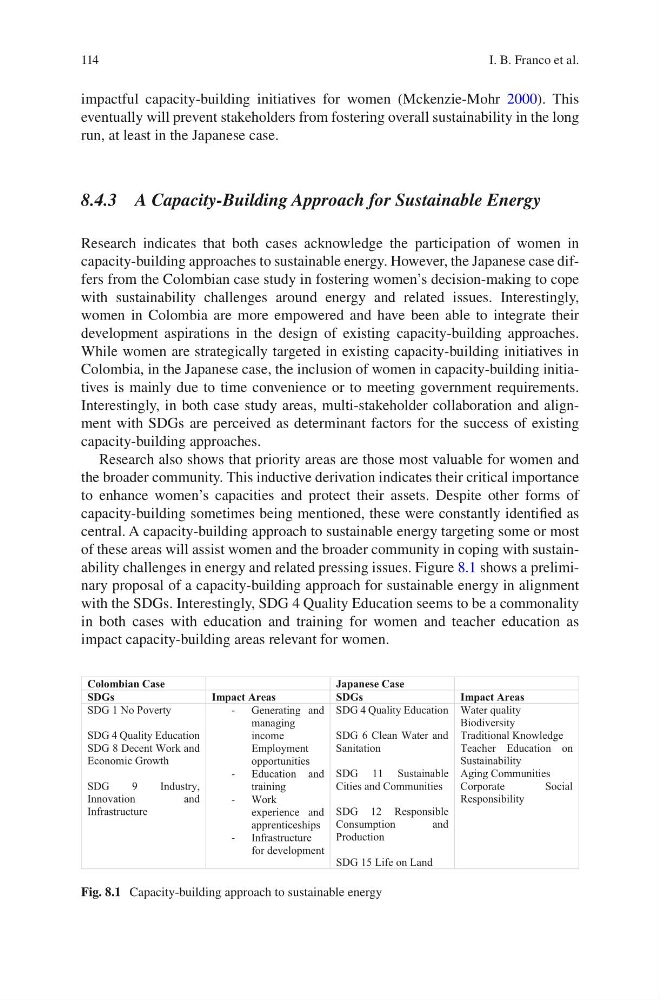
of these areas will assist women and the broader community in coping with sustainability challenges in energy and related pressing issues. Figure 8.1 shows a preliminary proposal of a capacity-building approach for sustainable energy in alignment
with the SDGs. Interestingly, SDG 4 Quality Education seems to be a commonality
in both cases with education and training for women and teacher education as
impact capacity-building areas relevant for women.
Colombian Case
Japanese Case
SDGs
Impact Areas
SDGs
Impact Areas
SDG 1 No Poverty
SDG 4 Quality Education
SDG 8 Decent Work and
Economic Growth
SDG
9
Industry,
Innovation
and
Infrastructure
- Generating and
managing
income
Employment
opportunities
- Education and
training
- Work
experience and
apprenticeships
- Infrastructure
for development
SDG 4 Quality Education
SDG 6 Clean Water and
Sanitation
SDG 11 Sustainable
Cities and Communities
SDG 12 Responsible
Consumption
and
Production
SDG 15 Life on Land
Water quality
Biodiversity
Traditional Knowledge
Teacher Education on
Sustainability
Aging Communities
Corporate
Social
Responsibility
Fig. 8.1 Capacity-building approach to sustainable energy
I. B. Franco et al.
impactful capacity-building initiatives for women (Mckenzie-Mohr 2000). This
eventually will prevent stakeholders from fostering overall sustainability in the long
run, at least in the Japanese case.
8.4.3 A Capacity-Building Approach for Sustainable Energy
Research indicates that both cases acknowledge the participation of women in
capacity-building approaches to sustainable energy. However, the Japanese case differs from the Colombian case study in fostering women’s decision-making to cope
with sustainability challenges around energy and related issues. Interestingly,
women in Colombia are more empowered and have been able to integrate their
development aspirations in the design of existing capacity-building approaches.
While women are strategically targeted in existing capacity-building initiatives in
Colombia, in the Japanese case, the inclusion of women in capacity-building initiatives is mainly due to time convenience or to meeting government requirements.
Interestingly, in both case study areas, multi-stakeholder collaboration and alignment with SDGs are perceived as determinant factors for the success of existing
capacity-building approaches.
Research also shows that priority areas are those most valuable for women and
the broader community. This inductive derivation indicates their critical importance
to enhance women’s capacities and protect their assets. Despite other forms of
capacity-building sometimes being mentioned, these were constantly identified as
central. A capacity-building approach to sustainable energy targeting some or most
of these areas will assist women and the broader community in coping with sustainability challenges in energy and related pressing issues. Figure 8.1 shows a preliminary proposal of a capacity-building approach for sustainable energy in alignment
with the SDGs. Interestingly, SDG 4 Quality Education seems to be a commonality
in both cases with education and training for women and teacher education as
impact capacity-building areas relevant for women.
Colombian Case
Japanese Case
SDGs
Impact Areas
SDGs
Impact Areas
SDG 1 No Poverty
SDG 4 Quality Education
SDG 8 Decent Work and
Economic Growth
SDG
9
Industry,
Innovation
and
Infrastructure
- Generating and
managing
income
Employment
opportunities
- Education and
training
- Work
experience and
apprenticeships
- Infrastructure
for development
SDG 4 Quality Education
SDG 6 Clean Water and
Sanitation
SDG 11 Sustainable
Cities and Communities
SDG 12 Responsible
Consumption
and
Production
SDG 15 Life on Land
Water quality
Biodiversity
Traditional Knowledge
Teacher Education on
Sustainability
Aging Communities
Corporate
Social
Responsibility
Fig. 8.1 Capacity-building approach to sustainable energy
I. B. Franco et al.