

112
ties such as the extractive industry, governments, civil society, and education institutions (Davies 2005; Franco 2014). Joint efforts of involved parties are further
required to help women boost their capacity and develop asset-based adaptation
strategies to cope with unsustainable energy practices:
Both, women and men have a strong sense of community. They own agriculture-based community associations that stimulate the local economy, foster employment and leadership.
For example, they own associations for blackberry and coffee production and commercialization. (Corporate Representative, Interview)
Another significant finding in the Colombian case study is the active participation of the women in the formulation of sustainable development agendas particularly in resource-rich regions. Women have benefited from capacity-building
initiatives helping them to cope with livelihood transformations due to the impact of
fossil fuel projects:
The company helped the municipality to open a plant for waste collection which has the
potential for generating income for women and the local community. (Community Leader,
Jewellery CBO, Interview)
Such initiatives include development activities in agribusiness, dressmaking,
jewelry, coffee production, and agriculture (Franco 2014). These initiatives are the
result of effective government-corporation partnerships and in response to requests
from women. Upfront investment in priority areas will assist women in realizing
their full potential in the case study area. Based on stakeholders’ and community’s
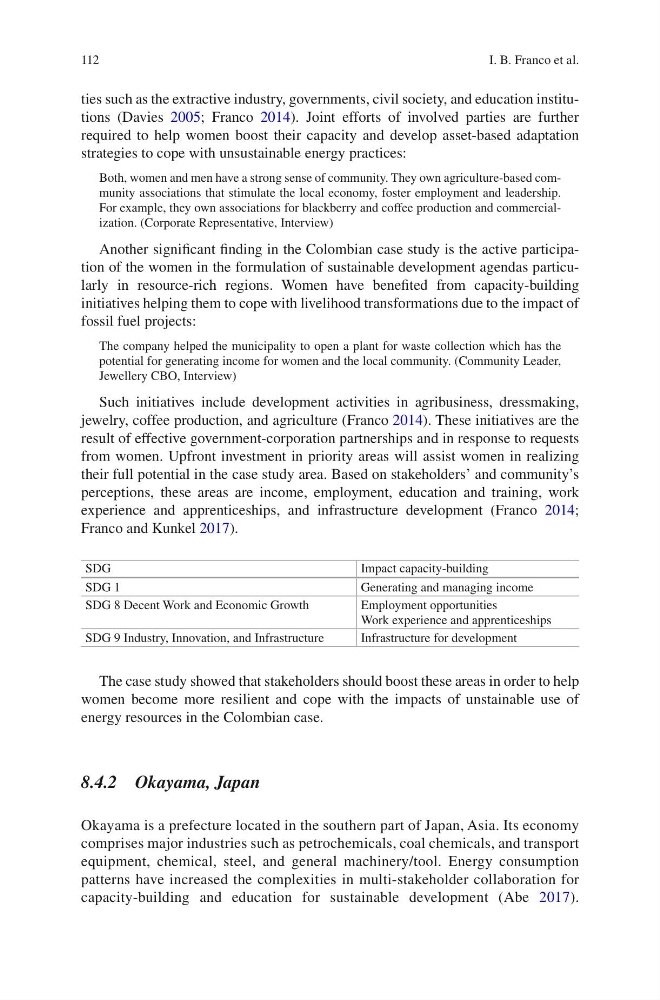
perceptions, these areas are income, employment, education and training, work
experience and apprenticeships, and infrastructure development (Franco 2014;
Franco and Kunkel 2017).
SDG
Impact capacity-building
SDG 1
Generating and managing income
SDG 8 Decent Work and Economic Growth
Employment opportunities
Work experience and apprenticeships
SDG 9 Industry, Innovation, and Infrastructure
Infrastructure for development
The case study showed that stakeholders should boost these areas in order to help
women become more resilient and cope with the impacts of unstainable use of
energy resources in the Colombian case.
8.4.2 Okayama, Japan
Okayama is a prefecture located in the southern part of Japan, Asia. Its economy
comprises major industries such as petrochemicals, coal chemicals, and transport
equipment, chemical, steel, and general machinery/tool. Energy consumption
patterns have increased the complexities in multi-stakeholder collaboration for
capacity- building and education for sustainable development (Abe 2017).
I. B. Franco et al.
ties such as the extractive industry, governments, civil society, and education institutions (Davies 2005; Franco 2014). Joint efforts of involved parties are further
required to help women boost their capacity and develop asset-based adaptation
strategies to cope with unsustainable energy practices:
Both, women and men have a strong sense of community. They own agriculture-based community associations that stimulate the local economy, foster employment and leadership.
For example, they own associations for blackberry and coffee production and commercialization. (Corporate Representative, Interview)
Another significant finding in the Colombian case study is the active participation of the women in the formulation of sustainable development agendas particularly in resource-rich regions. Women have benefited from capacity-building
initiatives helping them to cope with livelihood transformations due to the impact of
fossil fuel projects:
The company helped the municipality to open a plant for waste collection which has the
potential for generating income for women and the local community. (Community Leader,
Jewellery CBO, Interview)
Such initiatives include development activities in agribusiness, dressmaking,
jewelry, coffee production, and agriculture (Franco 2014). These initiatives are the
result of effective government-corporation partnerships and in response to requests
from women. Upfront investment in priority areas will assist women in realizing
their full potential in the case study area. Based on stakeholders’ and community’s
perceptions, these areas are income, employment, education and training, work
experience and apprenticeships, and infrastructure development (Franco 2014;
Franco and Kunkel 2017).
SDG
Impact capacity-building
SDG 1
Generating and managing income
SDG 8 Decent Work and Economic Growth
Employment opportunities
Work experience and apprenticeships
SDG 9 Industry, Innovation, and Infrastructure
Infrastructure for development
The case study showed that stakeholders should boost these areas in order to help
women become more resilient and cope with the impacts of unstainable use of
energy resources in the Colombian case.
8.4.2 Okayama, Japan
Okayama is a prefecture located in the southern part of Japan, Asia. Its economy
comprises major industries such as petrochemicals, coal chemicals, and transport
equipment, chemical, steel, and general machinery/tool. Energy consumption
patterns have increased the complexities in multi-stakeholder collaboration for
capacity- building and education for sustainable development (Abe 2017).
I. B. Franco et al.