

3 Causes and Effects of Water Pollution in Romania
61
Water sources of all kinds can be cleaned naturally by dispersing certain quantities
of pollutants. Water pollution specifically refers to quantities: firstly, the amount of
pollutant released and, secondly, how large is the volume of water it delivers. A low
amount of toxic chemical can have a low impact if it flows into the ocean. But the
same amount of the same chemical can have a much greater impact if pumped into
a lake or river, with less clean water to ensure its dispersion.
Water pollution almost always means that a water source suffered a series of
damages. By happy chance the Earth is kindly, and the damage induced by water
pollution is often reversible.
3.1.1.1 Point-Source, Nonpoint Source, Cross-Border
When we say the water resources of the planet, we refer initially to oceans, lakes
and rivers, in other words to the surface waters that are first affected by pollution
processes (a spill of oil products creates a hydrophobic oil layer that can affect a vast
area of an ocean/watercourse). But not all the water on the planet is on the surface,
a substantial amount of water is found in underground rock structures known as
aquifers or underground waters. Aquifers feed the rivers, supplying much of the
drinking water. These, as well as surface waters, are susceptible to pollution (the
leaching of pesticides used in agriculture), their pollution being much less obvious
than that of the surface waters, which is a matter of particular importance Hill [76]
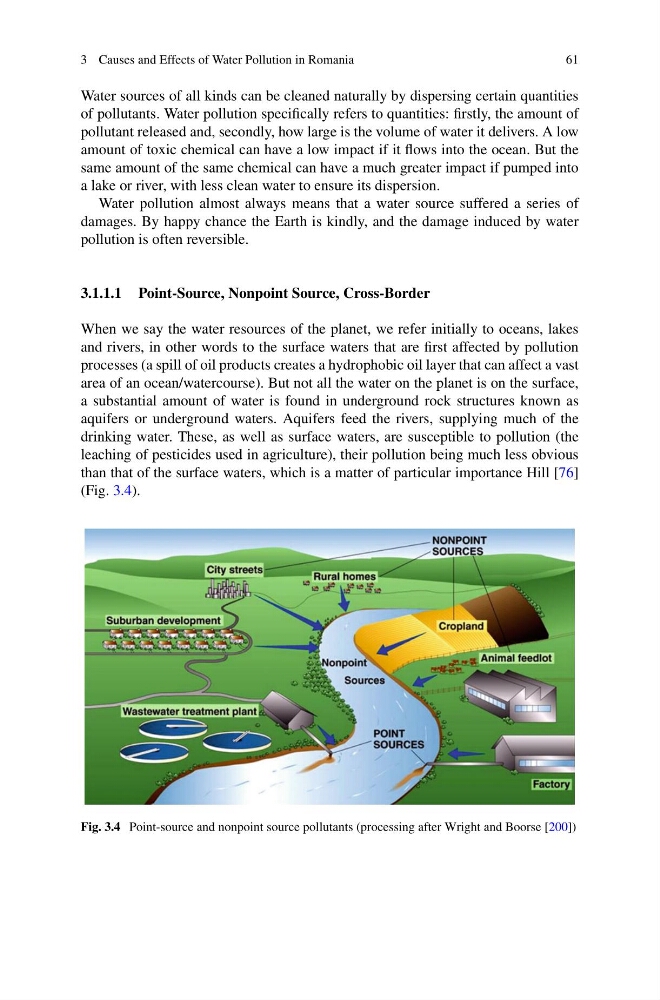
(Fig. 3.4).
Fig. 3.4 Point-source and nonpoint source pollutants (processing after Wright and Boorse [200])
61
Water sources of all kinds can be cleaned naturally by dispersing certain quantities
of pollutants. Water pollution specifically refers to quantities: firstly, the amount of
pollutant released and, secondly, how large is the volume of water it delivers. A low
amount of toxic chemical can have a low impact if it flows into the ocean. But the
same amount of the same chemical can have a much greater impact if pumped into
a lake or river, with less clean water to ensure its dispersion.
Water pollution almost always means that a water source suffered a series of
damages. By happy chance the Earth is kindly, and the damage induced by water
pollution is often reversible.
3.1.1.1 Point-Source, Nonpoint Source, Cross-Border
When we say the water resources of the planet, we refer initially to oceans, lakes
and rivers, in other words to the surface waters that are first affected by pollution
processes (a spill of oil products creates a hydrophobic oil layer that can affect a vast
area of an ocean/watercourse). But not all the water on the planet is on the surface,
a substantial amount of water is found in underground rock structures known as
aquifers or underground waters. Aquifers feed the rivers, supplying much of the
drinking water. These, as well as surface waters, are susceptible to pollution (the
leaching of pesticides used in agriculture), their pollution being much less obvious
than that of the surface waters, which is a matter of particular importance Hill [76]
(Fig. 3.4).
Fig. 3.4 Point-source and nonpoint source pollutants (processing after Wright and Boorse [200])