

542
R. B˘ atina¸ s et al.
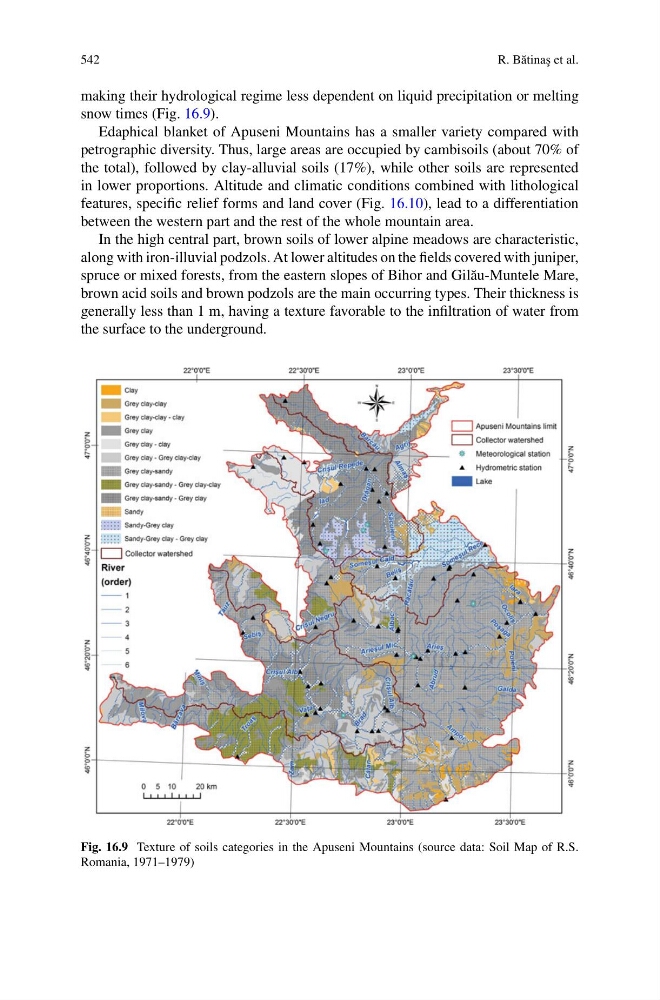
making their hydrological regime less dependent on liquid precipitation or melting
snow times (Fig. 16.9).
Edaphical blanket of Apuseni Mountains has a smaller variety compared with
petrographic diversity. Thus, large areas are occupied by cambisoils (about 70% of
the total), followed by clay-alluvial soils (17%), while other soils are represented
in lower proportions. Altitude and climatic conditions combined with lithological
features, specific relief forms and land cover (Fig. 16.10), lead to a differentiation
between the western part and the rest of the whole mountain area.
In the high central part, brown soils of lower alpine meadows are characteristic,
along with iron-illuvial podzols. At lower altitudes on the fields covered with juniper,
spruce or mixed forests, from the eastern slopes of Bihor and Gil˘ au-Muntele Mare,
brown acid soils and brown podzols are the main occurring types. Their thickness is
generally less than 1 m, having a texture favorable to the infiltration of water from
the surface to the underground.
Fig. 16.9 Texture of soils categories in the Apuseni Mountains (source data: Soil Map of R.S.
Romania, 1971–1979)
R. B˘ atina¸ s et al.
making their hydrological regime less dependent on liquid precipitation or melting
snow times (Fig. 16.9).
Edaphical blanket of Apuseni Mountains has a smaller variety compared with
petrographic diversity. Thus, large areas are occupied by cambisoils (about 70% of
the total), followed by clay-alluvial soils (17%), while other soils are represented
in lower proportions. Altitude and climatic conditions combined with lithological
features, specific relief forms and land cover (Fig. 16.10), lead to a differentiation
between the western part and the rest of the whole mountain area.
In the high central part, brown soils of lower alpine meadows are characteristic,
along with iron-illuvial podzols. At lower altitudes on the fields covered with juniper,
spruce or mixed forests, from the eastern slopes of Bihor and Gil˘ au-Muntele Mare,
brown acid soils and brown podzols are the main occurring types. Their thickness is
generally less than 1 m, having a texture favorable to the infiltration of water from
the surface to the underground.
Fig. 16.9 Texture of soils categories in the Apuseni Mountains (source data: Soil Map of R.S.
Romania, 1971–1979)