

16 Water Resources from Apuseni Mountains …
541
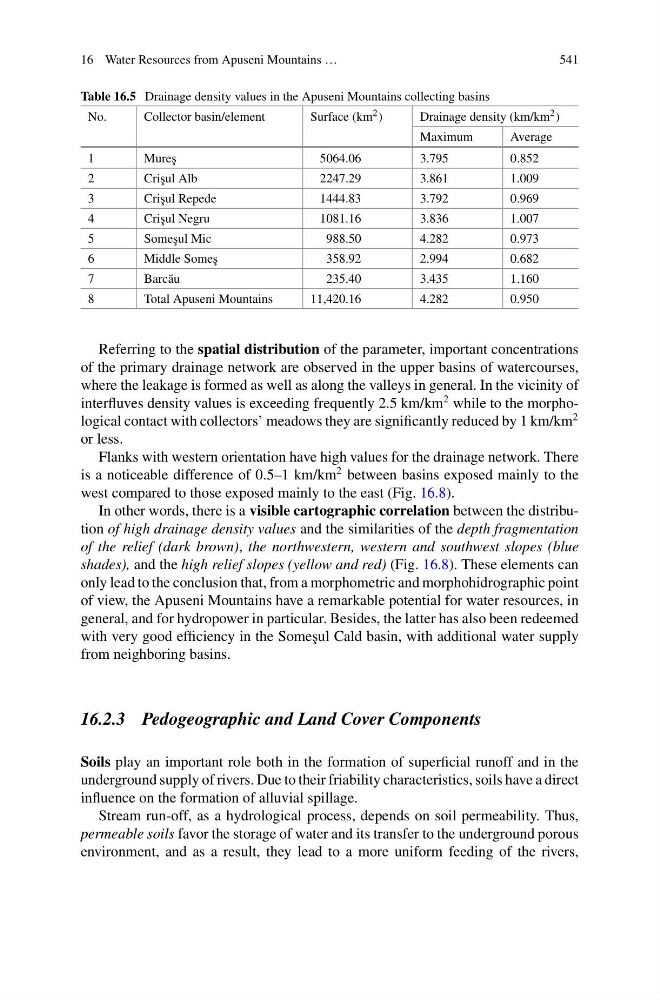
Table 16.5 Drainage density values in the Apuseni Mountains collecting basins
No.
Collector basin/element
Surface (km 2 )
Drainage density (km/km 2 )
Maximum
Average
1
Mure¸ s
5064.06
3.795
0.852
2
Cri¸ sul Alb
2247.29
3.861
1.009
3
Cri¸ sul Repede
1444.83
3.792
0.969
4
Cri¸ sul Negru
1081.16
3.836
1.007
5
Some¸ sul Mic
988.50
4.282
0.973
6
Middle Some¸ s
358.92
2.994
0.682
7
Barc˘ au
235.40
3.435
1.160
8
Total Apuseni Mountains
11,420.16
4.282
0.950
Referring to the spatial distribution of the parameter, important concentrations
of the primary drainage network are observed in the upper basins of watercourses,
where the leakage is formed as well as along the valleys in general. In the vicinity of
interfluves density values is exceeding frequently 2.5 km/km
2 while to the morphological contact with collectors’ meadows they are significantly reduced by 1 km/km
2
or less.
Flanks with western orientation have high values for the drainage network. There
is a noticeable difference of 0.5–1 km/km
2 between basins exposed mainly to the
west compared to those exposed mainly to the east (Fig. 16.8).
In other words, there is a visible cartographic correlation between the distribution of high drainage density values and the similarities of the depth fragmentation
of the relief (dark brown), the northwestern, western and southwest slopes (blue
shades), and the high relief slopes (yellow and red) (Fig. 16.8). These elements can
only lead to the conclusion that, from a morphometric and morphohidrographic point
of view, the Apuseni Mountains have a remarkable potential for water resources, in
general, and for hydropower in particular. Besides, the latter has also been redeemed
with very good efficiency in the Some¸ sul Cald basin, with additional water supply
from neighboring basins.
16.2.3 Pedogeographic and Land Cover Components
Soils play an important role both in the formation of superficial runoff and in the
underground supply of rivers. Due to their friability characteristics, soils have a direct
influence on the formation of alluvial spillage.
Stream run-off, as a hydrological process, depends on soil permeability. Thus,
permeable soils favor the storage of water and its transfer to the underground porous
environment, and as a result, they lead to a more uniform feeding of the rivers,
541
Table 16.5 Drainage density values in the Apuseni Mountains collecting basins
No.
Collector basin/element
Surface (km 2 )
Drainage density (km/km 2 )
Maximum
Average
1
Mure¸ s
5064.06
3.795
0.852
2
Cri¸ sul Alb
2247.29
3.861
1.009
3
Cri¸ sul Repede
1444.83
3.792
0.969
4
Cri¸ sul Negru
1081.16
3.836
1.007
5
Some¸ sul Mic
988.50
4.282
0.973
6
Middle Some¸ s
358.92
2.994
0.682
7
Barc˘ au
235.40
3.435
1.160
8
Total Apuseni Mountains
11,420.16
4.282
0.950
Referring to the spatial distribution of the parameter, important concentrations
of the primary drainage network are observed in the upper basins of watercourses,
where the leakage is formed as well as along the valleys in general. In the vicinity of
interfluves density values is exceeding frequently 2.5 km/km
2 while to the morphological contact with collectors’ meadows they are significantly reduced by 1 km/km
2
or less.
Flanks with western orientation have high values for the drainage network. There
is a noticeable difference of 0.5–1 km/km
2 between basins exposed mainly to the
west compared to those exposed mainly to the east (Fig. 16.8).
In other words, there is a visible cartographic correlation between the distribution of high drainage density values and the similarities of the depth fragmentation
of the relief (dark brown), the northwestern, western and southwest slopes (blue
shades), and the high relief slopes (yellow and red) (Fig. 16.8). These elements can
only lead to the conclusion that, from a morphometric and morphohidrographic point
of view, the Apuseni Mountains have a remarkable potential for water resources, in
general, and for hydropower in particular. Besides, the latter has also been redeemed
with very good efficiency in the Some¸ sul Cald basin, with additional water supply
from neighboring basins.
16.2.3 Pedogeographic and Land Cover Components
Soils play an important role both in the formation of superficial runoff and in the
underground supply of rivers. Due to their friability characteristics, soils have a direct
influence on the formation of alluvial spillage.
Stream run-off, as a hydrological process, depends on soil permeability. Thus,
permeable soils favor the storage of water and its transfer to the underground porous
environment, and as a result, they lead to a more uniform feeding of the rivers,