

526
R. B˘ atina¸ s et al.
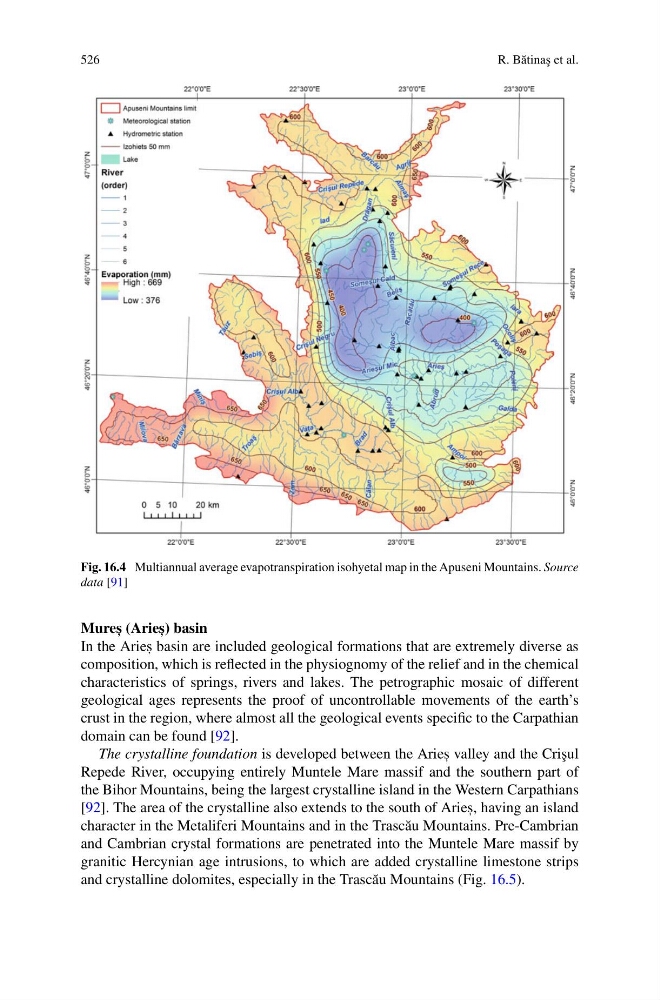
Fig. 16.4 Multiannual average evapotranspiration isohyetal map in the Apuseni Mountains. Source
data [91]
Mures , (Aries , ) basin
In the Aries , basin are included geological formations that are extremely diverse as
composition, which is reflected in the physiognomy of the relief and in the chemical
characteristics of springs, rivers and lakes. The petrographic mosaic of different
geological ages represents the proof of uncontrollable movements of the earth’s
crust in the region, where almost all the geological events specific to the Carpathian
domain can be found [92].
The crystalline foundation is developed between the Aries , valley and the Cri¸ sul
Repede River, occupying entirely Muntele Mare massif and the southern part of
the Bihor Mountains, being the largest crystalline island in the Western Carpathians
[92]. The area of the crystalline also extends to the south of Aries , , having an island
character in the Metaliferi Mountains and in the Trasc˘ au Mountains. Pre-Cambrian
and Cambrian crystal formations are penetrated into the Muntele Mare massif by
granitic Hercynian age intrusions, to which are added crystalline limestone strips
and crystalline dolomites, especially in the Trasc˘ au Mountains (Fig. 16.5).
R. B˘ atina¸ s et al.
Fig. 16.4 Multiannual average evapotranspiration isohyetal map in the Apuseni Mountains. Source
data [91]
Mures , (Aries , ) basin
In the Aries , basin are included geological formations that are extremely diverse as
composition, which is reflected in the physiognomy of the relief and in the chemical
characteristics of springs, rivers and lakes. The petrographic mosaic of different
geological ages represents the proof of uncontrollable movements of the earth’s
crust in the region, where almost all the geological events specific to the Carpathian
domain can be found [92].
The crystalline foundation is developed between the Aries , valley and the Cri¸ sul
Repede River, occupying entirely Muntele Mare massif and the southern part of
the Bihor Mountains, being the largest crystalline island in the Western Carpathians
[92]. The area of the crystalline also extends to the south of Aries , , having an island
character in the Metaliferi Mountains and in the Trasc˘ au Mountains. Pre-Cambrian
and Cambrian crystal formations are penetrated into the Muntele Mare massif by
granitic Hercynian age intrusions, to which are added crystalline limestone strips
and crystalline dolomites, especially in the Trasc˘ au Mountains (Fig. 16.5).