

16 Water Resources from Apuseni Mountains …
527
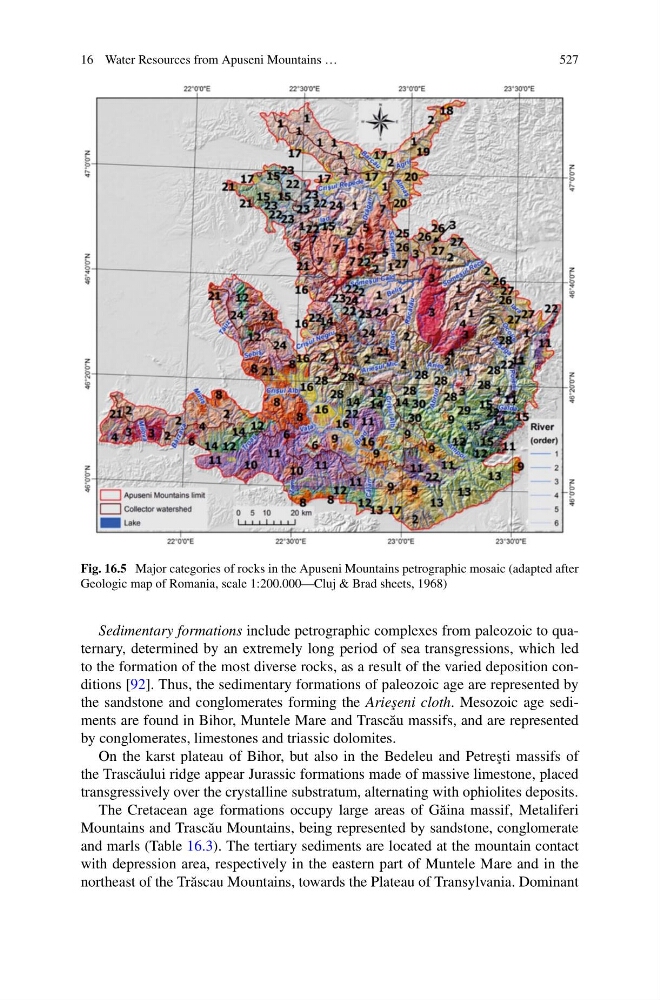
Fig. 16.5 Major categories of rocks in the Apuseni Mountains petrographic mosaic (adapted after
Geologic map of Romania, scale 1:200.000—Cluj & Brad sheets, 1968)
Sedimentary formations include petrographic complexes from paleozoic to quaternary, determined by an extremely long period of sea transgressions, which led
to the formation of the most diverse rocks, as a result of the varied deposition conditions [92]. Thus, the sedimentary formations of paleozoic age are represented by
the sandstone and conglomerates forming the Arie¸ seni cloth. Mesozoic age sediments are found in Bihor, Muntele Mare and Trasc˘ au massifs, and are represented
by conglomerates, limestones and triassic dolomites.
On the karst plateau of Bihor, but also in the Bedeleu and Petre¸ sti massifs of
the Trasc˘ aului ridge appear Jurassic formations made of massive limestone, placed
transgressively over the crystalline substratum, alternating with ophiolites deposits.
The Cretacean age formations occupy large areas of G˘ aina massif, Metaliferi
Mountains and Trasc˘ au Mountains, being represented by sandstone, conglomerate
and marls (Table 16.3). The tertiary sediments are located at the mountain contact
with depression area, respectively in the eastern part of Muntele Mare and in the
northeast of the Tr˘ ascau Mountains, towards the Plateau of Transylvania. Dominant
527
Fig. 16.5 Major categories of rocks in the Apuseni Mountains petrographic mosaic (adapted after
Geologic map of Romania, scale 1:200.000—Cluj & Brad sheets, 1968)
Sedimentary formations include petrographic complexes from paleozoic to quaternary, determined by an extremely long period of sea transgressions, which led
to the formation of the most diverse rocks, as a result of the varied deposition conditions [92]. Thus, the sedimentary formations of paleozoic age are represented by
the sandstone and conglomerates forming the Arie¸ seni cloth. Mesozoic age sediments are found in Bihor, Muntele Mare and Trasc˘ au massifs, and are represented
by conglomerates, limestones and triassic dolomites.
On the karst plateau of Bihor, but also in the Bedeleu and Petre¸ sti massifs of
the Trasc˘ aului ridge appear Jurassic formations made of massive limestone, placed
transgressively over the crystalline substratum, alternating with ophiolites deposits.
The Cretacean age formations occupy large areas of G˘ aina massif, Metaliferi
Mountains and Trasc˘ au Mountains, being represented by sandstone, conglomerate
and marls (Table 16.3). The tertiary sediments are located at the mountain contact
with depression area, respectively in the eastern part of Muntele Mare and in the
northeast of the Tr˘ ascau Mountains, towards the Plateau of Transylvania. Dominant