

36
G. Romanescu et al.
starting point for the measures corresponding to anthropic activities, including the
measures of water management at the basin and local level [90, 91]. The Framework
Directive Water in Romania respects the timescale and the implementation phases at
European level. The following were analyzed: the characterization of hydrographical
basins; the impact of human activities; the economic activity. The following were
identified, analyzed and evaluated: the categories of surface water; the eco-regions,
the typology and reference conditions for the surface waters; the significant anthropic
pressures and their impact on the water resources; the surface bodies of water; the
groundwater bodies; the protected areas [91].
The typology of streams was redefined and synthesized, leading to the reduction
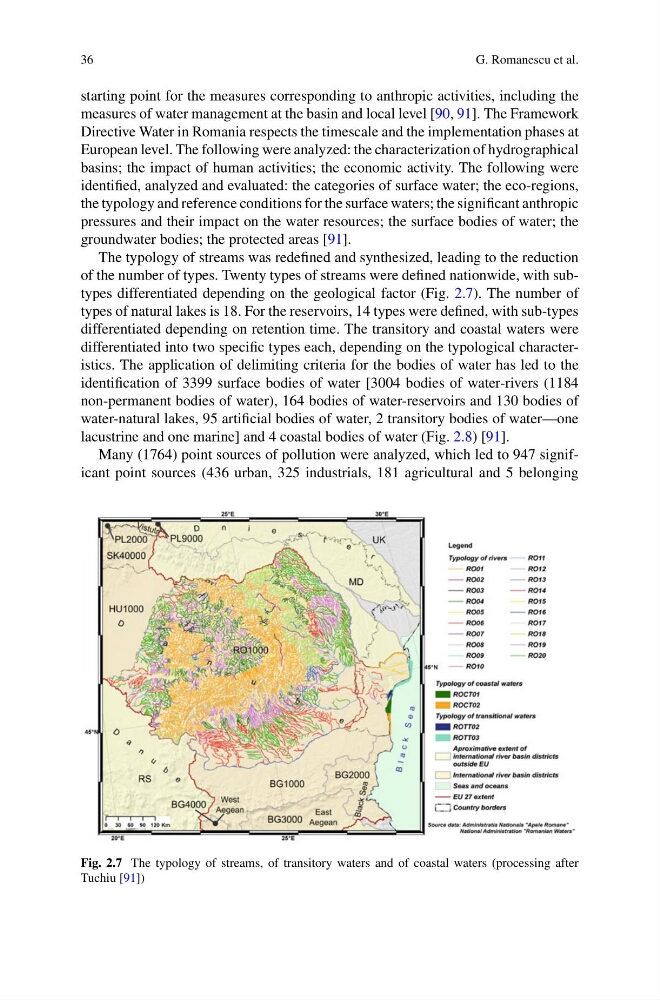
of the number of types. Twenty types of streams were defined nationwide, with subtypes differentiated depending on the geological factor (Fig. 2.7). The number of
types of natural lakes is 18. For the reservoirs, 14 types were defined, with sub-types
differentiated depending on retention time. The transitory and coastal waters were
differentiated into two specific types each, depending on the typological characteristics. The application of delimiting criteria for the bodies of water has led to the
identification of 3399 surface bodies of water [3004 bodies of water-rivers (1184
non-permanent bodies of water), 164 bodies of water-reservoirs and 130 bodies of
water-natural lakes, 95 artificial bodies of water, 2 transitory bodies of water—one
lacustrine and one marine] and 4 coastal bodies of water (Fig. 2.8) [91].
Many (1764) point sources of pollution were analyzed, which led to 947 significant point sources (436 urban, 325 industrials, 181 agricultural and 5 belonging
Fig. 2.7 The typology of streams, of transitory waters and of coastal waters (processing after
Tuchiu [91])
G. Romanescu et al.
starting point for the measures corresponding to anthropic activities, including the
measures of water management at the basin and local level [90, 91]. The Framework
Directive Water in Romania respects the timescale and the implementation phases at
European level. The following were analyzed: the characterization of hydrographical
basins; the impact of human activities; the economic activity. The following were
identified, analyzed and evaluated: the categories of surface water; the eco-regions,
the typology and reference conditions for the surface waters; the significant anthropic
pressures and their impact on the water resources; the surface bodies of water; the
groundwater bodies; the protected areas [91].
The typology of streams was redefined and synthesized, leading to the reduction
of the number of types. Twenty types of streams were defined nationwide, with subtypes differentiated depending on the geological factor (Fig. 2.7). The number of
types of natural lakes is 18. For the reservoirs, 14 types were defined, with sub-types
differentiated depending on retention time. The transitory and coastal waters were
differentiated into two specific types each, depending on the typological characteristics. The application of delimiting criteria for the bodies of water has led to the
identification of 3399 surface bodies of water [3004 bodies of water-rivers (1184
non-permanent bodies of water), 164 bodies of water-reservoirs and 130 bodies of
water-natural lakes, 95 artificial bodies of water, 2 transitory bodies of water—one
lacustrine and one marine] and 4 coastal bodies of water (Fig. 2.8) [91].
Many (1764) point sources of pollution were analyzed, which led to 947 significant point sources (436 urban, 325 industrials, 181 agricultural and 5 belonging
Fig. 2.7 The typology of streams, of transitory waters and of coastal waters (processing after
Tuchiu [91])