

2 Implementation of EU Water Framework Directive (2000/60/EC) …
37
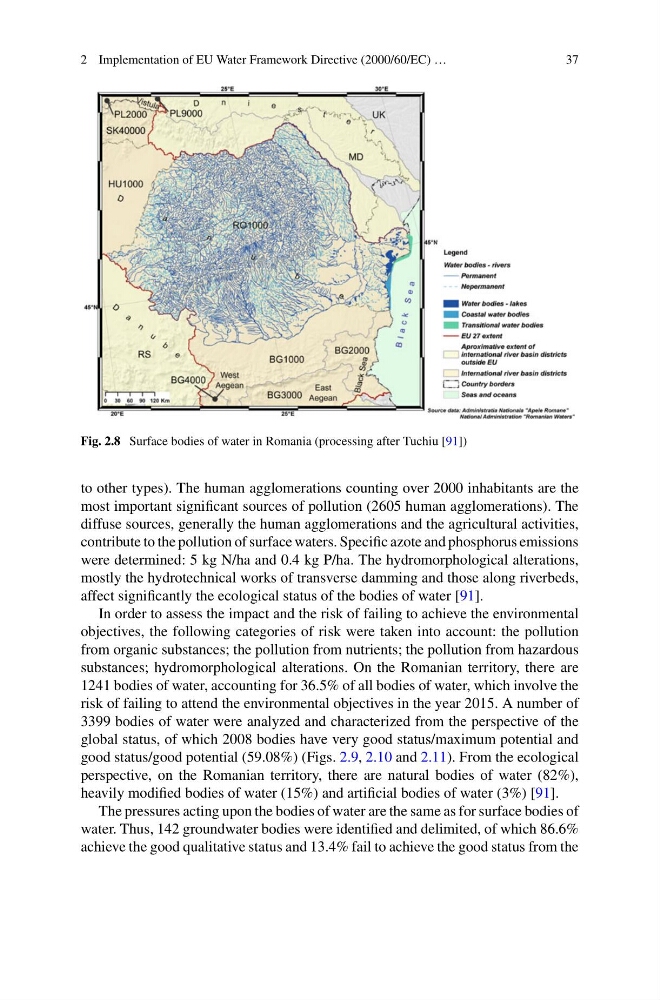
Fig. 2.8 Surface bodies of water in Romania (processing after Tuchiu [91])
to other types). The human agglomerations counting over 2000 inhabitants are the
most important significant sources of pollution (2605 human agglomerations). The
diffuse sources, generally the human agglomerations and the agricultural activities,
contribute to the pollution of surface waters. Specific azote and phosphorus emissions
were determined: 5 kg N/ha and 0.4 kg P/ha. The hydromorphological alterations,
mostly the hydrotechnical works of transverse damming and those along riverbeds,
affect significantly the ecological status of the bodies of water [91].
In order to assess the impact and the risk of failing to achieve the environmental
objectives, the following categories of risk were taken into account: the pollution
from organic substances; the pollution from nutrients; the pollution from hazardous
substances; hydromorphological alterations. On the Romanian territory, there are
1241 bodies of water, accounting for 36.5% of all bodies of water, which involve the
risk of failing to attend the environmental objectives in the year 2015. A number of
3399 bodies of water were analyzed and characterized from the perspective of the
global status, of which 2008 bodies have very good status/maximum potential and
good status/good potential (59.08%) (Figs. 2.9, 2.10 and 2.11). From the ecological
perspective, on the Romanian territory, there are natural bodies of water (82%),
heavily modified bodies of water (15%) and artificial bodies of water (3%) [91].
The pressures acting upon the bodies of water are the same as for surface bodies of
water. Thus, 142 groundwater bodies were identified and delimited, of which 86.6%
achieve the good qualitative status and 13.4% fail to achieve the good status from the
37
Fig. 2.8 Surface bodies of water in Romania (processing after Tuchiu [91])
to other types). The human agglomerations counting over 2000 inhabitants are the
most important significant sources of pollution (2605 human agglomerations). The
diffuse sources, generally the human agglomerations and the agricultural activities,
contribute to the pollution of surface waters. Specific azote and phosphorus emissions
were determined: 5 kg N/ha and 0.4 kg P/ha. The hydromorphological alterations,
mostly the hydrotechnical works of transverse damming and those along riverbeds,
affect significantly the ecological status of the bodies of water [91].
In order to assess the impact and the risk of failing to achieve the environmental
objectives, the following categories of risk were taken into account: the pollution
from organic substances; the pollution from nutrients; the pollution from hazardous
substances; hydromorphological alterations. On the Romanian territory, there are
1241 bodies of water, accounting for 36.5% of all bodies of water, which involve the
risk of failing to attend the environmental objectives in the year 2015. A number of
3399 bodies of water were analyzed and characterized from the perspective of the
global status, of which 2008 bodies have very good status/maximum potential and
good status/good potential (59.08%) (Figs. 2.9, 2.10 and 2.11). From the ecological
perspective, on the Romanian territory, there are natural bodies of water (82%),
heavily modified bodies of water (15%) and artificial bodies of water (3%) [91].
The pressures acting upon the bodies of water are the same as for surface bodies of
water. Thus, 142 groundwater bodies were identified and delimited, of which 86.6%
achieve the good qualitative status and 13.4% fail to achieve the good status from the