

12 Water Resources from Romanian Upper Tisa Basin
419
10 m
3 per day. The rest of the area, even if it has local underground accumulation
conditions, doesn’t form a “groundwater body”, as stipulated by the Framework
Directive 60/2000/EC (S.T.W.B.A. 2010).
The geological criterion influences not only through the age of water bearing
deposits but also through the petrographic and structural features or through their
capacity of storing the water. Thus, the following groundwater body types were
delimitated and characterized: porous, fissural and karstic.
The hydrodynamic criterion is especially linked to the extension of water bodies.
Thus, the phreatic water bodies expand only to the limit of the hydrographic basin,
which corresponds to their watershed, while the deep-water bodies can extend far
outside its boundaries.
The water bodies code (e.g. ROSO02) has the following significance: RO =
country code, SO = Water Basin Administration “Somes , -Tisa”, 02 = number of the
water body in the “Somes , -Tisa” Water Basin Administration list (S.T.W.B.A. 2010)
(Fig. 12.9).
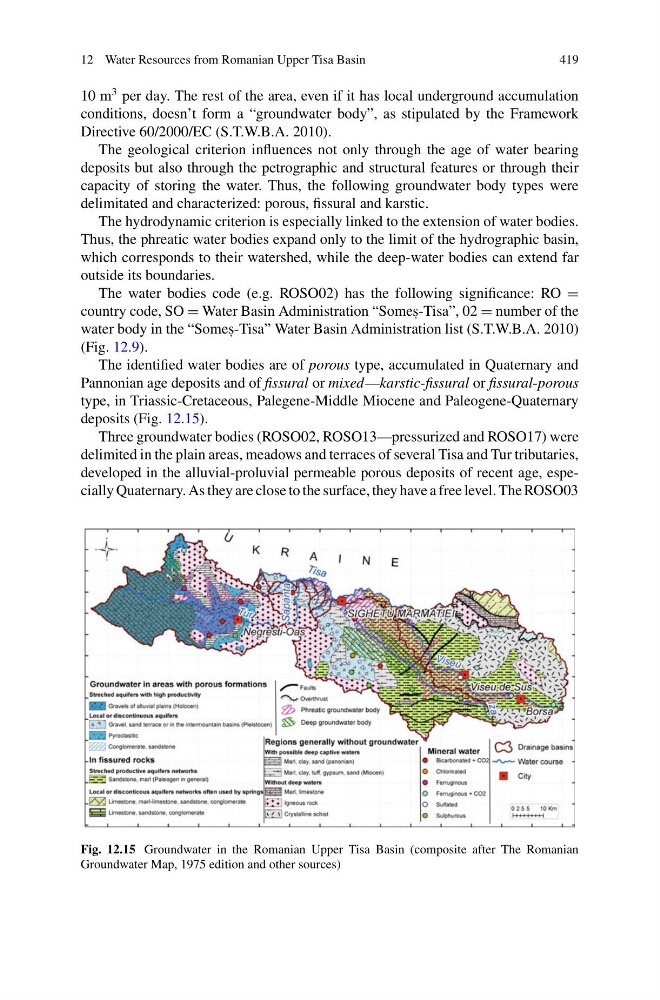
The identified water bodies are of porous type, accumulated in Quaternary and
Pannonian age deposits and of fissural or mixed—karstic-fissural or fissural-porous
type, in Triassic-Cretaceous, Palegene-Middle Miocene and Paleogene-Quaternary
deposits (Fig. 12.15).
Three groundwater bodies (ROSO02, ROSO13—pressurized and ROSO17) were
delimited in the plain areas, meadows and terraces of several Tisa and Tur tributaries,
developed in the alluvial-proluvial permeable porous deposits of recent age, especially Quaternary. As they are close to the surface, they have a free level. The ROSO03
Fig. 12.15 Groundwater in the Romanian Upper Tisa Basin (composite after The Romanian
Groundwater Map, 1975 edition and other sources)
419
10 m
3 per day. The rest of the area, even if it has local underground accumulation
conditions, doesn’t form a “groundwater body”, as stipulated by the Framework
Directive 60/2000/EC (S.T.W.B.A. 2010).
The geological criterion influences not only through the age of water bearing
deposits but also through the petrographic and structural features or through their
capacity of storing the water. Thus, the following groundwater body types were
delimitated and characterized: porous, fissural and karstic.
The hydrodynamic criterion is especially linked to the extension of water bodies.
Thus, the phreatic water bodies expand only to the limit of the hydrographic basin,
which corresponds to their watershed, while the deep-water bodies can extend far
outside its boundaries.
The water bodies code (e.g. ROSO02) has the following significance: RO =
country code, SO = Water Basin Administration “Somes , -Tisa”, 02 = number of the
water body in the “Somes , -Tisa” Water Basin Administration list (S.T.W.B.A. 2010)
(Fig. 12.9).
The identified water bodies are of porous type, accumulated in Quaternary and
Pannonian age deposits and of fissural or mixed—karstic-fissural or fissural-porous
type, in Triassic-Cretaceous, Palegene-Middle Miocene and Paleogene-Quaternary
deposits (Fig. 12.15).
Three groundwater bodies (ROSO02, ROSO13—pressurized and ROSO17) were
delimited in the plain areas, meadows and terraces of several Tisa and Tur tributaries,
developed in the alluvial-proluvial permeable porous deposits of recent age, especially Quaternary. As they are close to the surface, they have a free level. The ROSO03
Fig. 12.15 Groundwater in the Romanian Upper Tisa Basin (composite after The Romanian
Groundwater Map, 1975 edition and other sources)