

7 The Vulnerability of Water Resources from Eastern Romania …
245
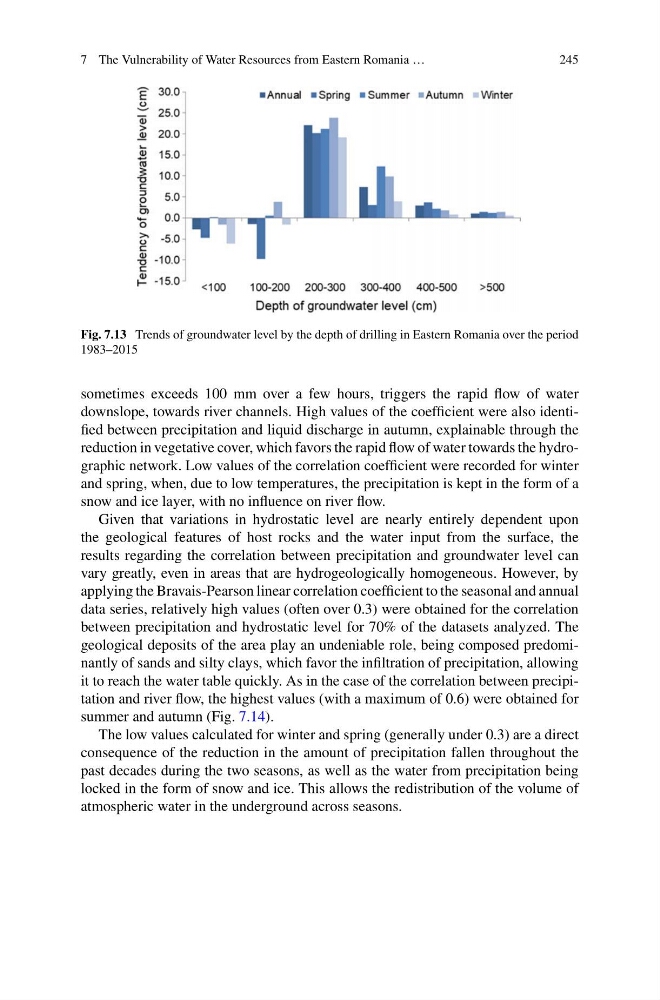
Fig. 7.13 Trends of groundwater level by the depth of drilling in Eastern Romania over the period
1983–2015
sometimes exceeds 100 mm over a few hours, triggers the rapid flow of water
downslope, towards river channels. High values of the coefficient were also identified between precipitation and liquid discharge in autumn, explainable through the
reduction in vegetative cover, which favors the rapid flow of water towards the hydrographic network. Low values of the correlation coefficient were recorded for winter
and spring, when, due to low temperatures, the precipitation is kept in the form of a
snow and ice layer, with no influence on river flow.
Given that variations in hydrostatic level are nearly entirely dependent upon
the geological features of host rocks and the water input from the surface, the
results regarding the correlation between precipitation and groundwater level can
vary greatly, even in areas that are hydrogeologically homogeneous. However, by
applying the Bravais-Pearson linear correlation coefficient to the seasonal and annual
data series, relatively high values (often over 0.3) were obtained for the correlation
between precipitation and hydrostatic level for 70% of the datasets analyzed. The
geological deposits of the area play an undeniable role, being composed predominantly of sands and silty clays, which favor the infiltration of precipitation, allowing
it to reach the water table quickly. As in the case of the correlation between precipitation and river flow, the highest values (with a maximum of 0.6) were obtained for
summer and autumn (Fig. 7.14).
The low values calculated for winter and spring (generally under 0.3) are a direct
consequence of the reduction in the amount of precipitation fallen throughout the
past decades during the two seasons, as well as the water from precipitation being
locked in the form of snow and ice. This allows the redistribution of the volume of
atmospheric water in the underground across seasons.
245
Fig. 7.13 Trends of groundwater level by the depth of drilling in Eastern Romania over the period
1983–2015
sometimes exceeds 100 mm over a few hours, triggers the rapid flow of water
downslope, towards river channels. High values of the coefficient were also identified between precipitation and liquid discharge in autumn, explainable through the
reduction in vegetative cover, which favors the rapid flow of water towards the hydrographic network. Low values of the correlation coefficient were recorded for winter
and spring, when, due to low temperatures, the precipitation is kept in the form of a
snow and ice layer, with no influence on river flow.
Given that variations in hydrostatic level are nearly entirely dependent upon
the geological features of host rocks and the water input from the surface, the
results regarding the correlation between precipitation and groundwater level can
vary greatly, even in areas that are hydrogeologically homogeneous. However, by
applying the Bravais-Pearson linear correlation coefficient to the seasonal and annual
data series, relatively high values (often over 0.3) were obtained for the correlation
between precipitation and hydrostatic level for 70% of the datasets analyzed. The
geological deposits of the area play an undeniable role, being composed predominantly of sands and silty clays, which favor the infiltration of precipitation, allowing
it to reach the water table quickly. As in the case of the correlation between precipitation and river flow, the highest values (with a maximum of 0.6) were obtained for
summer and autumn (Fig. 7.14).
The low values calculated for winter and spring (generally under 0.3) are a direct
consequence of the reduction in the amount of precipitation fallen throughout the
past decades during the two seasons, as well as the water from precipitation being
locked in the form of snow and ice. This allows the redistribution of the volume of
atmospheric water in the underground across seasons.