

246
I. Minea
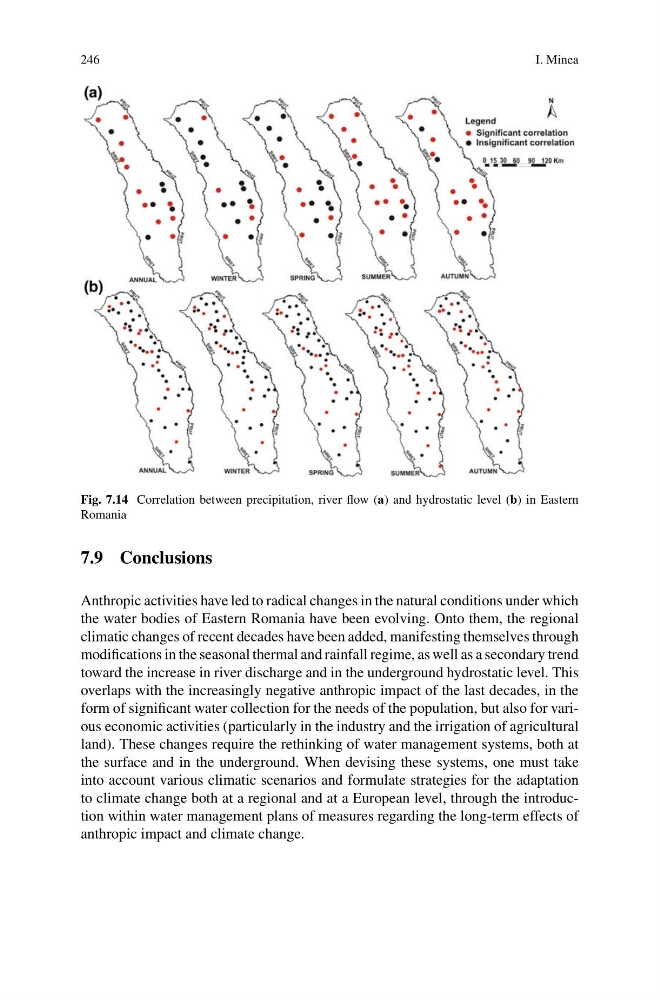
Fig. 7.14 Correlation between precipitation, river flow (a) and hydrostatic level (b) in Eastern
Romania
7.9 Conclusions
Anthropic activities have led to radical changes in the natural conditions under which
the water bodies of Eastern Romania have been evolving. Onto them, the regional
climatic changes of recent decades have been added, manifesting themselves through
modifications in the seasonal thermal and rainfall regime, as well as a secondary trend
toward the increase in river discharge and in the underground hydrostatic level. This
overlaps with the increasingly negative anthropic impact of the last decades, in the
form of significant water collection for the needs of the population, but also for various economic activities (particularly in the industry and the irrigation of agricultural
land). These changes require the rethinking of water management systems, both at
the surface and in the underground. When devising these systems, one must take
into account various climatic scenarios and formulate strategies for the adaptation
to climate change both at a regional and at a European level, through the introduction within water management plans of measures regarding the long-term effects of
anthropic impact and climate change.
I. Minea
Fig. 7.14 Correlation between precipitation, river flow (a) and hydrostatic level (b) in Eastern
Romania
7.9 Conclusions
Anthropic activities have led to radical changes in the natural conditions under which
the water bodies of Eastern Romania have been evolving. Onto them, the regional
climatic changes of recent decades have been added, manifesting themselves through
modifications in the seasonal thermal and rainfall regime, as well as a secondary trend
toward the increase in river discharge and in the underground hydrostatic level. This
overlaps with the increasingly negative anthropic impact of the last decades, in the
form of significant water collection for the needs of the population, but also for various economic activities (particularly in the industry and the irrigation of agricultural
land). These changes require the rethinking of water management systems, both at
the surface and in the underground. When devising these systems, one must take
into account various climatic scenarios and formulate strategies for the adaptation
to climate change both at a regional and at a European level, through the introduction within water management plans of measures regarding the long-term effects of
anthropic impact and climate change.