

244
I. Minea
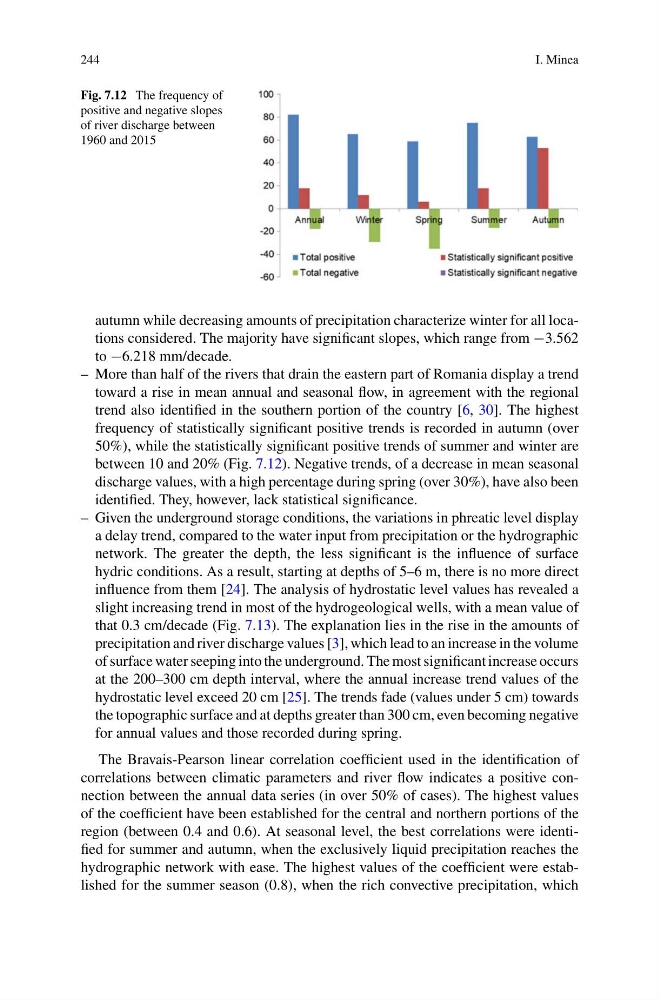
Fig. 7.12 The frequency of
positive and negative slopes
of river discharge between
1960 and 2015
autumn while decreasing amounts of precipitation characterize winter for all locations considered. The majority have significant slopes, which range from −3.562
to −6.218 mm/decade.
– More than half of the rivers that drain the eastern part of Romania display a trend
toward a rise in mean annual and seasonal flow, in agreement with the regional
trend also identified in the southern portion of the country [6, 30]. The highest
frequency of statistically significant positive trends is recorded in autumn (over
50%), while the statistically significant positive trends of summer and winter are
between 10 and 20% (Fig. 7.12). Negative trends, of a decrease in mean seasonal
discharge values, with a high percentage during spring (over 30%), have also been
identified. They, however, lack statistical significance.
– Given the underground storage conditions, the variations in phreatic level display
a delay trend, compared to the water input from precipitation or the hydrographic
network. The greater the depth, the less significant is the influence of surface
hydric conditions. As a result, starting at depths of 5–6 m, there is no more direct
influence from them [24]. The analysis of hydrostatic level values has revealed a
slight increasing trend in most of the hydrogeological wells, with a mean value of
that 0.3 cm/decade (Fig. 7.13). The explanation lies in the rise in the amounts of
precipitation and river discharge values [3], which lead to an increase in the volume
of surface water seeping into the underground. The most significant increase occurs
at the 200–300 cm depth interval, where the annual increase trend values of the
hydrostatic level exceed 20 cm [25]. The trends fade (values under 5 cm) towards
the topographic surface and at depths greater than 300 cm, even becoming negative
for annual values and those recorded during spring.
The Bravais-Pearson linear correlation coefficient used in the identification of
correlations between climatic parameters and river flow indicates a positive connection between the annual data series (in over 50% of cases). The highest values
of the coefficient have been established for the central and northern portions of the
region (between 0.4 and 0.6). At seasonal level, the best correlations were identified for summer and autumn, when the exclusively liquid precipitation reaches the
hydrographic network with ease. The highest values of the coefficient were established for the summer season (0.8), when the rich convective precipitation, which
I. Minea
Fig. 7.12 The frequency of
positive and negative slopes
of river discharge between
1960 and 2015
autumn while decreasing amounts of precipitation characterize winter for all locations considered. The majority have significant slopes, which range from −3.562
to −6.218 mm/decade.
– More than half of the rivers that drain the eastern part of Romania display a trend
toward a rise in mean annual and seasonal flow, in agreement with the regional
trend also identified in the southern portion of the country [6, 30]. The highest
frequency of statistically significant positive trends is recorded in autumn (over
50%), while the statistically significant positive trends of summer and winter are
between 10 and 20% (Fig. 7.12). Negative trends, of a decrease in mean seasonal
discharge values, with a high percentage during spring (over 30%), have also been
identified. They, however, lack statistical significance.
– Given the underground storage conditions, the variations in phreatic level display
a delay trend, compared to the water input from precipitation or the hydrographic
network. The greater the depth, the less significant is the influence of surface
hydric conditions. As a result, starting at depths of 5–6 m, there is no more direct
influence from them [24]. The analysis of hydrostatic level values has revealed a
slight increasing trend in most of the hydrogeological wells, with a mean value of
that 0.3 cm/decade (Fig. 7.13). The explanation lies in the rise in the amounts of
precipitation and river discharge values [3], which lead to an increase in the volume
of surface water seeping into the underground. The most significant increase occurs
at the 200–300 cm depth interval, where the annual increase trend values of the
hydrostatic level exceed 20 cm [25]. The trends fade (values under 5 cm) towards
the topographic surface and at depths greater than 300 cm, even becoming negative
for annual values and those recorded during spring.
The Bravais-Pearson linear correlation coefficient used in the identification of
correlations between climatic parameters and river flow indicates a positive connection between the annual data series (in over 50% of cases). The highest values
of the coefficient have been established for the central and northern portions of the
region (between 0.4 and 0.6). At seasonal level, the best correlations were identified for summer and autumn, when the exclusively liquid precipitation reaches the
hydrographic network with ease. The highest values of the coefficient were established for the summer season (0.8), when the rich convective precipitation, which