

7 The Vulnerability of Water Resources from Eastern Romania …
243
compared to 1961–2010, along with the quantifiable effects upon the mean multiannual temperature and precipitation in Romania. Thus, for 2020–2029, a series of
modifications to climatic parameters, similar to those occurring at European level,
are expected nation-wide, with increases in mean annual temperature between 0.5
and 1.5 °C. As far as the precipitation regime is concerned, the analyses for the
1901–2010 interval indicate a nation-wide trend, particularly after 1961, towards a
decrease in the annual quantity of precipitation, along with a pronounced increase
in precipitation deficit for southern and eastern Romania.
Croitoru and Minea [8] and Minea and Croitoru [24, 25] have revealed the effects
of climate change upon river flow and phreatic level in the eastern part of the country.
The nonparametric Mann-Kendal test, used to determine the trends of the main climatic parameters (temperature and mean seasonal and annual precipitation), hydrological parameters (mean seasonal and annual flow) and hydrogeological ones (mean
monthly and annual values of the piezometric level). The following aspects have been
identified for the region under study:
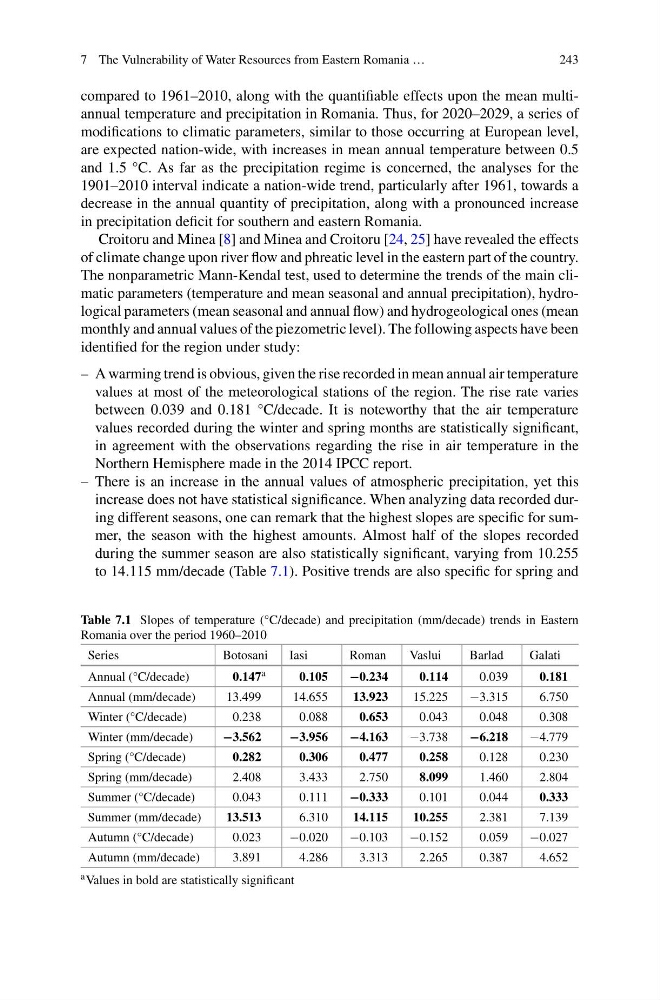
– A warming trend is obvious, given the rise recorded in mean annual air temperature
values at most of the meteorological stations of the region. The rise rate varies
between 0.039 and 0.181 °C/decade. It is noteworthy that the air temperature
values recorded during the winter and spring months are statistically significant,
in agreement with the observations regarding the rise in air temperature in the
Northern Hemisphere made in the 2014 IPCC report.
– There is an increase in the annual values of atmospheric precipitation, yet this
increase does not have statistical significance. When analyzing data recorded during different seasons, one can remark that the highest slopes are specific for summer, the season with the highest amounts. Almost half of the slopes recorded
during the summer season are also statistically significant, varying from 10.255
to 14.115 mm/decade (Table 7.1). Positive trends are also specific for spring and
Table 7.1 Slopes of temperature (°C/decade) and precipitation (mm/decade) trends in Eastern
Romania over the period 1960–2010
Series
Botosani
Iasi
Roman
Vaslui
Barlad
Galati
Annual (°C/decade)
0.147 a
0.105
−0.234
0.114
0.039
0.181
Annual (mm/decade)
13.499
14.655
13.923
15.225
−3.315
6.750
Winter (°C/decade)
0.238
0.088
0.653
0.043
0.048
0.308
Winter (mm/decade)
−3.562
−3.956
−4.163
−3.738
−6.218
−4.779
Spring (°C/decade)
0.282
0.306
0.477
0.258
0.128
0.230
Spring (mm/decade)
2.408
3.433
2.750
8.099
1.460
2.804
Summer (°C/decade)
0.043
0.111
−0.333
0.101
0.044
0.333
Summer (mm/decade)
13.513
6.310
14.115
10.255
2.381
7.139
Autumn (°C/decade)
0.023
−0.020
−0.103
−0.152
0.059
−0.027
Autumn (mm/decade)
3.891
4.286
3.313
2.265
0.387
4.652
a Values in bold are statistically significant
243
compared to 1961–2010, along with the quantifiable effects upon the mean multiannual temperature and precipitation in Romania. Thus, for 2020–2029, a series of
modifications to climatic parameters, similar to those occurring at European level,
are expected nation-wide, with increases in mean annual temperature between 0.5
and 1.5 °C. As far as the precipitation regime is concerned, the analyses for the
1901–2010 interval indicate a nation-wide trend, particularly after 1961, towards a
decrease in the annual quantity of precipitation, along with a pronounced increase
in precipitation deficit for southern and eastern Romania.
Croitoru and Minea [8] and Minea and Croitoru [24, 25] have revealed the effects
of climate change upon river flow and phreatic level in the eastern part of the country.
The nonparametric Mann-Kendal test, used to determine the trends of the main climatic parameters (temperature and mean seasonal and annual precipitation), hydrological parameters (mean seasonal and annual flow) and hydrogeological ones (mean
monthly and annual values of the piezometric level). The following aspects have been
identified for the region under study:
– A warming trend is obvious, given the rise recorded in mean annual air temperature
values at most of the meteorological stations of the region. The rise rate varies
between 0.039 and 0.181 °C/decade. It is noteworthy that the air temperature
values recorded during the winter and spring months are statistically significant,
in agreement with the observations regarding the rise in air temperature in the
Northern Hemisphere made in the 2014 IPCC report.
– There is an increase in the annual values of atmospheric precipitation, yet this
increase does not have statistical significance. When analyzing data recorded during different seasons, one can remark that the highest slopes are specific for summer, the season with the highest amounts. Almost half of the slopes recorded
during the summer season are also statistically significant, varying from 10.255
to 14.115 mm/decade (Table 7.1). Positive trends are also specific for spring and
Table 7.1 Slopes of temperature (°C/decade) and precipitation (mm/decade) trends in Eastern
Romania over the period 1960–2010
Series
Botosani
Iasi
Roman
Vaslui
Barlad
Galati
Annual (°C/decade)
0.147 a
0.105
−0.234
0.114
0.039
0.181
Annual (mm/decade)
13.499
14.655
13.923
15.225
−3.315
6.750
Winter (°C/decade)
0.238
0.088
0.653
0.043
0.048
0.308
Winter (mm/decade)
−3.562
−3.956
−4.163
−3.738
−6.218
−4.779
Spring (°C/decade)
0.282
0.306
0.477
0.258
0.128
0.230
Spring (mm/decade)
2.408
3.433
2.750
8.099
1.460
2.804
Summer (°C/decade)
0.043
0.111
−0.333
0.101
0.044
0.333
Summer (mm/decade)
13.513
6.310
14.115
10.255
2.381
7.139
Autumn (°C/decade)
0.023
−0.020
−0.103
−0.152
0.059
−0.027
Autumn (mm/decade)
3.891
4.286
3.313
2.265
0.387
4.652
a Values in bold are statistically significant