

242
I. Minea
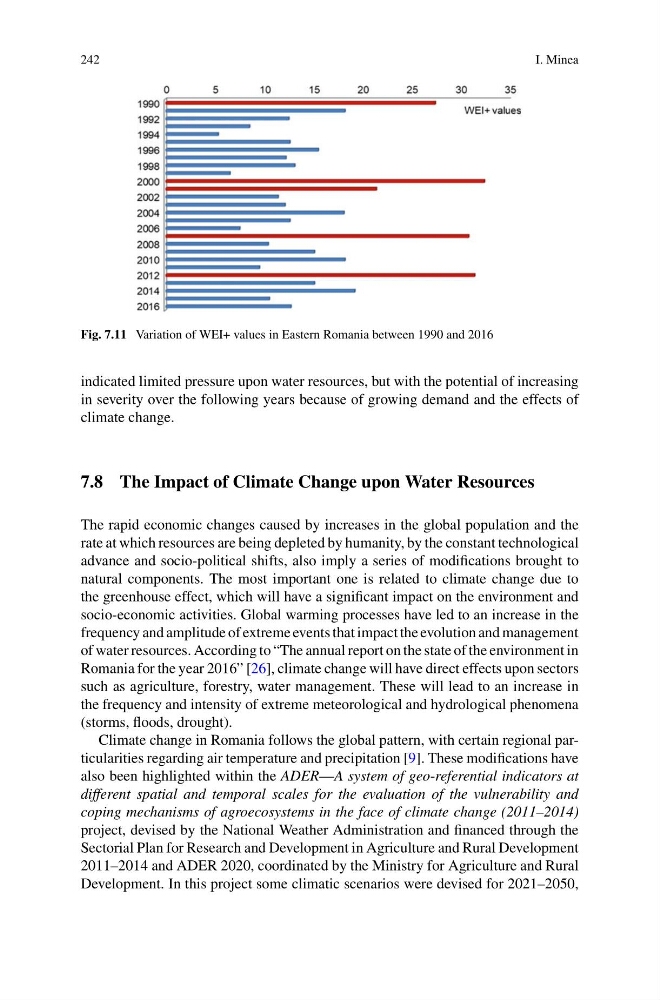
Fig. 7.11 Variation of WEI+ values in Eastern Romania between 1990 and 2016
indicated limited pressure upon water resources, but with the potential of increasing
in severity over the following years because of growing demand and the effects of
climate change.
7.8 The Impact of Climate Change upon Water Resources
The rapid economic changes caused by increases in the global population and the
rate at which resources are being depleted by humanity, by the constant technological
advance and socio-political shifts, also imply a series of modifications brought to
natural components. The most important one is related to climate change due to
the greenhouse effect, which will have a significant impact on the environment and
socio-economic activities. Global warming processes have led to an increase in the
frequency and amplitude of extreme events that impact the evolution and management
of water resources. According to “The annual report on the state of the environment in
Romania for the year 2016” [26], climate change will have direct effects upon sectors
such as agriculture, forestry, water management. These will lead to an increase in
the frequency and intensity of extreme meteorological and hydrological phenomena
(storms, floods, drought).
Climate change in Romania follows the global pattern, with certain regional particularities regarding air temperature and precipitation [9]. These modifications have
also been highlighted within the ADER—A system of geo-referential indicators at
different spatial and temporal scales for the evaluation of the vulnerability and
coping mechanisms of agroecosystems in the face of climate change (2011–2014)
project, devised by the National Weather Administration and financed through the
Sectorial Plan for Research and Development in Agriculture and Rural Development
2011–2014 and ADER 2020, coordinated by the Ministry for Agriculture and Rural
Development. In this project some climatic scenarios were devised for 2021–2050,
I. Minea
Fig. 7.11 Variation of WEI+ values in Eastern Romania between 1990 and 2016
indicated limited pressure upon water resources, but with the potential of increasing
in severity over the following years because of growing demand and the effects of
climate change.
7.8 The Impact of Climate Change upon Water Resources
The rapid economic changes caused by increases in the global population and the
rate at which resources are being depleted by humanity, by the constant technological
advance and socio-political shifts, also imply a series of modifications brought to
natural components. The most important one is related to climate change due to
the greenhouse effect, which will have a significant impact on the environment and
socio-economic activities. Global warming processes have led to an increase in the
frequency and amplitude of extreme events that impact the evolution and management
of water resources. According to “The annual report on the state of the environment in
Romania for the year 2016” [26], climate change will have direct effects upon sectors
such as agriculture, forestry, water management. These will lead to an increase in
the frequency and intensity of extreme meteorological and hydrological phenomena
(storms, floods, drought).
Climate change in Romania follows the global pattern, with certain regional particularities regarding air temperature and precipitation [9]. These modifications have
also been highlighted within the ADER—A system of geo-referential indicators at
different spatial and temporal scales for the evaluation of the vulnerability and
coping mechanisms of agroecosystems in the face of climate change (2011–2014)
project, devised by the National Weather Administration and financed through the
Sectorial Plan for Research and Development in Agriculture and Rural Development
2011–2014 and ADER 2020, coordinated by the Ministry for Agriculture and Rural
Development. In this project some climatic scenarios were devised for 2021–2050,