

222
C. Bacotiu et al.
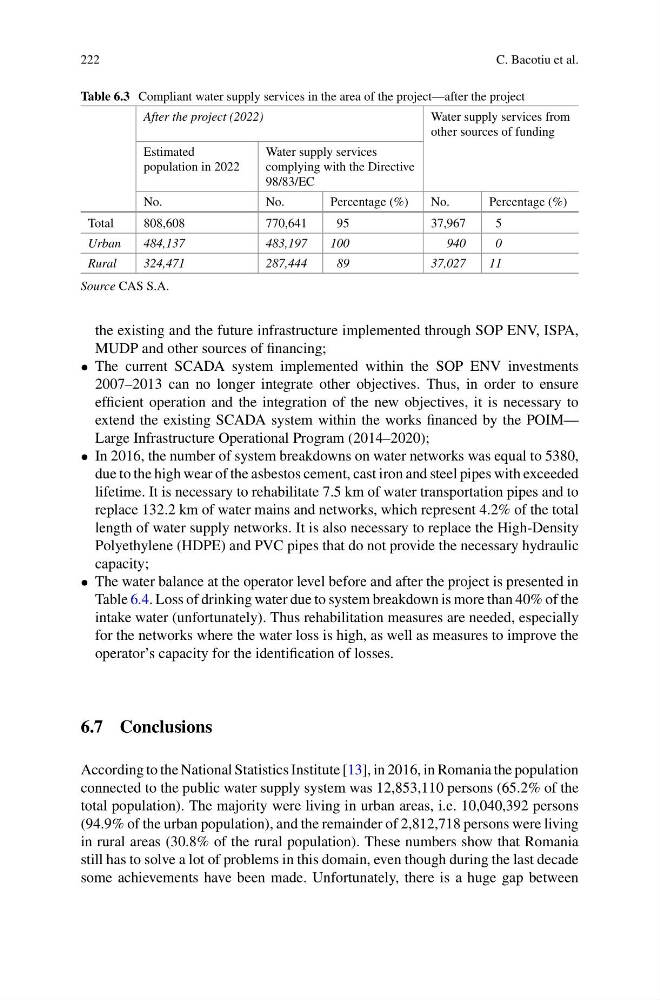
Table 6.3 Compliant water supply services in the area of the project—after the project
After the project (2022)
Water supply services from
other sources of funding
Estimated
population in 2022
Water supply services
complying with the Directive
98/83/EC
No.
No.
Percentage (%)
No.
Percentage (%)
Total
808,608
770,641
95
37,967
5
Urban
484,137
483,197
100
940
0
Rural
324,471
287,444
89
37,027
11
Source CAS S.A.
the existing and the future infrastructure implemented through SOP ENV, ISPA,
MUDP and other sources of financing;
• The current SCADA system implemented within the SOP ENV investments
2007–2013 can no longer integrate other objectives. Thus, in order to ensure
efficient operation and the integration of the new objectives, it is necessary to
extend the existing SCADA system within the works financed by the POIM—
Large Infrastructure Operational Program (2014–2020);
• In 2016, the number of system breakdowns on water networks was equal to 5380,
due to the high wear of the asbestos cement, cast iron and steel pipes with exceeded
lifetime. It is necessary to rehabilitate 7.5 km of water transportation pipes and to
replace 132.2 km of water mains and networks, which represent 4.2% of the total
length of water supply networks. It is also necessary to replace the High-Density
Polyethylene (HDPE) and PVC pipes that do not provide the necessary hydraulic
capacity;
• The water balance at the operator level before and after the project is presented in
Table 6.4. Loss of drinking water due to system breakdown is more than 40% of the
intake water (unfortunately). Thus rehabilitation measures are needed, especially
for the networks where the water loss is high, as well as measures to improve the
operator’s capacity for the identification of losses.
6.7 Conclusions
According to the National Statistics Institute [13], in 2016, in Romania the population
connected to the public water supply system was 12,853,110 persons (65.2% of the
total population). The majority were living in urban areas, i.e. 10,040,392 persons
(94.9% of the urban population), and the remainder of 2,812,718 persons were living
in rural areas (30.8% of the rural population). These numbers show that Romania
still has to solve a lot of problems in this domain, even though during the last decade
some achievements have been made. Unfortunately, there is a huge gap between
C. Bacotiu et al.
Table 6.3 Compliant water supply services in the area of the project—after the project
After the project (2022)
Water supply services from
other sources of funding
Estimated
population in 2022
Water supply services
complying with the Directive
98/83/EC
No.
No.
Percentage (%)
No.
Percentage (%)
Total
808,608
770,641
95
37,967
5
Urban
484,137
483,197
100
940
0
Rural
324,471
287,444
89
37,027
11
Source CAS S.A.
the existing and the future infrastructure implemented through SOP ENV, ISPA,
MUDP and other sources of financing;
• The current SCADA system implemented within the SOP ENV investments
2007–2013 can no longer integrate other objectives. Thus, in order to ensure
efficient operation and the integration of the new objectives, it is necessary to
extend the existing SCADA system within the works financed by the POIM—
Large Infrastructure Operational Program (2014–2020);
• In 2016, the number of system breakdowns on water networks was equal to 5380,
due to the high wear of the asbestos cement, cast iron and steel pipes with exceeded
lifetime. It is necessary to rehabilitate 7.5 km of water transportation pipes and to
replace 132.2 km of water mains and networks, which represent 4.2% of the total
length of water supply networks. It is also necessary to replace the High-Density
Polyethylene (HDPE) and PVC pipes that do not provide the necessary hydraulic
capacity;
• The water balance at the operator level before and after the project is presented in
Table 6.4. Loss of drinking water due to system breakdown is more than 40% of the
intake water (unfortunately). Thus rehabilitation measures are needed, especially
for the networks where the water loss is high, as well as measures to improve the
operator’s capacity for the identification of losses.
6.7 Conclusions
According to the National Statistics Institute [13], in 2016, in Romania the population
connected to the public water supply system was 12,853,110 persons (65.2% of the
total population). The majority were living in urban areas, i.e. 10,040,392 persons
(94.9% of the urban population), and the remainder of 2,812,718 persons were living
in rural areas (30.8% of the rural population). These numbers show that Romania
still has to solve a lot of problems in this domain, even though during the last decade
some achievements have been made. Unfortunately, there is a huge gap between