

311
and the arid categories. Regarding the number of municipalities by categories, the
three humid categories are predicted to be found in less municipalities in the future,
while the number of arid municipalities will increase 66% (Table 17.5).
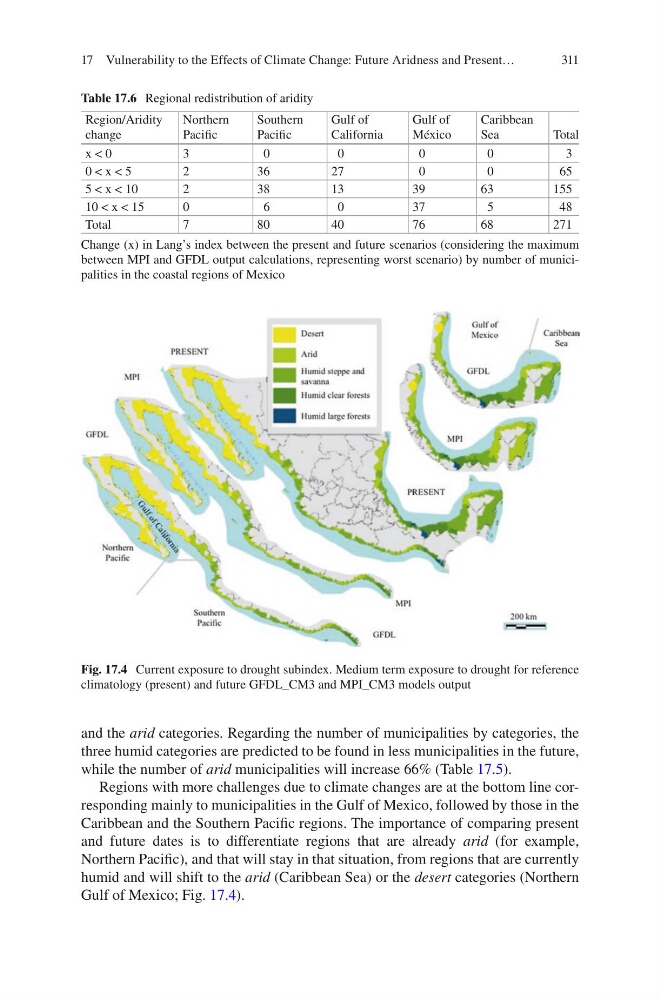
Regions with more challenges due to climate changes are at the bottom line corresponding mainly to municipalities in the Gulf of Mexico, followed by those in the
Caribbean and the Southern Pacific regions. The importance of comparing present
and future dates is to differentiate regions that are already arid (for example,
Northern Pacific), and that will stay in that situation, from regions that are currently
humid and will shift to the arid (Caribbean Sea) or the desert categories (Northern
Gulf of Mexico; Fig. 17.4).
Table 17.6 Regional redistribution of aridity
Region/Aridity
change
Northern
Pacific
Southern
Pacific
Gulf of
California
Gulf of
México
Caribbean
Sea
Total
x < 0
3
0
0
0
0
3
0 < x < 5
2
36
27
0
0
65
5 < x < 10
2
38
13
39
63
155
10 < x < 15
0
6
0
37
5
48
Total
7
80
40
76
68
271
Change (x) in Lang’s index between the present and future scenarios (considering the maximum
between MPI and GFDL output calculations, representing worst scenario) by number of municipalities in the coastal regions of Mexico
Fig. 17.4 Current exposure to drought subindex. Medium term exposure to drought for reference
climatology (present) and future GFDL_CM3 and MPI_CM3 models output
17 Vulnerability to the Effects of Climate Change: Future Aridness and Present…
and the arid categories. Regarding the number of municipalities by categories, the
three humid categories are predicted to be found in less municipalities in the future,
while the number of arid municipalities will increase 66% (Table 17.5).
Regions with more challenges due to climate changes are at the bottom line corresponding mainly to municipalities in the Gulf of Mexico, followed by those in the
Caribbean and the Southern Pacific regions. The importance of comparing present
and future dates is to differentiate regions that are already arid (for example,
Northern Pacific), and that will stay in that situation, from regions that are currently
humid and will shift to the arid (Caribbean Sea) or the desert categories (Northern
Gulf of Mexico; Fig. 17.4).
Table 17.6 Regional redistribution of aridity
Region/Aridity
change
Northern
Pacific
Southern
Pacific
Gulf of
California
Gulf of
México
Caribbean
Sea
Total
x < 0
3
0
0
0
0
3
0 < x < 5
2
36
27
0
0
65
5 < x < 10
2
38
13
39
63
155
10 < x < 15
0
6
0
37
5
48
Total
7
80
40
76
68
271
Change (x) in Lang’s index between the present and future scenarios (considering the maximum
between MPI and GFDL output calculations, representing worst scenario) by number of municipalities in the coastal regions of Mexico
Fig. 17.4 Current exposure to drought subindex. Medium term exposure to drought for reference
climatology (present) and future GFDL_CM3 and MPI_CM3 models output
17 Vulnerability to the Effects of Climate Change: Future Aridness and Present…