

310
compared to determine the regions with the greatest impact as those regions having
larger differences between the reference climatological value and the two models’
output values. The higher the differences in the index are, the greater will be the
future challenge to build capacity and to strengthen the institutions and the
interactions among actors to be prepared to cope with a municipality transiting
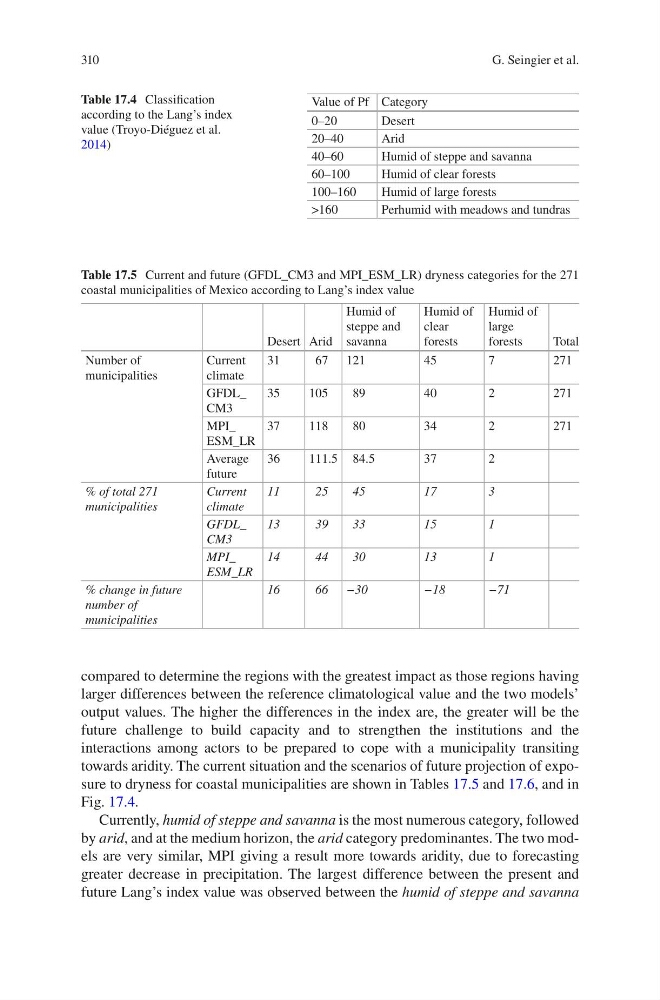
towards aridity. The current situation and the scenarios of future projection of exposure to dryness for coastal municipalities are shown in Tables 17.5 and 17.6, and in
Fig. 17.4.
Currently, humid of steppe and savanna is the most numerous category, followed
by arid, and at the medium horizon, the arid category predominantes. The two models are very similar, MPI giving a result more towards aridity, due to forecasting
greater decrease in precipitation. The largest difference between the present and
future Lang’s index value was observed between the humid of steppe and savanna
Table 17.4 Classification
according to the Lang’s index
value (Troyo-Diéguez et al.
2014)
Value of Pf Category
0–20
Desert
20–40
Arid
40–60
Humid of steppe and savanna
60–100
Humid of clear forests
100–160
Humid of large forests
>160
Perhumid with meadows and tundras
Table 17.5 Current and future (GFDL_CM3 and MPI_ESM_LR) dryness categories for the 271
coastal municipalities of Mexico according to Lang’s index value
Desert Arid
Humid of
steppe and
savanna
Humid of
clear
forests
Humid of
large
forests
Total
Number of
municipalities
Current
climate
31
67 121
45
7
271
GFDL_
CM3
35
105
89
40
2
271
MPI_
ESM_LR
37
118
80
34
2
271
Average
future
36
111.5 84.5
37
2
% of total 271
municipalities
Current
climate
11
25
45
17
3
GFDL_
CM3
13
39
33
15
1
MPI_
ESM_LR
14
44
30
13
1
% change in future
number of
municipalities
16
66 −30
−18
−71
G. Seingier et al.
compared to determine the regions with the greatest impact as those regions having
larger differences between the reference climatological value and the two models’
output values. The higher the differences in the index are, the greater will be the
future challenge to build capacity and to strengthen the institutions and the
interactions among actors to be prepared to cope with a municipality transiting
towards aridity. The current situation and the scenarios of future projection of exposure to dryness for coastal municipalities are shown in Tables 17.5 and 17.6, and in
Fig. 17.4.
Currently, humid of steppe and savanna is the most numerous category, followed
by arid, and at the medium horizon, the arid category predominantes. The two models are very similar, MPI giving a result more towards aridity, due to forecasting
greater decrease in precipitation. The largest difference between the present and
future Lang’s index value was observed between the humid of steppe and savanna
Table 17.4 Classification
according to the Lang’s index
value (Troyo-Diéguez et al.
2014)
Value of Pf Category
0–20
Desert
20–40
Arid
40–60
Humid of steppe and savanna
60–100
Humid of clear forests
100–160
Humid of large forests
>160
Perhumid with meadows and tundras
Table 17.5 Current and future (GFDL_CM3 and MPI_ESM_LR) dryness categories for the 271
coastal municipalities of Mexico according to Lang’s index value
Desert Arid
Humid of
steppe and
savanna
Humid of
clear
forests
Humid of
large
forests
Total
Number of
municipalities
Current
climate
31
67 121
45
7
271
GFDL_
CM3
35
105
89
40
2
271
MPI_
ESM_LR
37
118
80
34
2
271
Average
future
36
111.5 84.5
37
2
% of total 271
municipalities
Current
climate
11
25
45
17
3
GFDL_
CM3
13
39
33
15
1
MPI_
ESM_LR
14
44
30
13
1
% change in future
number of
municipalities
16
66 −30
−18
−71
G. Seingier et al.