

304
Indicators are inputs to improve governance. Nowadays, it is necessary to sensitize
people about the possible phenomena, processes, and environmental problems that
could affect them. For an indicator to be useful it must comply with certain characteristics such as being simple, relevant, adequate, meaningful, and having a largescale and long-term vision. This means that indicators must be sufficient, have a
methodology of transparent construction, prove their usefulness for making evident
decisions, and be able to show changes (sensitive) or to measure progress clearly
(Spangenberg and Bonniot 1998).
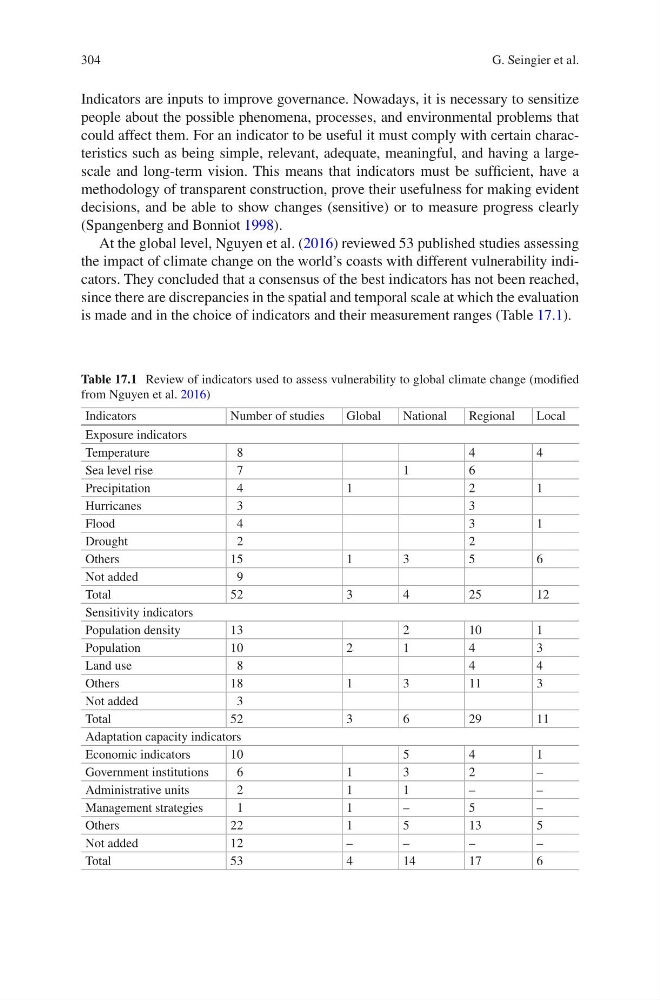
At the global level, Nguyen et al. (2016) reviewed 53 published studies assessing
the impact of climate change on the world’s coasts with different vulnerability indicators. They concluded that a consensus of the best indicators has not been reached,
since there are discrepancies in the spatial and temporal scale at which the evaluation
is made and in the choice of indicators and their measurement ranges (Table 17.1).
Table 17.1 Review of indicators used to assess vulnerability to global climate change (modified
from Nguyen et al. 2016)
Indicators
Number of studies
Global
National
Regional
Local
Exposure indicators
Temperature
8
4
4
Sea level rise
7
1
6
Precipitation
4
1
2
1
Hurricanes
3
3
Flood
4
3
1
Drought
2
2
Others
15
1
3
5
6
Not added
9
Total
52
3
4
25
12
Sensitivity indicators
Population density
13
2
10
1
Population
10
2
1
4
3
Land use
8
4
4
Others
18
1
3
11
3
Not added
3
Total
52
3
6
29
11
Adaptation capacity indicators
Economic indicators
10
5
4
1
Government institutions
6
1
3
2
–
Administrative units
2
1
1
–
–
Management strategies
1
1
–
5
–
Others
22
1
5
13
5
Not added
12
–
–
–
–
Total
53
4
14
17
6
G. Seingier et al.
Indicators are inputs to improve governance. Nowadays, it is necessary to sensitize
people about the possible phenomena, processes, and environmental problems that
could affect them. For an indicator to be useful it must comply with certain characteristics such as being simple, relevant, adequate, meaningful, and having a largescale and long-term vision. This means that indicators must be sufficient, have a
methodology of transparent construction, prove their usefulness for making evident
decisions, and be able to show changes (sensitive) or to measure progress clearly
(Spangenberg and Bonniot 1998).
At the global level, Nguyen et al. (2016) reviewed 53 published studies assessing
the impact of climate change on the world’s coasts with different vulnerability indicators. They concluded that a consensus of the best indicators has not been reached,
since there are discrepancies in the spatial and temporal scale at which the evaluation
is made and in the choice of indicators and their measurement ranges (Table 17.1).
Table 17.1 Review of indicators used to assess vulnerability to global climate change (modified
from Nguyen et al. 2016)
Indicators
Number of studies
Global
National
Regional
Local
Exposure indicators
Temperature
8
4
4
Sea level rise
7
1
6
Precipitation
4
1
2
1
Hurricanes
3
3
Flood
4
3
1
Drought
2
2
Others
15
1
3
5
6
Not added
9
Total
52
3
4
25
12
Sensitivity indicators
Population density
13
2
10
1
Population
10
2
1
4
3
Land use
8
4
4
Others
18
1
3
11
3
Not added
3
Total
52
3
6
29
11
Adaptation capacity indicators
Economic indicators
10
5
4
1
Government institutions
6
1
3
2
–
Administrative units
2
1
1
–
–
Management strategies
1
1
–
5
–
Others
22
1
5
13
5
Not added
12
–
–
–
–
Total
53
4
14
17
6
G. Seingier et al.