

264
two or more individuals, cultures, or cultural paradigms interact to form “hybrids,”
which comprise hybrid identities, hybrid ways of thinking, or hybrid cultures. In the
context of the project, the complex theoretical foundation and post-colonial discourse of the Third Space Theory was translated into an applicable approach by
creating space for interaction, exchange, discussion, and reflection within and
beyond cultural boundaries to foster the intercultural dialogue.
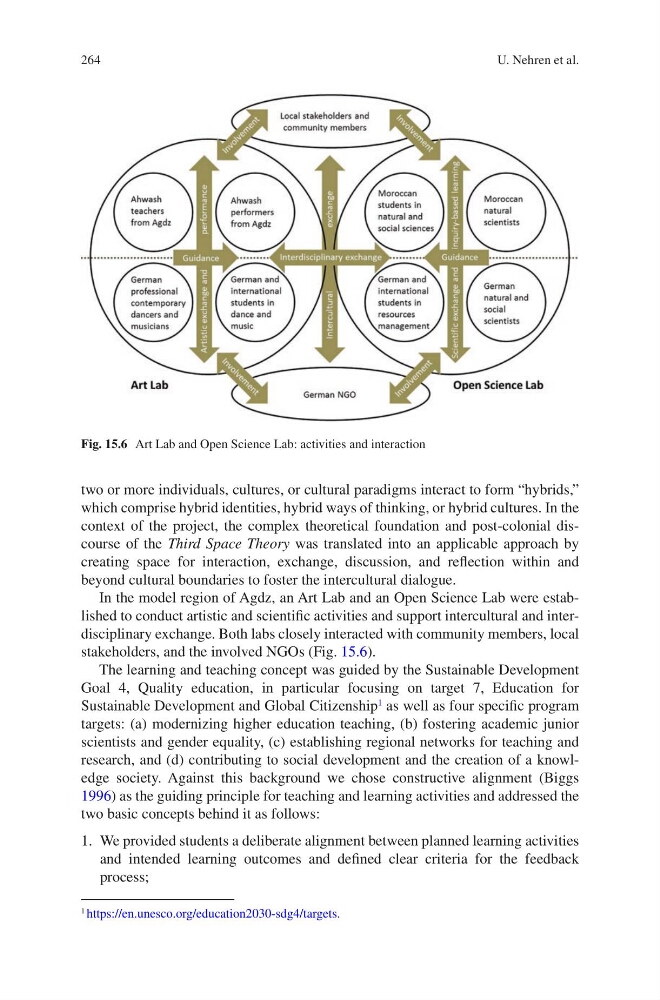
In the model region of Agdz, an Art Lab and an Open Science Lab were established to conduct artistic and scientific activities and support intercultural and interdisciplinary exchange. Both labs closely interacted with community members, local
stakeholders, and the involved NGOs (Fig. 15.6).
The learning and teaching concept was guided by the Sustainable Development
Goal 4, Quality education, in particular focusing on target 7, Education for
Sustainable Development and Global Citizenship
1
as well as four specific program
targets: (a) modernizing higher education teaching, (b) fostering academic junior
scientists and gender equality, (c) establishing regional networks for teaching and
research, and (d) contributing to social development and the creation of a knowledge society. Against this background we chose constructive alignment (Biggs
1996) as the guiding principle for teaching and learning activities and addressed the
two basic concepts behind it as follows:
1. We provided students a deliberate alignment between planned learning activities
and intended learning outcomes and defined clear criteria for the feedback
process;
1 https://en.unesco.org/education2030-sdg4/targets.
Fig. 15.6 Art Lab and Open Science Lab: activities and interaction
U. Nehren et al.
two or more individuals, cultures, or cultural paradigms interact to form “hybrids,”
which comprise hybrid identities, hybrid ways of thinking, or hybrid cultures. In the
context of the project, the complex theoretical foundation and post-colonial discourse of the Third Space Theory was translated into an applicable approach by
creating space for interaction, exchange, discussion, and reflection within and
beyond cultural boundaries to foster the intercultural dialogue.
In the model region of Agdz, an Art Lab and an Open Science Lab were established to conduct artistic and scientific activities and support intercultural and interdisciplinary exchange. Both labs closely interacted with community members, local
stakeholders, and the involved NGOs (Fig. 15.6).
The learning and teaching concept was guided by the Sustainable Development
Goal 4, Quality education, in particular focusing on target 7, Education for
Sustainable Development and Global Citizenship
1
as well as four specific program
targets: (a) modernizing higher education teaching, (b) fostering academic junior
scientists and gender equality, (c) establishing regional networks for teaching and
research, and (d) contributing to social development and the creation of a knowledge society. Against this background we chose constructive alignment (Biggs
1996) as the guiding principle for teaching and learning activities and addressed the
two basic concepts behind it as follows:
1. We provided students a deliberate alignment between planned learning activities
and intended learning outcomes and defined clear criteria for the feedback
process;
1 https://en.unesco.org/education2030-sdg4/targets.
Fig. 15.6 Art Lab and Open Science Lab: activities and interaction
U. Nehren et al.