

265
2. We supported students in linking their newly acquired knowledge with experiences from their own living environment and cultural background to promote
abstraction of basic principles through self-reflection.
Furthermore, we applied the concept of inquiry-based learning, which is considered
as a suitable concept to implement teaching and learning approaches within an
active transdisciplinary learning environment (Dostál 2015). The concept is based
on an explorative way of gaining new knowledge, for instance, by posing questions,
analyzing problems, or discussing scenarios (Bell et al. 2010). To foster active
learning, intercultural communication, and interdisciplinary exchange, we created
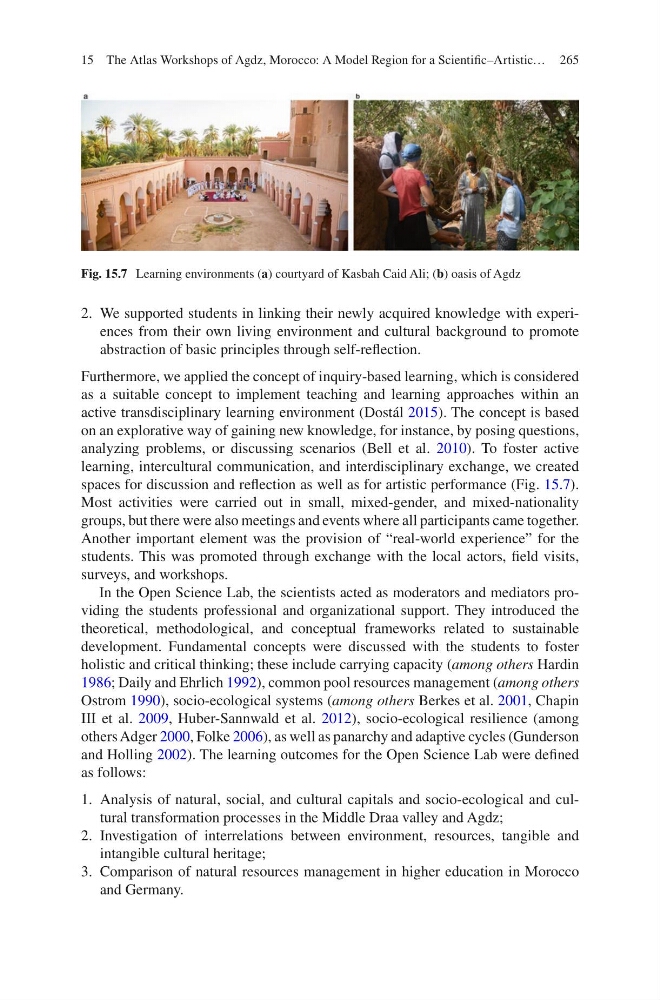
spaces for discussion and reflection as well as for artistic performance (Fig. 15.7).
Most activities were carried out in small, mixed-gender, and mixed-nationality
groups, but there were also meetings and events where all participants came together.
Another important element was the provision of “real-world experience” for the
students. This was promoted through exchange with the local actors, field visits,
surveys, and workshops.
In the Open Science Lab, the scientists acted as moderators and mediators providing the students professional and organizational support. They introduced the
theoretical, methodological, and conceptual frameworks related to sustainable
development. Fundamental concepts were discussed with the students to foster
holistic and critical thinking; these include carrying capacity (among others Hardin
1986; Daily and Ehrlich 1992), common pool resources management (among others
Ostrom 1990), socio-ecological systems (among others Berkes et al. 2001, Chapin
III et al. 2009, Huber-Sannwald et al. 2012), socio-ecological resilience (among
others Adger 2000, Folke 2006), as well as panarchy and adaptive cycles (Gunderson
and Holling 2002). The learning outcomes for the Open Science Lab were defined
as follows:
1. Analysis of natural, social, and cultural capitals and socio-ecological and cultural transformation processes in the Middle Draa valley and Agdz;
2. Investigation of interrelations between environment, resources, tangible and
intangible cultural heritage;
3. Comparison of natural resources management in higher education in Morocco
and Germany.
Fig. 15.7 Learning environments (a) courtyard of Kasbah Caid Ali; (b) oasis of Agdz
15 The Atlas Workshops of Agdz, Morocco: A Model Region for a Scientific–Artistic…
2. We supported students in linking their newly acquired knowledge with experiences from their own living environment and cultural background to promote
abstraction of basic principles through self-reflection.
Furthermore, we applied the concept of inquiry-based learning, which is considered
as a suitable concept to implement teaching and learning approaches within an
active transdisciplinary learning environment (Dostál 2015). The concept is based
on an explorative way of gaining new knowledge, for instance, by posing questions,
analyzing problems, or discussing scenarios (Bell et al. 2010). To foster active
learning, intercultural communication, and interdisciplinary exchange, we created
spaces for discussion and reflection as well as for artistic performance (Fig. 15.7).
Most activities were carried out in small, mixed-gender, and mixed-nationality
groups, but there were also meetings and events where all participants came together.
Another important element was the provision of “real-world experience” for the
students. This was promoted through exchange with the local actors, field visits,
surveys, and workshops.
In the Open Science Lab, the scientists acted as moderators and mediators providing the students professional and organizational support. They introduced the
theoretical, methodological, and conceptual frameworks related to sustainable
development. Fundamental concepts were discussed with the students to foster
holistic and critical thinking; these include carrying capacity (among others Hardin
1986; Daily and Ehrlich 1992), common pool resources management (among others
Ostrom 1990), socio-ecological systems (among others Berkes et al. 2001, Chapin
III et al. 2009, Huber-Sannwald et al. 2012), socio-ecological resilience (among
others Adger 2000, Folke 2006), as well as panarchy and adaptive cycles (Gunderson
and Holling 2002). The learning outcomes for the Open Science Lab were defined
as follows:
1. Analysis of natural, social, and cultural capitals and socio-ecological and cultural transformation processes in the Middle Draa valley and Agdz;
2. Investigation of interrelations between environment, resources, tangible and
intangible cultural heritage;
3. Comparison of natural resources management in higher education in Morocco
and Germany.
Fig. 15.7 Learning environments (a) courtyard of Kasbah Caid Ali; (b) oasis of Agdz
15 The Atlas Workshops of Agdz, Morocco: A Model Region for a Scientific–Artistic…