

263
regulated by the religious law (Montagne 1973). Although today men have often
emigrated to the cities and women take responsibility for the children, the fields,
and the harvest, men’s property is maintained (Hoffman 2008). After the independence colonial district leaders were called caids. They were distinguished from the
anghar who were elected by the tribe (Gellner 1970). Usually the caids were living
in kasbahs inside the ksur (see Fig. 15.3b).
Project Design and Teaching/Learning Concept
In the initial project workshop, the German and Moroccan project partners together
with representatives from the community and the involved NGOs decided to work
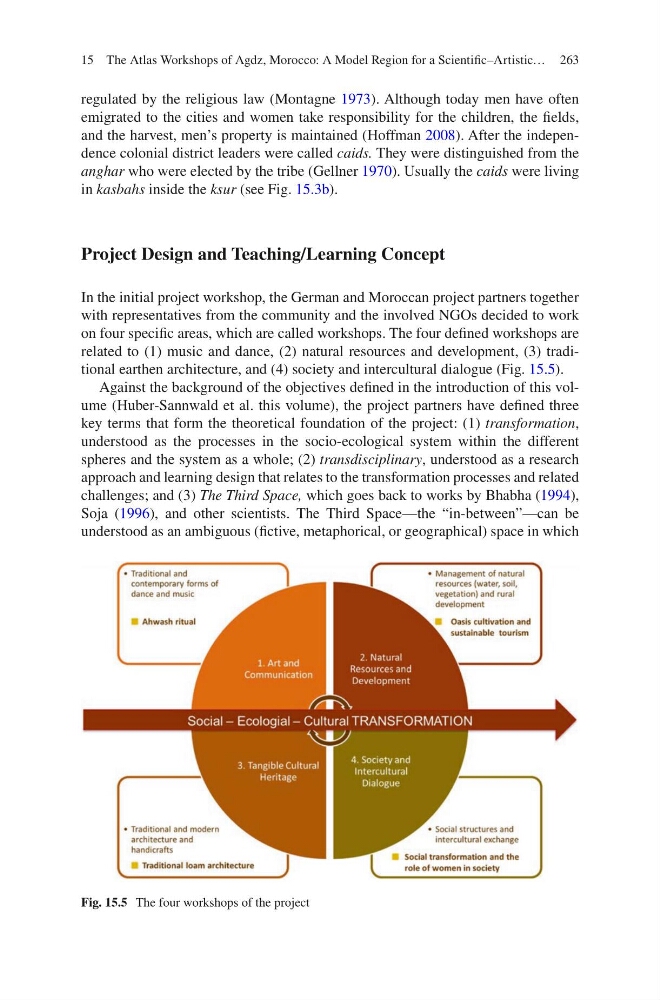
on four specific areas, which are called workshops. The four defined workshops are
related to (1) music and dance, (2) natural resources and development, (3) traditional earthen architecture, and (4) society and intercultural dialogue (Fig. 15.5).
Against the background of the objectives defined in the introduction of this volume (Huber-Sannwald et al. this volume), the project partners have defined three
key terms that form the theoretical foundation of the project: (1) transformation,
understood as the processes in the socio-ecological system within the different
spheres and the system as a whole; (2) transdisciplinary, understood as a research
approach and learning design that relates to the transformation processes and related
challenges; and (3) The Third Space, which goes back to works by Bhabha (1994),
Soja (1996), and other scientists. The Third Space—the “in-between”—can be
understood as an ambiguous (fictive, metaphorical, or geographical) space in which
Fig. 15.5 The four workshops of the project
15 The Atlas Workshops of Agdz, Morocco: A Model Region for a Scientific–Artistic…
regulated by the religious law (Montagne 1973). Although today men have often
emigrated to the cities and women take responsibility for the children, the fields,
and the harvest, men’s property is maintained (Hoffman 2008). After the independence colonial district leaders were called caids. They were distinguished from the
anghar who were elected by the tribe (Gellner 1970). Usually the caids were living
in kasbahs inside the ksur (see Fig. 15.3b).
Project Design and Teaching/Learning Concept
In the initial project workshop, the German and Moroccan project partners together
with representatives from the community and the involved NGOs decided to work
on four specific areas, which are called workshops. The four defined workshops are
related to (1) music and dance, (2) natural resources and development, (3) traditional earthen architecture, and (4) society and intercultural dialogue (Fig. 15.5).
Against the background of the objectives defined in the introduction of this volume (Huber-Sannwald et al. this volume), the project partners have defined three
key terms that form the theoretical foundation of the project: (1) transformation,
understood as the processes in the socio-ecological system within the different
spheres and the system as a whole; (2) transdisciplinary, understood as a research
approach and learning design that relates to the transformation processes and related
challenges; and (3) The Third Space, which goes back to works by Bhabha (1994),
Soja (1996), and other scientists. The Third Space—the “in-between”—can be
understood as an ambiguous (fictive, metaphorical, or geographical) space in which
Fig. 15.5 The four workshops of the project
15 The Atlas Workshops of Agdz, Morocco: A Model Region for a Scientific–Artistic…