

238
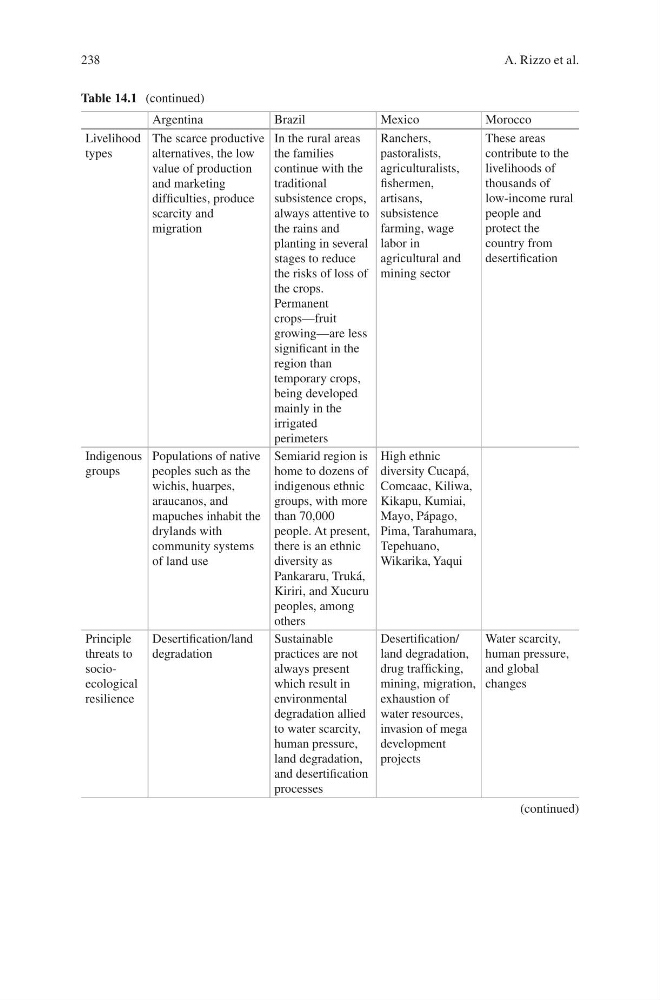
Table 14.1 (continued)
Argentina
Brazil
Mexico
Morocco
Livelihood
types
The scarce productive
alternatives, the low
value of production
and marketing
difficulties, produce
scarcity and
migration
In the rural areas
the families
continue with the
traditional
subsistence crops,
always attentive to
the rains and
planting in several
stages to reduce
the risks of loss of
the crops.
Permanent
crops—fruit
growing—are less
significant in the
region than
temporary crops,
being developed
mainly in the
irrigated
perimeters
Ranchers,
pastoralists,
agriculturalists,
fishermen,
artisans,
subsistence
farming, wage
labor in
agricultural and
mining sector
These areas
contribute to the
livelihoods of
thousands of
low-income rural
people and
protect the
country from
desertification
Indigenous
groups
Populations of native
peoples such as the
wichis, huarpes,
araucanos, and
mapuches inhabit the
drylands with
community systems
of land use
Semiarid region is
home to dozens of
indigenous ethnic
groups, with more
than 70,000
people. At present,
there is an ethnic
diversity as
Pankararu, Truká,
Kiriri, and Xucuru
peoples, among
others
High ethnic
diversity Cucapá,
Comcaac, Kiliwa,
Kikapu, Kumiai,
Mayo, Pápago,
Pima, Tarahumara,
Tepehuano,
Wikarika, Yaqui
Principle
threats to
socioecological
resilience
Desertification/land
degradation
Sustainable
practices are not
always present
which result in
environmental
degradation allied
to water scarcity,
human pressure,
land degradation,
and desertification
processes
Desertification/
land degradation,
drug trafficking,
mining, migration,
exhaustion of
water resources,
invasion of mega
development
projects
Water scarcity,
human pressure,
and global
changes
(continued)
A. Rizzo et al.
Table 14.1 (continued)
Argentina
Brazil
Mexico
Morocco
Livelihood
types
The scarce productive
alternatives, the low
value of production
and marketing
difficulties, produce
scarcity and
migration
In the rural areas
the families
continue with the
traditional
subsistence crops,
always attentive to
the rains and
planting in several
stages to reduce
the risks of loss of
the crops.
Permanent
crops—fruit
growing—are less
significant in the
region than
temporary crops,
being developed
mainly in the
irrigated
perimeters
Ranchers,
pastoralists,
agriculturalists,
fishermen,
artisans,
subsistence
farming, wage
labor in
agricultural and
mining sector
These areas
contribute to the
livelihoods of
thousands of
low-income rural
people and
protect the
country from
desertification
Indigenous
groups
Populations of native
peoples such as the
wichis, huarpes,
araucanos, and
mapuches inhabit the
drylands with
community systems
of land use
Semiarid region is
home to dozens of
indigenous ethnic
groups, with more
than 70,000
people. At present,
there is an ethnic
diversity as
Pankararu, Truká,
Kiriri, and Xucuru
peoples, among
others
High ethnic
diversity Cucapá,
Comcaac, Kiliwa,
Kikapu, Kumiai,
Mayo, Pápago,
Pima, Tarahumara,
Tepehuano,
Wikarika, Yaqui
Principle
threats to
socioecological
resilience
Desertification/land
degradation
Sustainable
practices are not
always present
which result in
environmental
degradation allied
to water scarcity,
human pressure,
land degradation,
and desertification
processes
Desertification/
land degradation,
drug trafficking,
mining, migration,
exhaustion of
water resources,
invasion of mega
development
projects
Water scarcity,
human pressure,
and global
changes
(continued)
A. Rizzo et al.