

239
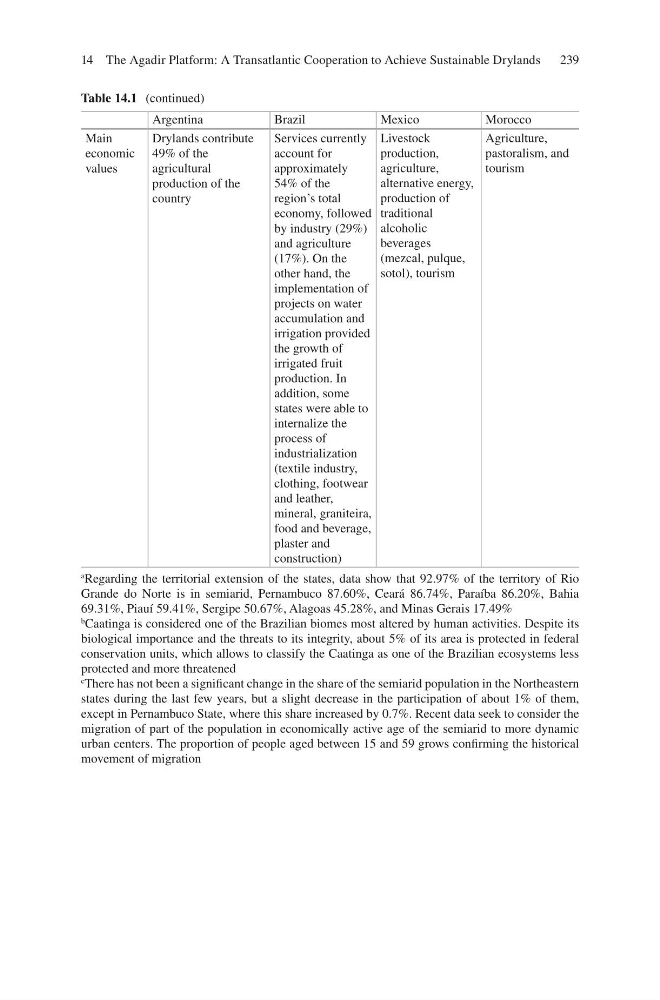
Table 14.1 (continued)
Argentina
Brazil
Mexico
Morocco
Main
economic
values
Drylands contribute
49% of the
agricultural
production of the
country
Services currently
account for
approximately
54% of the
region’s total
economy, followed
by industry (29%)
and agriculture
(17%). On the
other hand, the
implementation of
projects on water
accumulation and
irrigation provided
the growth of
irrigated fruit
production. In
addition, some
states were able to
internalize the
process of
industrialization
(textile industry,
clothing, footwear
and leather,
mineral, graniteira,
food and beverage,
plaster and
construction)
Livestock
production,
agriculture,
alternative energy,
production of
traditional
alcoholic
beverages
(mezcal, pulque,
sotol), tourism
Agriculture,
pastoralism, and
tourism
a
Regarding the territorial extension of the states, data show that 92.97% of the territory of Rio
Grande do Norte is in semiarid, Pernambuco 87.60%, Ceará 86.74%, Paraíba 86.20%, Bahia
69.31%, Piauí 59.41%, Sergipe 50.67%, Alagoas 45.28%, and Minas Gerais 17.49%
b
Caatinga is considered one of the Brazilian biomes most altered by human activities. Despite its
biological importance and the threats to its integrity, about 5% of its area is protected in federal
conservation units, which allows to classify the Caatinga as one of the Brazilian ecosystems less
protected and more threatened
c
There has not been a significant change in the share of the semiarid population in the Northeastern
states during the last few years, but a slight decrease in the participation of about 1% of them,
except in Pernambuco State, where this share increased by 0.7%. Recent data seek to consider the
migration of part of the population in economically active age of the semiarid to more dynamic
urban centers. The proportion of people aged between 15 and 59 grows confirming the historical
movement of migration
14 The Agadir Platform: A Transatlantic Cooperation to Achieve Sustainable Drylands
Table 14.1 (continued)
Argentina
Brazil
Mexico
Morocco
Main
economic
values
Drylands contribute
49% of the
agricultural
production of the
country
Services currently
account for
approximately
54% of the
region’s total
economy, followed
by industry (29%)
and agriculture
(17%). On the
other hand, the
implementation of
projects on water
accumulation and
irrigation provided
the growth of
irrigated fruit
production. In
addition, some
states were able to
internalize the
process of
industrialization
(textile industry,
clothing, footwear
and leather,
mineral, graniteira,
food and beverage,
plaster and
construction)
Livestock
production,
agriculture,
alternative energy,
production of
traditional
alcoholic
beverages
(mezcal, pulque,
sotol), tourism
Agriculture,
pastoralism, and
tourism
a
Regarding the territorial extension of the states, data show that 92.97% of the territory of Rio
Grande do Norte is in semiarid, Pernambuco 87.60%, Ceará 86.74%, Paraíba 86.20%, Bahia
69.31%, Piauí 59.41%, Sergipe 50.67%, Alagoas 45.28%, and Minas Gerais 17.49%
b
Caatinga is considered one of the Brazilian biomes most altered by human activities. Despite its
biological importance and the threats to its integrity, about 5% of its area is protected in federal
conservation units, which allows to classify the Caatinga as one of the Brazilian ecosystems less
protected and more threatened
c
There has not been a significant change in the share of the semiarid population in the Northeastern
states during the last few years, but a slight decrease in the participation of about 1% of them,
except in Pernambuco State, where this share increased by 0.7%. Recent data seek to consider the
migration of part of the population in economically active age of the semiarid to more dynamic
urban centers. The proportion of people aged between 15 and 59 grows confirming the historical
movement of migration
14 The Agadir Platform: A Transatlantic Cooperation to Achieve Sustainable Drylands