

237
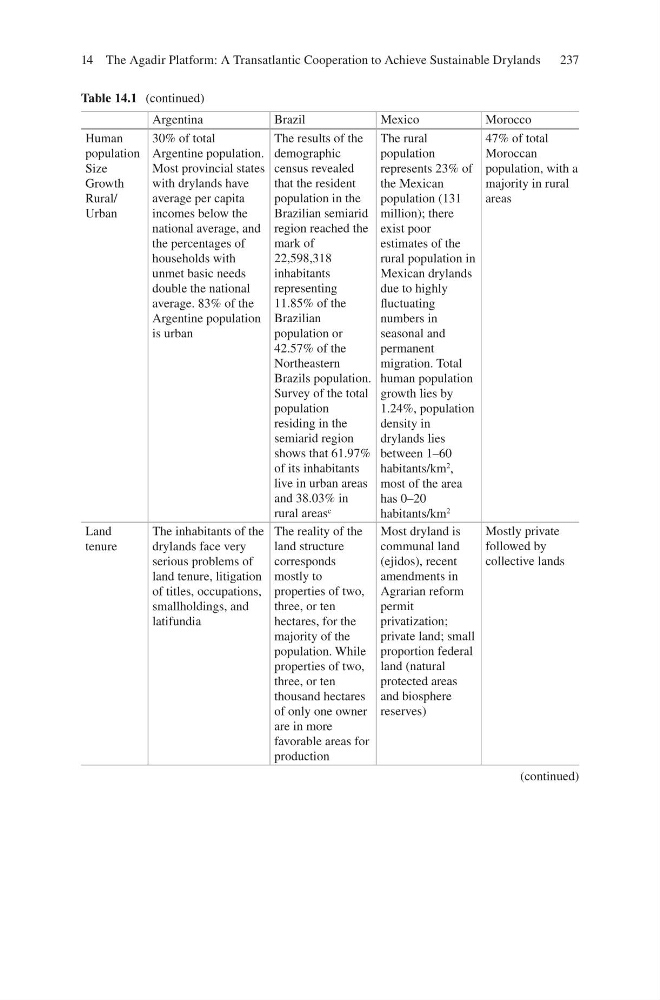
Table 14.1 (continued)
Argentina
Brazil
Mexico
Morocco
Human
population
Size
Growth
Rural/
Urban
30% of total
Argentine population.
Most provincial states
with drylands have
average per capita
incomes below the
national average, and
the percentages of
households with
unmet basic needs
double the national
average. 83% of the
Argentine population
is urban
The results of the
demographic
census revealed
that the resident
population in the
Brazilian semiarid
region reached the
mark of
22,598,318
inhabitants
representing
11.85% of the
Brazilian
population or
42.57% of the
Northeastern
Brazils population.
Survey of the total
population
residing in the
semiarid region
shows that 61.97%
of its inhabitants
live in urban areas
and 38.03% in
rural areas
c
The rural
population
represents 23% of
the Mexican
population (131
million); there
exist poor
estimates of the
rural population in
Mexican drylands
due to highly
fluctuating
numbers in
seasonal and
permanent
migration. Total
human population
growth lies by
1.24%, population
density in
drylands lies
between 1–60
habitants/km
2
,
most of the area
has 0–20
habitants/km
2
47% of total
Moroccan
population, with a
majority in rural
areas
Land
tenure
The inhabitants of the
drylands face very
serious problems of
land tenure, litigation
of titles, occupations,
smallholdings, and
latifundia
The reality of the
land structure
corresponds
mostly to
properties of two,
three, or ten
hectares, for the
majority of the
population. While
properties of two,
three, or ten
thousand hectares
of only one owner
are in more
favorable areas for
production
Most dryland is
communal land
(ejidos), recent
amendments in
Agrarian reform
permit
privatization;
private land; small
proportion federal
land (natural
protected areas
and biosphere
reserves)
Mostly private
followed by
collective lands
(continued)
14 The Agadir Platform: A Transatlantic Cooperation to Achieve Sustainable Drylands
Table 14.1 (continued)
Argentina
Brazil
Mexico
Morocco
Human
population
Size
Growth
Rural/
Urban
30% of total
Argentine population.
Most provincial states
with drylands have
average per capita
incomes below the
national average, and
the percentages of
households with
unmet basic needs
double the national
average. 83% of the
Argentine population
is urban
The results of the
demographic
census revealed
that the resident
population in the
Brazilian semiarid
region reached the
mark of
22,598,318
inhabitants
representing
11.85% of the
Brazilian
population or
42.57% of the
Northeastern
Brazils population.
Survey of the total
population
residing in the
semiarid region
shows that 61.97%
of its inhabitants
live in urban areas
and 38.03% in
rural areas
c
The rural
population
represents 23% of
the Mexican
population (131
million); there
exist poor
estimates of the
rural population in
Mexican drylands
due to highly
fluctuating
numbers in
seasonal and
permanent
migration. Total
human population
growth lies by
1.24%, population
density in
drylands lies
between 1–60
habitants/km
2
,
most of the area
has 0–20
habitants/km
2
47% of total
Moroccan
population, with a
majority in rural
areas
Land
tenure
The inhabitants of the
drylands face very
serious problems of
land tenure, litigation
of titles, occupations,
smallholdings, and
latifundia
The reality of the
land structure
corresponds
mostly to
properties of two,
three, or ten
hectares, for the
majority of the
population. While
properties of two,
three, or ten
thousand hectares
of only one owner
are in more
favorable areas for
production
Most dryland is
communal land
(ejidos), recent
amendments in
Agrarian reform
permit
privatization;
private land; small
proportion federal
land (natural
protected areas
and biosphere
reserves)
Mostly private
followed by
collective lands
(continued)
14 The Agadir Platform: A Transatlantic Cooperation to Achieve Sustainable Drylands