

236
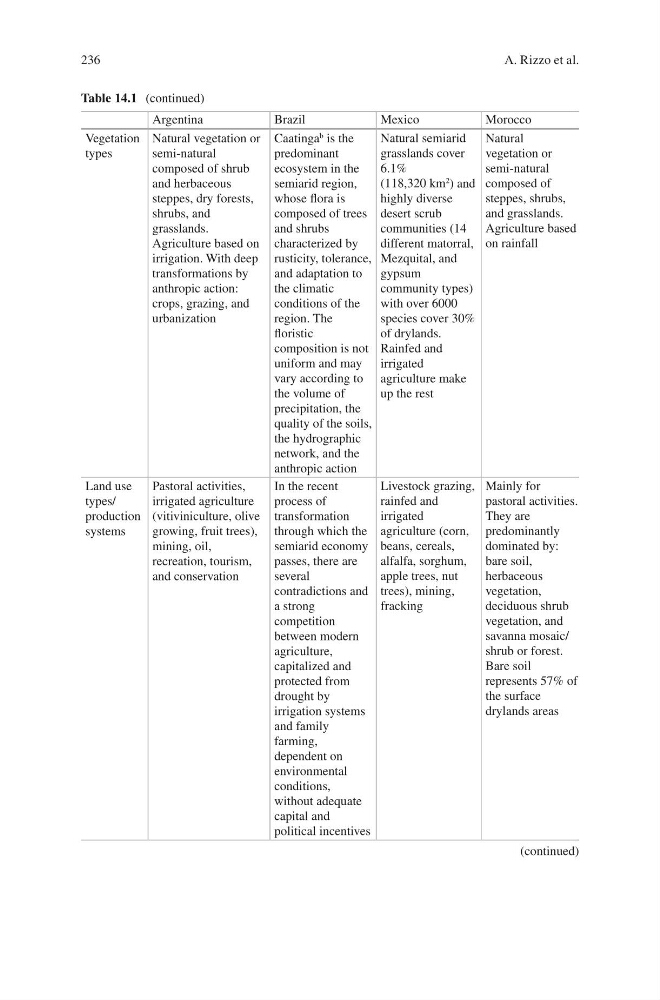
Table 14.1 (continued)
Argentina
Brazil
Mexico
Morocco
Vegetation
types
Natural vegetation or
semi-natural
composed of shrub
and herbaceous
steppes, dry forests,
shrubs, and
grasslands.
Agriculture based on
irrigation. With deep
transformations by
anthropic action:
crops, grazing, and
urbanization
Caatinga
b is the
predominant
ecosystem in the
semiarid region,
whose flora is
composed of trees
and shrubs
characterized by
rusticity, tolerance,
and adaptation to
the climatic
conditions of the
region. The
floristic
composition is not
uniform and may
vary according to
the volume of
precipitation, the
quality of the soils,
the hydrographic
network, and the
anthropic action
Natural semiarid
grasslands cover
6.1%
(118,320 km
2
) and
highly diverse
desert scrub
communities (14
different matorral,
Mezquital, and
gypsum
community types)
with over 6000
species cover 30%
of drylands.
Rainfed and
irrigated
agriculture make
up the rest
Natural
vegetation or
semi-natural
composed of
steppes, shrubs,
and grasslands.
Agriculture based
on rainfall
Land use
types/
production
systems
Pastoral activities,
irrigated agriculture
(vitiviniculture, olive
growing, fruit trees),
mining, oil,
recreation, tourism,
and conservation
In the recent
process of
transformation
through which the
semiarid economy
passes, there are
several
contradictions and
a strong
competition
between modern
agriculture,
capitalized and
protected from
drought by
irrigation systems
and family
farming,
dependent on
environmental
conditions,
without adequate
capital and
political incentives
Livestock grazing,
rainfed and
irrigated
agriculture (corn,
beans, cereals,
alfalfa, sorghum,
apple trees, nut
trees), mining,
fracking
Mainly for
pastoral activities.
They are
predominantly
dominated by:
bare soil,
herbaceous
vegetation,
deciduous shrub
vegetation, and
savanna mosaic/
shrub or forest.
Bare soil
represents 57% of
the surface
drylands areas
(continued)
A. Rizzo et al.
Table 14.1 (continued)
Argentina
Brazil
Mexico
Morocco
Vegetation
types
Natural vegetation or
semi-natural
composed of shrub
and herbaceous
steppes, dry forests,
shrubs, and
grasslands.
Agriculture based on
irrigation. With deep
transformations by
anthropic action:
crops, grazing, and
urbanization
Caatinga
b is the
predominant
ecosystem in the
semiarid region,
whose flora is
composed of trees
and shrubs
characterized by
rusticity, tolerance,
and adaptation to
the climatic
conditions of the
region. The
floristic
composition is not
uniform and may
vary according to
the volume of
precipitation, the
quality of the soils,
the hydrographic
network, and the
anthropic action
Natural semiarid
grasslands cover
6.1%
(118,320 km
2
) and
highly diverse
desert scrub
communities (14
different matorral,
Mezquital, and
gypsum
community types)
with over 6000
species cover 30%
of drylands.
Rainfed and
irrigated
agriculture make
up the rest
Natural
vegetation or
semi-natural
composed of
steppes, shrubs,
and grasslands.
Agriculture based
on rainfall
Land use
types/
production
systems
Pastoral activities,
irrigated agriculture
(vitiviniculture, olive
growing, fruit trees),
mining, oil,
recreation, tourism,
and conservation
In the recent
process of
transformation
through which the
semiarid economy
passes, there are
several
contradictions and
a strong
competition
between modern
agriculture,
capitalized and
protected from
drought by
irrigation systems
and family
farming,
dependent on
environmental
conditions,
without adequate
capital and
political incentives
Livestock grazing,
rainfed and
irrigated
agriculture (corn,
beans, cereals,
alfalfa, sorghum,
apple trees, nut
trees), mining,
fracking
Mainly for
pastoral activities.
They are
predominantly
dominated by:
bare soil,
herbaceous
vegetation,
deciduous shrub
vegetation, and
savanna mosaic/
shrub or forest.
Bare soil
represents 57% of
the surface
drylands areas
(continued)
A. Rizzo et al.