

203
for being integrated into the model. Therefore, 20 aspects were selected and transformed into indicators, and converted into a question. Such questions were later
polished aided by expert advice until the final questionnaire was integrated with 18
questions providing data of the 20 selected indicators (Table 12.1).
A total of 166 questionnaires were applied, 51 in the Kumiai community of San
Antonio Necua (29 women and 22 men, between 18 and 70 years), 56 in the Cucapá
community of El Mayor Cucapá (34 women and 22 men, between 18 and 83 years),
and 59 in the Pa Ipai community of Santa Catarina (38 women and 21 men, aged
between 18 and 73 years). The answers were analyzed applying the content analysis
qualitative tool, and the responses were assigned a weight ranging from 0 to 1
according to the remoteness (0) or proximity (1) to sustainability of response. For
example, in the case of Indicator 9: Hybridization of medical knowledge, weight
was assigned based on content of answers as explained in Table 12.2.
Subsequently, the values for each indicator were averaged, and then added,
according to the number of indicators in each sub-index (ecological sub-index, 5
indicators; social sub-index, 5 indicators; economic sub-index, 4 indicators; political sub-index 2 indicators, and cultural sub-index 4 indicators were added), the
result is the value of each sub-index. Since indigenous culture is the point at issue
of the proposed definition of community sustainability (Galván-Martínez et al.
2016) therefore the obtained values of the ecological, social, economic, and political sub-indexes were weighted multiplying them by the cultural sub-index value,
3
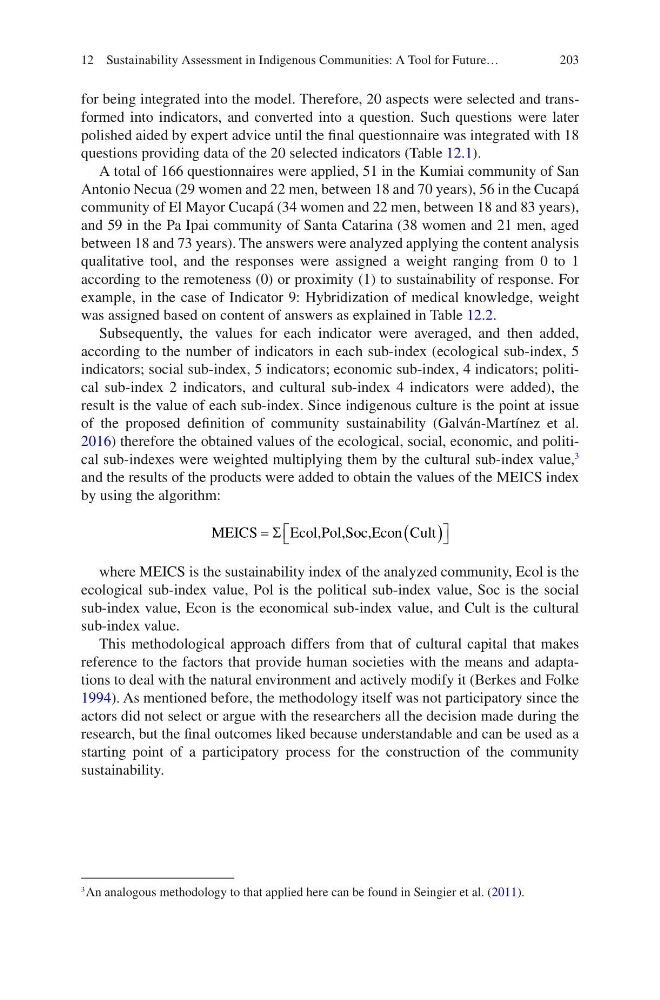
and the results of the products were added to obtain the values of the MEICS index
by using the algorithm:
MEICS
Ecol,Pol,Soc,Econ Cult
=
( )
é ë
ù û
S
where MEICS is the sustainability index of the analyzed community, Ecol is the
ecological sub-index value, Pol is the political sub-index value, Soc is the social
sub-index value, Econ is the economical sub-index value, and Cult is the cultural
sub-index value.
This methodological approach differs from that of cultural capital that makes
reference to the factors that provide human societies with the means and adaptations to deal with the natural environment and actively modify it (Berkes and Folke
1994). As mentioned before, the methodology itself was not participatory since the
actors did not select or argue with the researchers all the decision made during the
research, but the final outcomes liked because understandable and can be used as a
starting point of a participatory process for the construction of the community
sustainability.
3 An analogous methodology to that applied here can be found in Seingier et al. (2011).
12 Sustainability Assessment in Indigenous Communities: A Tool for Future…
for being integrated into the model. Therefore, 20 aspects were selected and transformed into indicators, and converted into a question. Such questions were later
polished aided by expert advice until the final questionnaire was integrated with 18
questions providing data of the 20 selected indicators (Table 12.1).
A total of 166 questionnaires were applied, 51 in the Kumiai community of San
Antonio Necua (29 women and 22 men, between 18 and 70 years), 56 in the Cucapá
community of El Mayor Cucapá (34 women and 22 men, between 18 and 83 years),
and 59 in the Pa Ipai community of Santa Catarina (38 women and 21 men, aged
between 18 and 73 years). The answers were analyzed applying the content analysis
qualitative tool, and the responses were assigned a weight ranging from 0 to 1
according to the remoteness (0) or proximity (1) to sustainability of response. For
example, in the case of Indicator 9: Hybridization of medical knowledge, weight
was assigned based on content of answers as explained in Table 12.2.
Subsequently, the values for each indicator were averaged, and then added,
according to the number of indicators in each sub-index (ecological sub-index, 5
indicators; social sub-index, 5 indicators; economic sub-index, 4 indicators; political sub-index 2 indicators, and cultural sub-index 4 indicators were added), the
result is the value of each sub-index. Since indigenous culture is the point at issue
of the proposed definition of community sustainability (Galván-Martínez et al.
2016) therefore the obtained values of the ecological, social, economic, and political sub-indexes were weighted multiplying them by the cultural sub-index value,
3
and the results of the products were added to obtain the values of the MEICS index
by using the algorithm:
MEICS
Ecol,Pol,Soc,Econ Cult
=
( )
é ë
ù û
S
where MEICS is the sustainability index of the analyzed community, Ecol is the
ecological sub-index value, Pol is the political sub-index value, Soc is the social
sub-index value, Econ is the economical sub-index value, and Cult is the cultural
sub-index value.
This methodological approach differs from that of cultural capital that makes
reference to the factors that provide human societies with the means and adaptations to deal with the natural environment and actively modify it (Berkes and Folke
1994). As mentioned before, the methodology itself was not participatory since the
actors did not select or argue with the researchers all the decision made during the
research, but the final outcomes liked because understandable and can be used as a
starting point of a participatory process for the construction of the community
sustainability.
3 An analogous methodology to that applied here can be found in Seingier et al. (2011).
12 Sustainability Assessment in Indigenous Communities: A Tool for Future…