

202
Ensenada (Fig. 12.1). The other indigenous community named Kumiai was not visited for security reasons, but some people living in Ensenada were interviewed and
their answers were used for the discussion of the results.
Methods
The theoretical indigenous community sustainability assessment model MEICS
previously proposed by Galván-Martínez et al. (2016) was subjected to practical
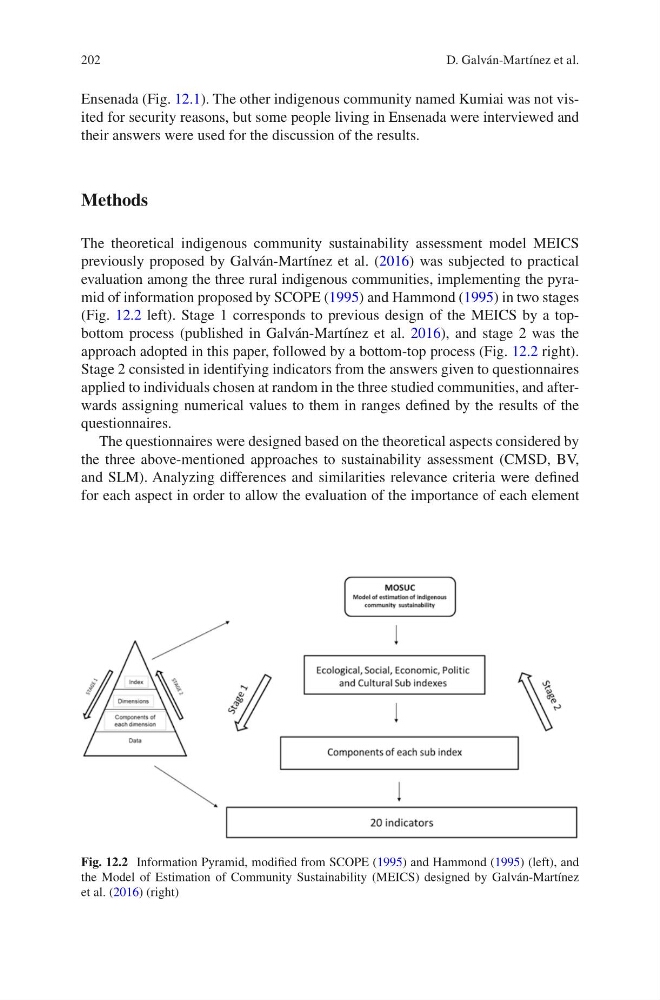
evaluation among the three rural indigenous communities, implementing the pyramid of information proposed by SCOPE (1995) and Hammond (1995) in two stages
(Fig. 12.2 left). Stage 1 corresponds to previous design of the MEICS by a topbottom process (published in Galván-Martínez et al. 2016), and stage 2 was the
approach adopted in this paper, followed by a bottom-top process (Fig. 12.2 right).
Stage 2 consisted in identifying indicators from the answers given to questionnaires
applied to individuals chosen at random in the three studied communities, and afterwards assigning numerical values to them in ranges defined by the results of the
questionnaires.
The questionnaires were designed based on the theoretical aspects considered by
the three above-mentioned approaches to sustainability assessment (CMSD, BV,
and SLM). Analyzing differences and similarities relevance criteria were defined
for each aspect in order to allow the evaluation of the importance of each element
Fig. 12.2 Information Pyramid, modified from SCOPE (1995) and Hammond (1995) (left), and
the Model of Estimation of Community Sustainability (MEICS) designed by Galván-Martínez
et al. (2016) (right)
D. Galván-Martínez et al.
Ensenada (Fig. 12.1). The other indigenous community named Kumiai was not visited for security reasons, but some people living in Ensenada were interviewed and
their answers were used for the discussion of the results.
Methods
The theoretical indigenous community sustainability assessment model MEICS
previously proposed by Galván-Martínez et al. (2016) was subjected to practical
evaluation among the three rural indigenous communities, implementing the pyramid of information proposed by SCOPE (1995) and Hammond (1995) in two stages
(Fig. 12.2 left). Stage 1 corresponds to previous design of the MEICS by a topbottom process (published in Galván-Martínez et al. 2016), and stage 2 was the
approach adopted in this paper, followed by a bottom-top process (Fig. 12.2 right).
Stage 2 consisted in identifying indicators from the answers given to questionnaires
applied to individuals chosen at random in the three studied communities, and afterwards assigning numerical values to them in ranges defined by the results of the
questionnaires.
The questionnaires were designed based on the theoretical aspects considered by
the three above-mentioned approaches to sustainability assessment (CMSD, BV,
and SLM). Analyzing differences and similarities relevance criteria were defined
for each aspect in order to allow the evaluation of the importance of each element
Fig. 12.2 Information Pyramid, modified from SCOPE (1995) and Hammond (1995) (left), and
the Model of Estimation of Community Sustainability (MEICS) designed by Galván-Martínez
et al. (2016) (right)
D. Galván-Martínez et al.