

167
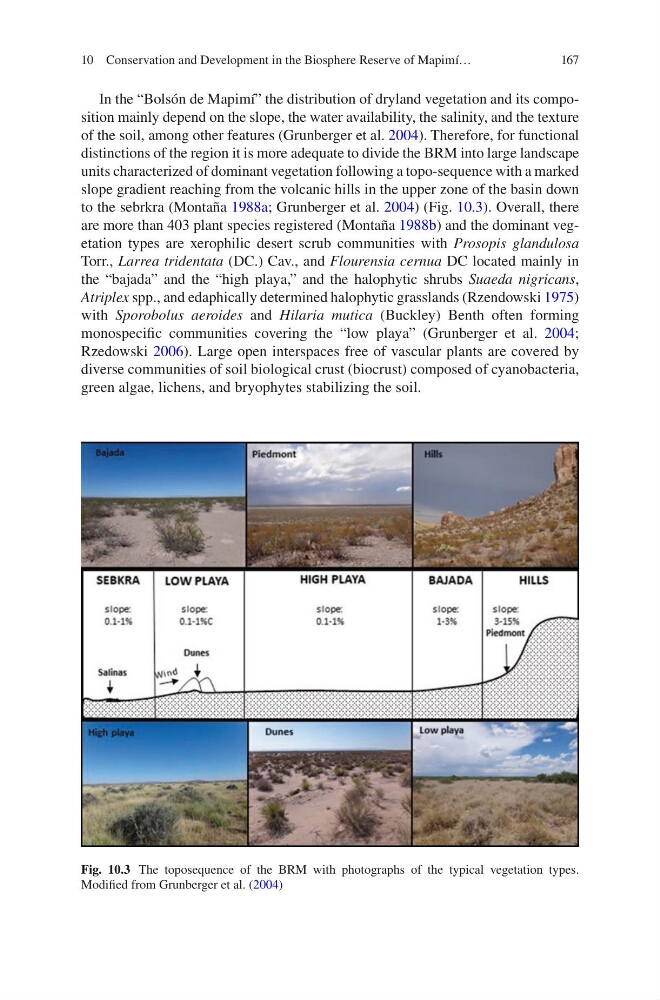
In the “Bolsón de Mapimí” the distribution of dryland vegetation and its composition mainly depend on the slope, the water availability, the salinity, and the texture
of the soil, among other features (Grunberger et al. 2004). Therefore, for functional
distinctions of the region it is more adequate to divide the BRM into large landscape
units characterized of dominant vegetation following a topo-sequence with a marked
slope gradient reaching from the volcanic hills in the upper zone of the basin down
to the sebrkra (Montaña 1988a; Grunberger et al. 2004) (Fig. 10.3). Overall, there
are more than 403 plant species registered (Montaña 1988b) and the dominant vegetation types are xerophilic desert scrub communities with Prosopis glandulosa
Torr., Larrea tridentata (DC.) Cav., and Flourensia cernua DC located mainly in
the “bajada” and the “high playa,” and the halophytic shrubs Suaeda nigricans,
Atriplex spp., and edaphically determined halophytic grasslands (Rzendowski 1975)
with Sporobolus aeroides and Hilaria mutica (Buckley) Benth often forming
monospecific communities covering the “low playa” (Grunberger et al. 2004;
Rzedowski 2006). Large open interspaces free of vascular plants are covered by
diverse communities of soil biological crust (biocrust) composed of cyanobacteria,
green algae, lichens, and bryophytes stabilizing the soil.
Fig. 10.3 The toposequence of the BRM with photographs of the typical vegetation types.
Modified from Grunberger et al. (2004)
10 Conservation and Development in the Biosphere Reserve of Mapimí…
In the “Bolsón de Mapimí” the distribution of dryland vegetation and its composition mainly depend on the slope, the water availability, the salinity, and the texture
of the soil, among other features (Grunberger et al. 2004). Therefore, for functional
distinctions of the region it is more adequate to divide the BRM into large landscape
units characterized of dominant vegetation following a topo-sequence with a marked
slope gradient reaching from the volcanic hills in the upper zone of the basin down
to the sebrkra (Montaña 1988a; Grunberger et al. 2004) (Fig. 10.3). Overall, there
are more than 403 plant species registered (Montaña 1988b) and the dominant vegetation types are xerophilic desert scrub communities with Prosopis glandulosa
Torr., Larrea tridentata (DC.) Cav., and Flourensia cernua DC located mainly in
the “bajada” and the “high playa,” and the halophytic shrubs Suaeda nigricans,
Atriplex spp., and edaphically determined halophytic grasslands (Rzendowski 1975)
with Sporobolus aeroides and Hilaria mutica (Buckley) Benth often forming
monospecific communities covering the “low playa” (Grunberger et al. 2004;
Rzedowski 2006). Large open interspaces free of vascular plants are covered by
diverse communities of soil biological crust (biocrust) composed of cyanobacteria,
green algae, lichens, and bryophytes stabilizing the soil.
Fig. 10.3 The toposequence of the BRM with photographs of the typical vegetation types.
Modified from Grunberger et al. (2004)
10 Conservation and Development in the Biosphere Reserve of Mapimí…