

166
research, development, and education as fundamental pillars in its management
plans (di Castri et al. 1981). Thus, their establishment seeks to bridge the gap
between conservation and development (Kaus 1992). Since 2002, the BRM has
been managed by the National Commission of Protected Natural Areas (CONANP,
by its initials in Spanish), with the dual purpose of conserving the ecosystem while
promoting human development. Thus, this goal generates a complex dynamic
between the conservation policies and the productive activities carried out by the
local inhabitants (Kaus 1993; Toledo 2005). In the BRM there are 11 ejidos (the
Mexican common land tenure system) and three private ranches with a total of
approximately 326 people (CONANP 2006). They live in small isolated settlements; the overall low population density is explained by high emigration rates
mostly due to the lack of opportunities of children education nearby. This SES is
integrated by various forms of land tenure and land use activities that predate the
protected area status and its official establishment.
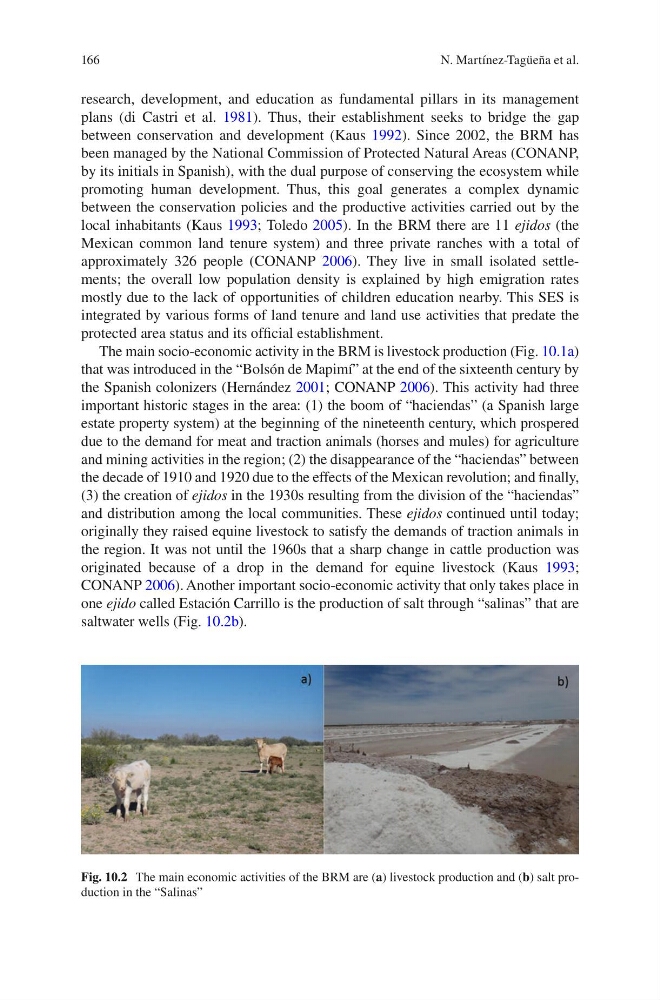
The main socio-economic activity in the BRM is livestock production (Fig. 10.1a)
that was introduced in the “Bolsón de Mapimí” at the end of the sixteenth century by
the Spanish colonizers (Hernández 2001; CONANP 2006). This activity had three
important historic stages in the area: (1) the boom of “haciendas” (a Spanish large
estate property system) at the beginning of the nineteenth century, which prospered
due to the demand for meat and traction animals (horses and mules) for agriculture
and mining activities in the region; (2) the disappearance of the “haciendas” between
the decade of 1910 and 1920 due to the effects of the Mexican revolution; and finally,
(3) the creation of ejidos in the 1930s resulting from the division of the “haciendas”
and distribution among the local communities. These ejidos continued until today;
originally they raised equine livestock to satisfy the demands of traction animals in
the region. It was not until the 1960s that a sharp change in cattle production was
originated because of a drop in the demand for equine livestock (Kaus 1993;
CONANP 2006). Another important socio-economic activity that only takes place in
one ejido called Estación Carrillo is the production of salt through “salinas” that are
saltwater wells (Fig. 10.2b).
Fig. 10.2 The main economic activities of the BRM are (a) livestock production and (b) salt production in the “Salinas”
N. Martínez-Tagüeña et al.
research, development, and education as fundamental pillars in its management
plans (di Castri et al. 1981). Thus, their establishment seeks to bridge the gap
between conservation and development (Kaus 1992). Since 2002, the BRM has
been managed by the National Commission of Protected Natural Areas (CONANP,
by its initials in Spanish), with the dual purpose of conserving the ecosystem while
promoting human development. Thus, this goal generates a complex dynamic
between the conservation policies and the productive activities carried out by the
local inhabitants (Kaus 1993; Toledo 2005). In the BRM there are 11 ejidos (the
Mexican common land tenure system) and three private ranches with a total of
approximately 326 people (CONANP 2006). They live in small isolated settlements; the overall low population density is explained by high emigration rates
mostly due to the lack of opportunities of children education nearby. This SES is
integrated by various forms of land tenure and land use activities that predate the
protected area status and its official establishment.
The main socio-economic activity in the BRM is livestock production (Fig. 10.1a)
that was introduced in the “Bolsón de Mapimí” at the end of the sixteenth century by
the Spanish colonizers (Hernández 2001; CONANP 2006). This activity had three
important historic stages in the area: (1) the boom of “haciendas” (a Spanish large
estate property system) at the beginning of the nineteenth century, which prospered
due to the demand for meat and traction animals (horses and mules) for agriculture
and mining activities in the region; (2) the disappearance of the “haciendas” between
the decade of 1910 and 1920 due to the effects of the Mexican revolution; and finally,
(3) the creation of ejidos in the 1930s resulting from the division of the “haciendas”
and distribution among the local communities. These ejidos continued until today;
originally they raised equine livestock to satisfy the demands of traction animals in
the region. It was not until the 1960s that a sharp change in cattle production was
originated because of a drop in the demand for equine livestock (Kaus 1993;
CONANP 2006). Another important socio-economic activity that only takes place in
one ejido called Estación Carrillo is the production of salt through “salinas” that are
saltwater wells (Fig. 10.2b).
Fig. 10.2 The main economic activities of the BRM are (a) livestock production and (b) salt production in the “Salinas”
N. Martínez-Tagüeña et al.