

168
This region is a closed basin with large extensions of plains that have an average
altitude of 1150 m.a.s.l. (CONANP 2006). In the RBM there are soils of alluvial and
colluvial origin; the most dominant are calcareous regosols, xerosols, yermosols,
and saline vertisols (Delhoume 1992). As in other closed basins, soils of the lower
zones show a high degree of salinity (NaCl and KCl) and in the case of the Estación
Carrillo, important saltwater wells are present and used for salt production (see
Fig. 10.3). The climate of the BRM is BWhw(e) characterized as extreme arid with
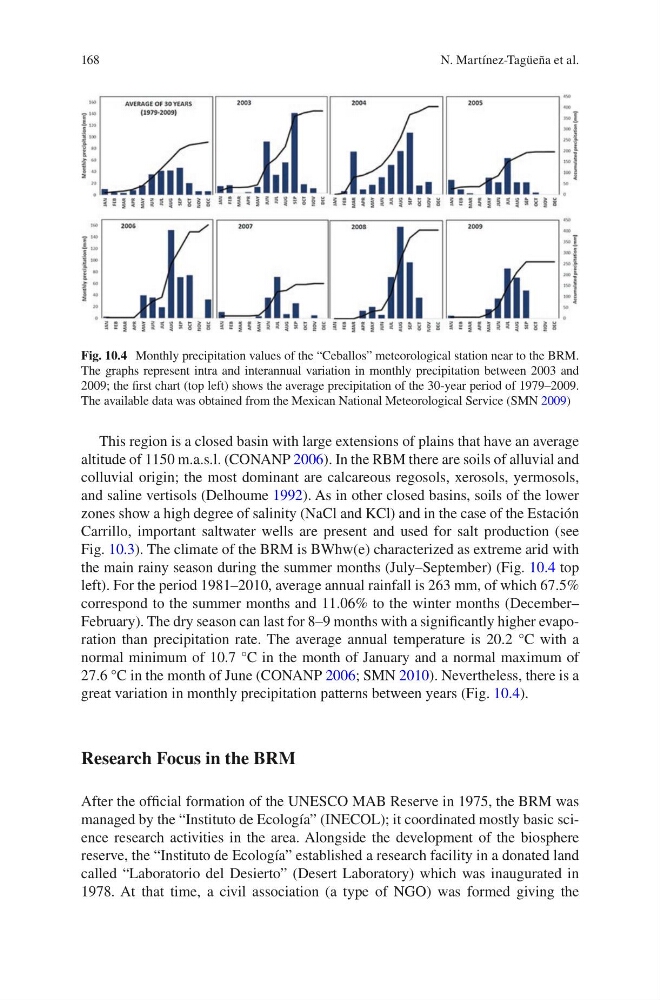
the main rainy season during the summer months (July–September) (Fig. 10.4 top
left). For the period 1981–2010, average annual rainfall is 263 mm, of which 67.5%
correspond to the summer months and 11.06% to the winter months (December–
February). The dry season can last for 8–9 months with a significantly higher evaporation than precipitation rate. The average annual temperature is 20.2 °C with a
normal minimum of 10.7 °C in the month of January and a normal maximum of
27.6 °C in the month of June (CONANP 2006; SMN 2010). Nevertheless, there is a
great variation in monthly precipitation patterns between years (Fig. 10.4).
Research Focus in the BRM
After the official formation of the UNESCO MAB Reserve in 1975, the BRM was
managed by the “Instituto de Ecología” (INECOL); it coordinated mostly basic science research activities in the area. Alongside the development of the biosphere
reserve, the “Instituto de Ecología” established a research facility in a donated land
called “Laboratorio del Desierto” (Desert Laboratory) which was inaugurated in
1978. At that time, a civil association (a type of NGO) was formed giving the
Fig. 10.4 Monthly precipitation values of the “Ceballos” meteorological station near to the BRM.
The graphs represent intra and interannual variation in monthly precipitation between 2003 and
2009; the first chart (top left) shows the average precipitation of the 30-year period of 1979–2009.
The available data was obtained from the Mexican National Meteorological Service (SMN 2009)
N. Martínez-Tagüeña et al.
This region is a closed basin with large extensions of plains that have an average
altitude of 1150 m.a.s.l. (CONANP 2006). In the RBM there are soils of alluvial and
colluvial origin; the most dominant are calcareous regosols, xerosols, yermosols,
and saline vertisols (Delhoume 1992). As in other closed basins, soils of the lower
zones show a high degree of salinity (NaCl and KCl) and in the case of the Estación
Carrillo, important saltwater wells are present and used for salt production (see
Fig. 10.3). The climate of the BRM is BWhw(e) characterized as extreme arid with
the main rainy season during the summer months (July–September) (Fig. 10.4 top
left). For the period 1981–2010, average annual rainfall is 263 mm, of which 67.5%
correspond to the summer months and 11.06% to the winter months (December–
February). The dry season can last for 8–9 months with a significantly higher evaporation than precipitation rate. The average annual temperature is 20.2 °C with a
normal minimum of 10.7 °C in the month of January and a normal maximum of
27.6 °C in the month of June (CONANP 2006; SMN 2010). Nevertheless, there is a
great variation in monthly precipitation patterns between years (Fig. 10.4).
Research Focus in the BRM
After the official formation of the UNESCO MAB Reserve in 1975, the BRM was
managed by the “Instituto de Ecología” (INECOL); it coordinated mostly basic science research activities in the area. Alongside the development of the biosphere
reserve, the “Instituto de Ecología” established a research facility in a donated land
called “Laboratorio del Desierto” (Desert Laboratory) which was inaugurated in
1978. At that time, a civil association (a type of NGO) was formed giving the
Fig. 10.4 Monthly precipitation values of the “Ceballos” meteorological station near to the BRM.
The graphs represent intra and interannual variation in monthly precipitation between 2003 and
2009; the first chart (top left) shows the average precipitation of the 30-year period of 1979–2009.
The available data was obtained from the Mexican National Meteorological Service (SMN 2009)
N. Martínez-Tagüeña et al.