

124
Synthesis
A United Approach
ERIS In general, the advantages of integrating more public participation with
applied research, outreach, policy making, and planning are self-evident. A heightened utility of project outcomes or impacts should improve dryland stewardship.
This unified approach can be consolidated as “Engaged Research within an
Innovation System,” or ERIS for short.
Process Comprehensive approaches like ERIS to integrate the various actors—
from community members to researchers, outreach agents, development specialists,
policy makers, and planners—should be a key feature of a new way of working in
the dry lands. All of these people (and associated institutions) should be part of a
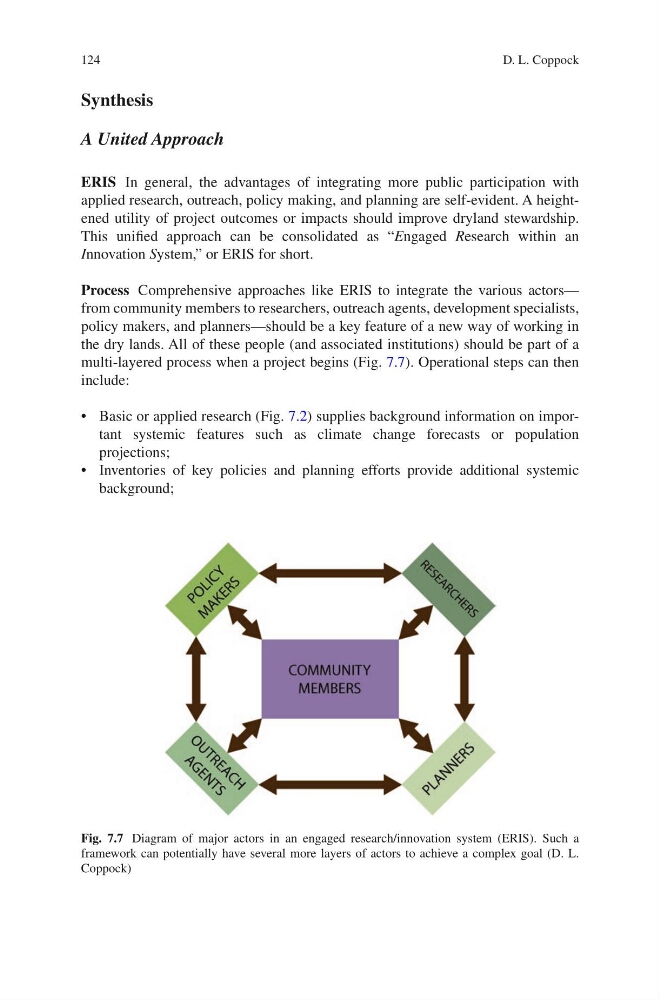
multi-layered process when a project begins (Fig. 7.7). Operational steps can then
include:
• Basic or applied research (Fig. 7.2) supplies background information on important systemic features such as climate change forecasts or population
projections;
• Inventories of key policies and planning efforts provide additional systemic
background;
Fig. 7.7 Diagram of major actors in an engaged research/innovation system (ERIS). Such a
framework can potentially have several more layers of actors to achieve a complex goal (D. L.
Coppock)
D. L. Coppock
Synthesis
A United Approach
ERIS In general, the advantages of integrating more public participation with
applied research, outreach, policy making, and planning are self-evident. A heightened utility of project outcomes or impacts should improve dryland stewardship.
This unified approach can be consolidated as “Engaged Research within an
Innovation System,” or ERIS for short.
Process Comprehensive approaches like ERIS to integrate the various actors—
from community members to researchers, outreach agents, development specialists,
policy makers, and planners—should be a key feature of a new way of working in
the dry lands. All of these people (and associated institutions) should be part of a
multi-layered process when a project begins (Fig. 7.7). Operational steps can then
include:
• Basic or applied research (Fig. 7.2) supplies background information on important systemic features such as climate change forecasts or population
projections;
• Inventories of key policies and planning efforts provide additional systemic
background;
Fig. 7.7 Diagram of major actors in an engaged research/innovation system (ERIS). Such a
framework can potentially have several more layers of actors to achieve a complex goal (D. L.
Coppock)
D. L. Coppock