

125
• An initial membership of an IS can be identified;
• Community engagement begins with PRAs that are conducted across multiple
locations; this can reveal patterns in priority problems and generate hypotheses.
Refinement of potential problem solutions can be assessed across multiple locations using PAR. Once major issues are clarified, an expanded membership of an
IS can be proposed;
• The research process can then morph into other forms of hypothesis testing, followed by a knowledge-to-action mode and/or an engaged research mode
(Fig. 7.2). Feedback loops are solidified to better connect the evolving roster of
the IS;
• Local or regional partnerships within the IS can be expanded depending on
resources and emerging needs; and
• Multiple IS across regions or nations can be connected via a central coordinating
platform; this expands the possibilities for supra-regional or international partnerships, further enlarging the scope for information sharing—and hence
impact—within any given IS.
Potential Pitfalls
While the process of creating an innovation system appears straightforward, in reality it can be difficult (Coppock et al. 2009). First, there usually are no traditions for
the various actors to work closely together, and the transaction costs of doing so can
be a deterrent. Second, lack of continuity among participants is a common challenge. Rapid turnover among key personnel leads to a revolving door; the project
then incurs added costs to recruit and educate new participants. Third, the aforementioned short funding cycles rarely afford enough time to get sufficient momentum to achieve impact. Fourth, inadequate funding levels can undermine collaborative
partnerships given that incentives matter. Some of the most acute trade-offs would
be felt by scientists given that research traditions typically have not involved the
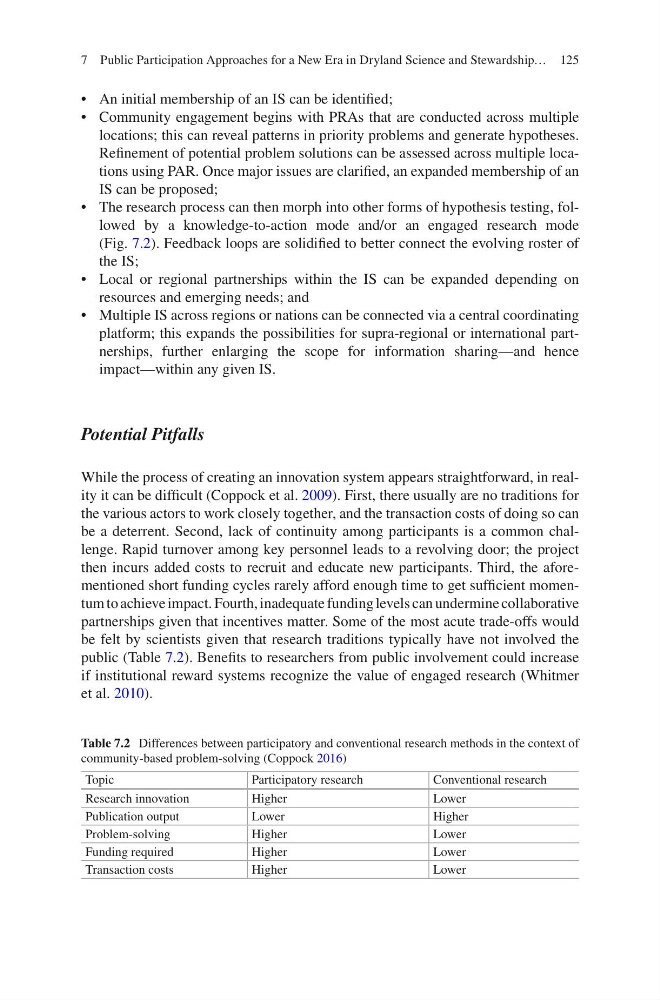
public (Table 7.2). Benefits to researchers from public involvement could increase
if institutional reward systems recognize the value of engaged research (Whitmer
et al. 2010).
Table 7.2 Differences between participatory and conventional research methods in the context of
community-based problem- solving (Coppock 2016)
Topic
Participatory research
Conventional research
Research innovation
Higher
Lower
Publication output
Lower
Higher
Problem-solving
Higher
Lower
Funding required
Higher
Lower
Transaction costs
Higher
Lower
7 Public Participation Approaches for a New Era in Dryland Science and Stewardship…
• An initial membership of an IS can be identified;
• Community engagement begins with PRAs that are conducted across multiple
locations; this can reveal patterns in priority problems and generate hypotheses.
Refinement of potential problem solutions can be assessed across multiple locations using PAR. Once major issues are clarified, an expanded membership of an
IS can be proposed;
• The research process can then morph into other forms of hypothesis testing, followed by a knowledge-to-action mode and/or an engaged research mode
(Fig. 7.2). Feedback loops are solidified to better connect the evolving roster of
the IS;
• Local or regional partnerships within the IS can be expanded depending on
resources and emerging needs; and
• Multiple IS across regions or nations can be connected via a central coordinating
platform; this expands the possibilities for supra-regional or international partnerships, further enlarging the scope for information sharing—and hence
impact—within any given IS.
Potential Pitfalls
While the process of creating an innovation system appears straightforward, in reality it can be difficult (Coppock et al. 2009). First, there usually are no traditions for
the various actors to work closely together, and the transaction costs of doing so can
be a deterrent. Second, lack of continuity among participants is a common challenge. Rapid turnover among key personnel leads to a revolving door; the project
then incurs added costs to recruit and educate new participants. Third, the aforementioned short funding cycles rarely afford enough time to get sufficient momentum to achieve impact. Fourth, inadequate funding levels can undermine collaborative
partnerships given that incentives matter. Some of the most acute trade-offs would
be felt by scientists given that research traditions typically have not involved the
public (Table 7.2). Benefits to researchers from public involvement could increase
if institutional reward systems recognize the value of engaged research (Whitmer
et al. 2010).
Table 7.2 Differences between participatory and conventional research methods in the context of
community-based problem- solving (Coppock 2016)
Topic
Participatory research
Conventional research
Research innovation
Higher
Lower
Publication output
Lower
Higher
Problem-solving
Higher
Lower
Funding required
Higher
Lower
Transaction costs
Higher
Lower
7 Public Participation Approaches for a New Era in Dryland Science and Stewardship…