

122
A successful IS also requires an operating platform for coordination and communication (Sanginga et al. 2009). A platform would organize relevant actors to
facilitate sharing of information and provide frameworks for reporting, analysis,
and planning. Hubs could be nested according to regional locations, and stakeholders could be networked according to local, regional, national, or international
domains.
Public Participation, Policy Making, and Planning
In a new era for dryland science and stewardship, engaged research leads to technical, management, or policy interventions that are climate-smart and help make communities more sustainable. This could be at local or regional scales. Outreach or
extension are processes that directly inform research and make research products
more useful and relevant. It is thus obvious that engaged research requires strong
connections to outreach or extension.
What is less obvious, however, is that policy making and planning should also be
part of an integrated process from the start. For example, integrated research and
outreach can identify needs for policy changes that govern the use of innovations.
Policy recommendations can therefore emerge from engaged research. The challenge is to do research or outreach that is relevant to policy and planning; this happens by bringing policy makers and planners into a project loop at the beginning.
Researchers, outreach practitioners, or community members may otherwise only be
dimly aware as to how national policies or regional plans affect current or future
circumstances for their projects.
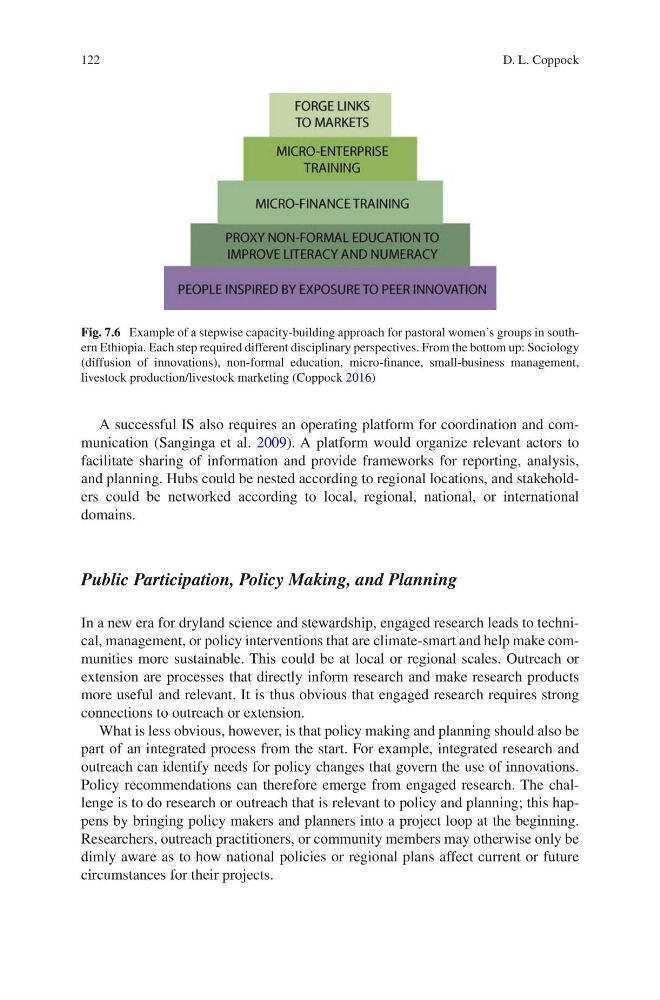
Fig. 7.6 Example of a stepwise capacity-building approach for pastoral women’s groups in southern Ethiopia. Each step required different disciplinary perspectives. From the bottom up: Sociology
(diffusion of innovations), non-formal education, micro-finance, small-business management,
livestock production/livestock marketing (Coppock 2016)
D. L. Coppock
A successful IS also requires an operating platform for coordination and communication (Sanginga et al. 2009). A platform would organize relevant actors to
facilitate sharing of information and provide frameworks for reporting, analysis,
and planning. Hubs could be nested according to regional locations, and stakeholders could be networked according to local, regional, national, or international
domains.
Public Participation, Policy Making, and Planning
In a new era for dryland science and stewardship, engaged research leads to technical, management, or policy interventions that are climate-smart and help make communities more sustainable. This could be at local or regional scales. Outreach or
extension are processes that directly inform research and make research products
more useful and relevant. It is thus obvious that engaged research requires strong
connections to outreach or extension.
What is less obvious, however, is that policy making and planning should also be
part of an integrated process from the start. For example, integrated research and
outreach can identify needs for policy changes that govern the use of innovations.
Policy recommendations can therefore emerge from engaged research. The challenge is to do research or outreach that is relevant to policy and planning; this happens by bringing policy makers and planners into a project loop at the beginning.
Researchers, outreach practitioners, or community members may otherwise only be
dimly aware as to how national policies or regional plans affect current or future
circumstances for their projects.
Fig. 7.6 Example of a stepwise capacity-building approach for pastoral women’s groups in southern Ethiopia. Each step required different disciplinary perspectives. From the bottom up: Sociology
(diffusion of innovations), non-formal education, micro-finance, small-business management,
livestock production/livestock marketing (Coppock 2016)
D. L. Coppock