

121
of a successful IS requires centralized leadership and vision. Use of IS in rural, agricultural contexts has been limited (Sanginga et al. 2009). More long-term field testing
and team learning must occur before best practices can be verified. As with PRA or
PAR, advocates for IS affirm that creative solutions for problem- solving require coproduction of knowledge from among diverse stakeholders (Waters-Bayer et al. 2009).
A good dryland example of using an IS can be found in Coppock et al. (2009).
Problem solutions discovered using an IS may not be rooted in new technology,
but rather in policies or processes that empower people by building human or social
capital. An example of a change process from southern Ethiopia illustrates how
pastoral women were empowered to improve household resilience by reducing poverty (Fig. 7.6). Each step required a different disciplinary lens as well as a different
suite of facilitating IS actors. An IS can thus promote transdisciplinary work.
A successful IS should be a long-term commitment because trust and learning
pathways need to be established among stakeholders. While what constitutes “long
term” is open to debate, it certainly is longer than the three-year grant periods that
typically characterize donor programs. An IS will have a life cycle (i.e., birth, growth,
death; Coppock et al. 2009). Stakeholder incentives are needed to maintain an IS.
17
17 An IS supporting a pastoral women’s empowerment program in southern Ethiopia existed for
10 years. The IS grew from a few members in 1999 to a peak of 70 by 2006, and then declined as
activities wrapped up by 2009 (D. L. Coppock, personal observations). Once project funding
ended after 2009 the IS quickly disappeared. Collaboration thus depended on funding incentives.
The good news is that the women’s empowerment program endured. The IS thus played an essential—but temporary—role in this capacity-building process. It is also noteworthy that for this project it was never originally planned to create an IS, it simply happened out of necessity to create a
development pathway. Each actor in the IS was needed to help create the final product.
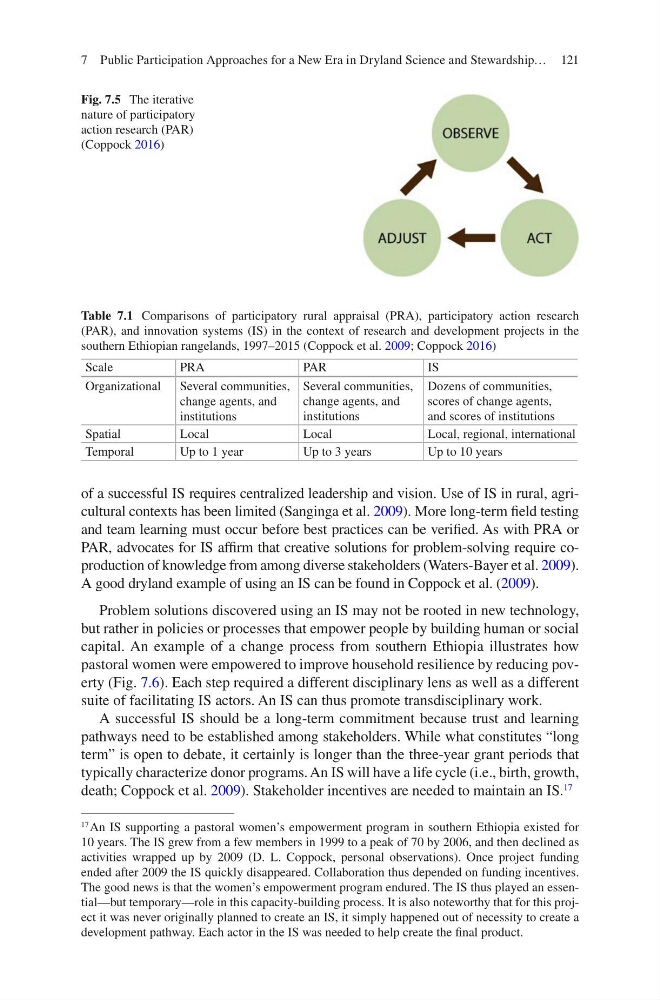
Fig. 7.5 The iterative
nature of participatory
action research (PAR)
(Coppock 2016)
Table 7.1 Comparisons of participatory rural appraisal (PRA), participatory action research
(PAR), and innovation systems (IS) in the context of research and development projects in the
southern Ethiopian rangelands, 1997–2015 (Coppock et al. 2009; Coppock 2016)
Scale
PRA
PAR
IS
Organizational Several communities,
change agents, and
institutions
Several communities,
change agents, and
institutions
Dozens of communities,
scores of change agents,
and scores of institutions
Spatial
Local
Local
Local, regional, international
Temporal
Up to 1 year
Up to 3 years
Up to 10 years
7 Public Participation Approaches for a New Era in Dryland Science and Stewardship…
of a successful IS requires centralized leadership and vision. Use of IS in rural, agricultural contexts has been limited (Sanginga et al. 2009). More long-term field testing
and team learning must occur before best practices can be verified. As with PRA or
PAR, advocates for IS affirm that creative solutions for problem- solving require coproduction of knowledge from among diverse stakeholders (Waters-Bayer et al. 2009).
A good dryland example of using an IS can be found in Coppock et al. (2009).
Problem solutions discovered using an IS may not be rooted in new technology,
but rather in policies or processes that empower people by building human or social
capital. An example of a change process from southern Ethiopia illustrates how
pastoral women were empowered to improve household resilience by reducing poverty (Fig. 7.6). Each step required a different disciplinary lens as well as a different
suite of facilitating IS actors. An IS can thus promote transdisciplinary work.
A successful IS should be a long-term commitment because trust and learning
pathways need to be established among stakeholders. While what constitutes “long
term” is open to debate, it certainly is longer than the three-year grant periods that
typically characterize donor programs. An IS will have a life cycle (i.e., birth, growth,
death; Coppock et al. 2009). Stakeholder incentives are needed to maintain an IS.
17
17 An IS supporting a pastoral women’s empowerment program in southern Ethiopia existed for
10 years. The IS grew from a few members in 1999 to a peak of 70 by 2006, and then declined as
activities wrapped up by 2009 (D. L. Coppock, personal observations). Once project funding
ended after 2009 the IS quickly disappeared. Collaboration thus depended on funding incentives.
The good news is that the women’s empowerment program endured. The IS thus played an essential—but temporary—role in this capacity-building process. It is also noteworthy that for this project it was never originally planned to create an IS, it simply happened out of necessity to create a
development pathway. Each actor in the IS was needed to help create the final product.
Fig. 7.5 The iterative
nature of participatory
action research (PAR)
(Coppock 2016)
Table 7.1 Comparisons of participatory rural appraisal (PRA), participatory action research
(PAR), and innovation systems (IS) in the context of research and development projects in the
southern Ethiopian rangelands, 1997–2015 (Coppock et al. 2009; Coppock 2016)
Scale
PRA
PAR
IS
Organizational Several communities,
change agents, and
institutions
Several communities,
change agents, and
institutions
Dozens of communities,
scores of change agents,
and scores of institutions
Spatial
Local
Local
Local, regional, international
Temporal
Up to 1 year
Up to 3 years
Up to 10 years
7 Public Participation Approaches for a New Era in Dryland Science and Stewardship…