

For NO X , the emission factors of coal-fired power plants, expressed as the mass
of NO 2 per unit consumption of coal, varied little from 2005 to 2010, due to the
limited addition of SCR/SNCR technology. Evaluated as NO 2 per unit of electricity
output, in contrast, the emission factor declined by 12% attributed mainly to the
improved energy efficiency of power generation. After 2010, SCR began to be
widely applied, leading to reduced NO X emission factor, particularly for STD
case. The emission factor was estimated to decline by 42% and 63% in PRI and
STD cases, respectively, from 2010 and 2014, as indicated in Fig. 14.1a.
14.2.1.2 Cement Industry
Cement kiln technologies in China include precalciner (the most energy-efficient
technology), shaft, and other rotary kilns. As shown in Fig. 14.1b, the fraction of
precalciner kilns have grown from 13% to 91% during 2000–2014. Lei et al. (2011b)
compiled the emission factors of cement production by technology. Smaller
0%
20%
40%
60%
80%
100%
2000 2001 2002 2003 2004 2005 2006 2007 2008 2009 2010 2011 2012 2013 2014
n
o
i
t
a
r
t
e
n
e
p
y
g
o
l
o
n
h
c
e
T
1
0%
20%
40%
60%
80%
100%
120%
EF relative to 2000 level1
Pre National I
National I
II
III
IV (and stricter)
(d)
0%
20%
40%
60%
80%
100%
2000 2001 2002 2003 2004 2005 2006 2007 2008 2009 2010 2011 2012 2013 2014
n
o
i
t
a
r
t
e
n
e
p
y
g
o
l
o
n
h
c
e
T
1
0%
20%
40%
60%
80%
100%
120%
EF relative to 2000 level1
Pre National I
National I
II
III
IV (and stricter)
\
(e)
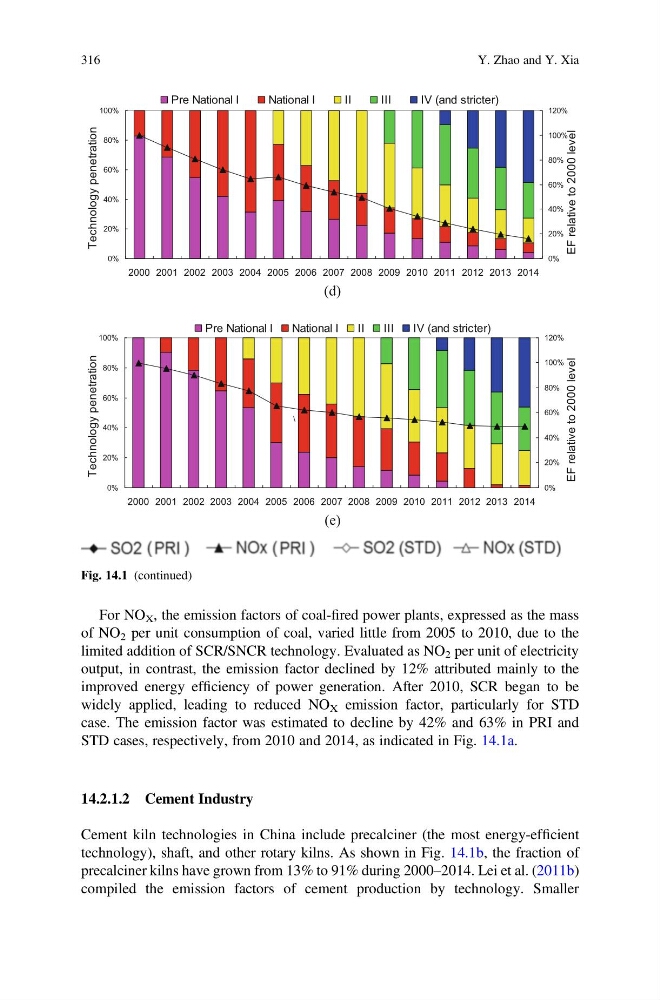
Fig. 14.1 (continued)
316
Y. Zhao and Y. Xia
of NO 2 per unit consumption of coal, varied little from 2005 to 2010, due to the
limited addition of SCR/SNCR technology. Evaluated as NO 2 per unit of electricity
output, in contrast, the emission factor declined by 12% attributed mainly to the
improved energy efficiency of power generation. After 2010, SCR began to be
widely applied, leading to reduced NO X emission factor, particularly for STD
case. The emission factor was estimated to decline by 42% and 63% in PRI and
STD cases, respectively, from 2010 and 2014, as indicated in Fig. 14.1a.
14.2.1.2 Cement Industry
Cement kiln technologies in China include precalciner (the most energy-efficient
technology), shaft, and other rotary kilns. As shown in Fig. 14.1b, the fraction of
precalciner kilns have grown from 13% to 91% during 2000–2014. Lei et al. (2011b)
compiled the emission factors of cement production by technology. Smaller
0%
20%
40%
60%
80%
100%
2000 2001 2002 2003 2004 2005 2006 2007 2008 2009 2010 2011 2012 2013 2014
n
o
i
t
a
r
t
e
n
e
p
y
g
o
l
o
n
h
c
e
T
1
0%
20%
40%
60%
80%
100%
120%
EF relative to 2000 level1
Pre National I
National I
II
III
IV (and stricter)
(d)
0%
20%
40%
60%
80%
100%
2000 2001 2002 2003 2004 2005 2006 2007 2008 2009 2010 2011 2012 2013 2014
n
o
i
t
a
r
t
e
n
e
p
y
g
o
l
o
n
h
c
e
T
1
0%
20%
40%
60%
80%
100%
120%
EF relative to 2000 level1
Pre National I
National I
II
III
IV (and stricter)
\
(e)
Fig. 14.1 (continued)
316
Y. Zhao and Y. Xia