

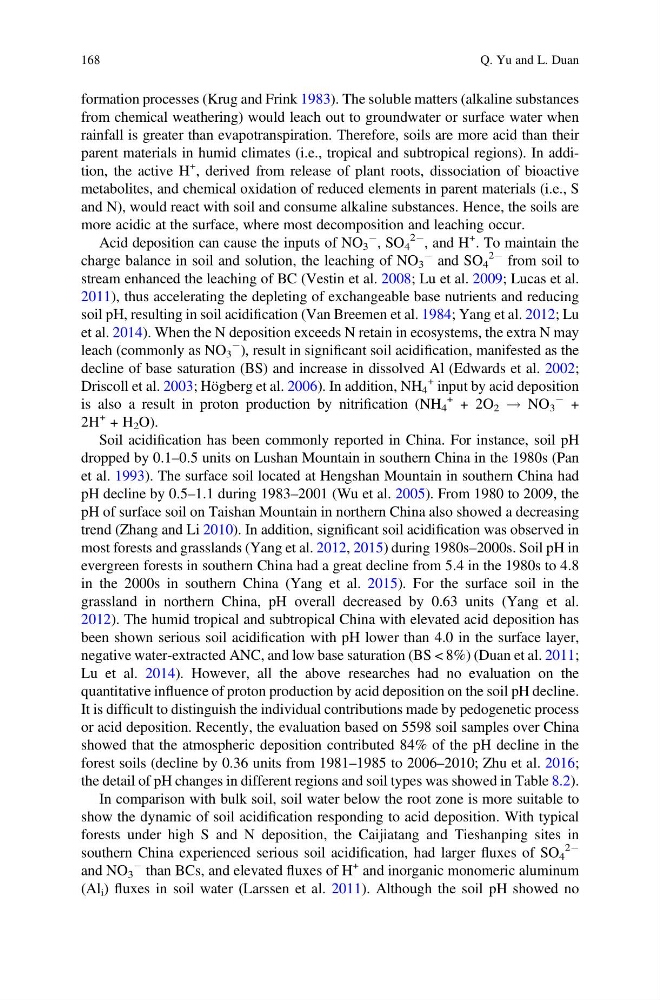
formation processes (Krug and Frink 1983). The soluble matters (alkaline substances
from chemical weathering) would leach out to groundwater or surface water when
rainfall is greater than evapotranspiration. Therefore, soils are more acid than their
parent materials in humid climates (i.e., tropical and subtropical regions). In addition, the active H
+ , derived from release of plant roots, dissociation of bioactive
metabolites, and chemical oxidation of reduced elements in parent materials (i.e., S
and N), would react with soil and consume alkaline substances. Hence, the soils are
more acidic at the surface, where most decomposition and leaching occur.
Acid deposition can cause the inputs of NO 3
À , SO 4
2À
, and H
+ . To maintain the
charge balance in soil and solution, the leaching of NO 3
À and SO 4
2À from soil to
stream enhanced the leaching of BC (Vestin et al. 2008; Lu et al. 2009; Lucas et al.
2011), thus accelerating the depleting of exchangeable base nutrients and reducing
soil pH, resulting in soil acidification (Van Breemen et al. 1984; Yang et al. 2012; Lu
et al. 2014). When the N deposition exceeds N retain in ecosystems, the extra N may
leach (commonly as NO 3
À ), result in significant soil acidification, manifested as the
decline of base saturation (BS) and increase in dissolved Al (Edwards et al. 2002;
Driscoll et al. 2003; Högberg et al. 2006). In addition, NH 4
+ input by acid deposition
is also a result in proton production by nitrification (NH 4
+ + 2O 2 ! NO 3
À +
2H
+ + H 2 O).
Soil acidification has been commonly reported in China. For instance, soil pH
dropped by 0.1–0.5 units on Lushan Mountain in southern China in the 1980s (Pan
et al. 1993). The surface soil located at Hengshan Mountain in southern China had
pH decline by 0.5–1.1 during 1983–2001 (Wu et al. 2005). From 1980 to 2009, the
pH of surface soil on Taishan Mountain in northern China also showed a decreasing
trend (Zhang and Li 2010). In addition, significant soil acidification was observed in
most forests and grasslands (Yang et al. 2012, 2015) during 1980s–2000s. Soil pH in
evergreen forests in southern China had a great decline from 5.4 in the 1980s to 4.8
in the 2000s in southern China (Yang et al. 2015). For the surface soil in the
grassland in northern China, pH overall decreased by 0.63 units (Yang et al.
2012). The humid tropical and subtropical China with elevated acid deposition has
been shown serious soil acidification with pH lower than 4.0 in the surface layer,
negative water-extracted ANC, and low base saturation (BS < 8%) (Duan et al. 2011;
Lu et al. 2014). However, all the above researches had no evaluation on the
quantitative influence of proton production by acid deposition on the soil pH decline.
It is difficult to distinguish the individual contributions made by pedogenetic process
or acid deposition. Recently, the evaluation based on 5598 soil samples over China
showed that the atmospheric deposition contributed 84% of the pH decline in the
forest soils (decline by 0.36 units from 1981–1985 to 2006–2010; Zhu et al. 2016;
the detail of pH changes in different regions and soil types was showed in Table 8.2).
In comparison with bulk soil, soil water below the root zone is more suitable to
show the dynamic of soil acidification responding to acid deposition. With typical
forests under high S and N deposition, the Caijiatang and Tieshanping sites in
southern China experienced serious soil acidification, had larger fluxes of SO 4
2À
and NO 3
À than BCs, and elevated fluxes of H
+ and inorganic monomeric aluminum
(Al i ) fluxes in soil water (Larssen et al. 2011). Although the soil pH showed no
168
Q. Yu and L. Duan
from chemical weathering) would leach out to groundwater or surface water when
rainfall is greater than evapotranspiration. Therefore, soils are more acid than their
parent materials in humid climates (i.e., tropical and subtropical regions). In addition, the active H
+ , derived from release of plant roots, dissociation of bioactive
metabolites, and chemical oxidation of reduced elements in parent materials (i.e., S
and N), would react with soil and consume alkaline substances. Hence, the soils are
more acidic at the surface, where most decomposition and leaching occur.
Acid deposition can cause the inputs of NO 3
À , SO 4
2À
, and H
+ . To maintain the
charge balance in soil and solution, the leaching of NO 3
À and SO 4
2À from soil to
stream enhanced the leaching of BC (Vestin et al. 2008; Lu et al. 2009; Lucas et al.
2011), thus accelerating the depleting of exchangeable base nutrients and reducing
soil pH, resulting in soil acidification (Van Breemen et al. 1984; Yang et al. 2012; Lu
et al. 2014). When the N deposition exceeds N retain in ecosystems, the extra N may
leach (commonly as NO 3
À ), result in significant soil acidification, manifested as the
decline of base saturation (BS) and increase in dissolved Al (Edwards et al. 2002;
Driscoll et al. 2003; Högberg et al. 2006). In addition, NH 4
+ input by acid deposition
is also a result in proton production by nitrification (NH 4
+ + 2O 2 ! NO 3
À +
2H
+ + H 2 O).
Soil acidification has been commonly reported in China. For instance, soil pH
dropped by 0.1–0.5 units on Lushan Mountain in southern China in the 1980s (Pan
et al. 1993). The surface soil located at Hengshan Mountain in southern China had
pH decline by 0.5–1.1 during 1983–2001 (Wu et al. 2005). From 1980 to 2009, the
pH of surface soil on Taishan Mountain in northern China also showed a decreasing
trend (Zhang and Li 2010). In addition, significant soil acidification was observed in
most forests and grasslands (Yang et al. 2012, 2015) during 1980s–2000s. Soil pH in
evergreen forests in southern China had a great decline from 5.4 in the 1980s to 4.8
in the 2000s in southern China (Yang et al. 2015). For the surface soil in the
grassland in northern China, pH overall decreased by 0.63 units (Yang et al.
2012). The humid tropical and subtropical China with elevated acid deposition has
been shown serious soil acidification with pH lower than 4.0 in the surface layer,
negative water-extracted ANC, and low base saturation (BS < 8%) (Duan et al. 2011;
Lu et al. 2014). However, all the above researches had no evaluation on the
quantitative influence of proton production by acid deposition on the soil pH decline.
It is difficult to distinguish the individual contributions made by pedogenetic process
or acid deposition. Recently, the evaluation based on 5598 soil samples over China
showed that the atmospheric deposition contributed 84% of the pH decline in the
forest soils (decline by 0.36 units from 1981–1985 to 2006–2010; Zhu et al. 2016;
the detail of pH changes in different regions and soil types was showed in Table 8.2).
In comparison with bulk soil, soil water below the root zone is more suitable to
show the dynamic of soil acidification responding to acid deposition. With typical
forests under high S and N deposition, the Caijiatang and Tieshanping sites in
southern China experienced serious soil acidification, had larger fluxes of SO 4
2À
and NO 3
À than BCs, and elevated fluxes of H
+ and inorganic monomeric aluminum
(Al i ) fluxes in soil water (Larssen et al. 2011). Although the soil pH showed no
168
Q. Yu and L. Duan