

7.3 Spatial-Temporal Pattern of NO x Emission Over China
Nitrogen dioxide (NO 2 ) and nitrogen oxide (NO), often combined under a general
name nitrogen oxides (NO x ), are present in the atmosphere as gas in trace amounts
and have short life period. Yet, they are very active participants in O 3 formation
(Seinfeld and Pandis 2006). Anthropogenic activities, especially usage and consumption of fossil fuel, are the major contributors to NO x in the atmosphere
especially at high concentrations of NO x near or around densely populated urban
and suburban/rural industrial areas as well as around power plants.
China is one of the major contributors to atmospheric NO x pollution in the world
as it contributes to ~18% of the global NO x emissions (EDGAR 4.2, EC-JRC/PBL
2011). China’s NO x release increased 1.5 times from 1980 to 1995 as Chinese GDP
was increasing by 10% annually during the same time frame (Klimont et al. 2009).
Because of Asian economy crisis, NO x emissions started to decline in 1996 and
continued to decrease till 2000. Utilization of coal relative to the total energy
consumption decreased from 77% to 71%, which was reflected in NO x emission
reduction during the 1996–2000 period (Hao et al. 2002; NBS 2010). After the
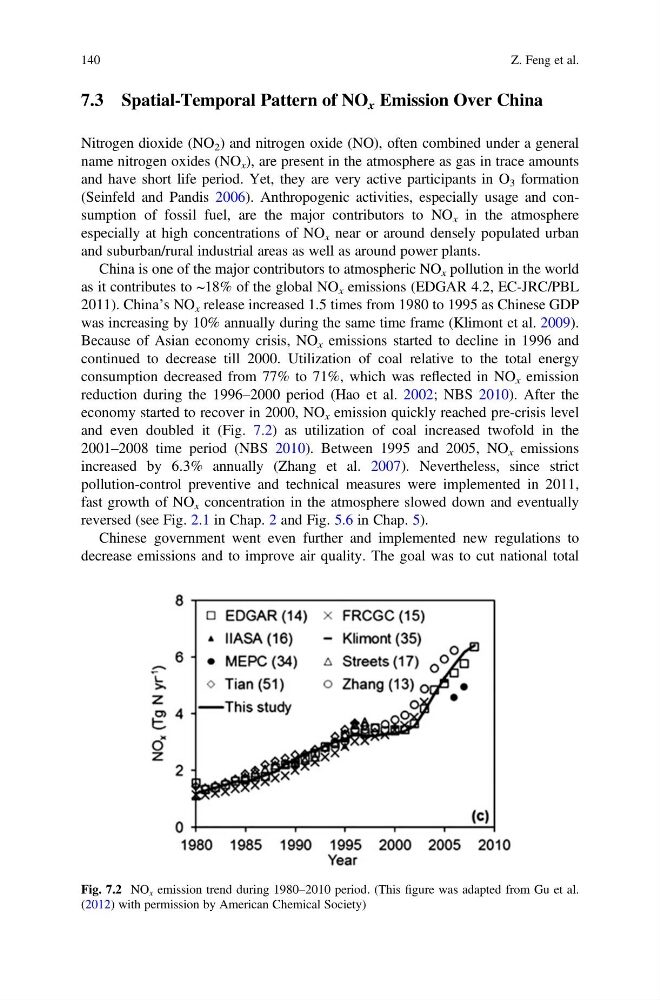
economy started to recover in 2000, NO x emission quickly reached pre-crisis level
and even doubled it (Fig. 7.2) as utilization of coal increased twofold in the
2001–2008 time period (NBS 2010). Between 1995 and 2005, NO x emissions
increased by 6.3% annually (Zhang et al. 2007). Nevertheless, since strict
pollution-control preventive and technical measures were implemented in 2011,
fast growth of NO x concentration in the atmosphere slowed down and eventually
reversed (see Fig. 2.1 in Chap. 2 and Fig. 5.6 in Chap. 5).
Chinese government went even further and implemented new regulations to
decrease emissions and to improve air quality. The goal was to cut national total
Fig. 7.2 NO x emission trend during 1980–2010 period. (This figure was adapted from Gu et al.
(2012) with permission by American Chemical Society)
140
Z. Feng et al.
Nitrogen dioxide (NO 2 ) and nitrogen oxide (NO), often combined under a general
name nitrogen oxides (NO x ), are present in the atmosphere as gas in trace amounts
and have short life period. Yet, they are very active participants in O 3 formation
(Seinfeld and Pandis 2006). Anthropogenic activities, especially usage and consumption of fossil fuel, are the major contributors to NO x in the atmosphere
especially at high concentrations of NO x near or around densely populated urban
and suburban/rural industrial areas as well as around power plants.
China is one of the major contributors to atmospheric NO x pollution in the world
as it contributes to ~18% of the global NO x emissions (EDGAR 4.2, EC-JRC/PBL
2011). China’s NO x release increased 1.5 times from 1980 to 1995 as Chinese GDP
was increasing by 10% annually during the same time frame (Klimont et al. 2009).
Because of Asian economy crisis, NO x emissions started to decline in 1996 and
continued to decrease till 2000. Utilization of coal relative to the total energy
consumption decreased from 77% to 71%, which was reflected in NO x emission
reduction during the 1996–2000 period (Hao et al. 2002; NBS 2010). After the
economy started to recover in 2000, NO x emission quickly reached pre-crisis level
and even doubled it (Fig. 7.2) as utilization of coal increased twofold in the
2001–2008 time period (NBS 2010). Between 1995 and 2005, NO x emissions
increased by 6.3% annually (Zhang et al. 2007). Nevertheless, since strict
pollution-control preventive and technical measures were implemented in 2011,
fast growth of NO x concentration in the atmosphere slowed down and eventually
reversed (see Fig. 2.1 in Chap. 2 and Fig. 5.6 in Chap. 5).
Chinese government went even further and implemented new regulations to
decrease emissions and to improve air quality. The goal was to cut national total
Fig. 7.2 NO x emission trend during 1980–2010 period. (This figure was adapted from Gu et al.
(2012) with permission by American Chemical Society)
140
Z. Feng et al.