

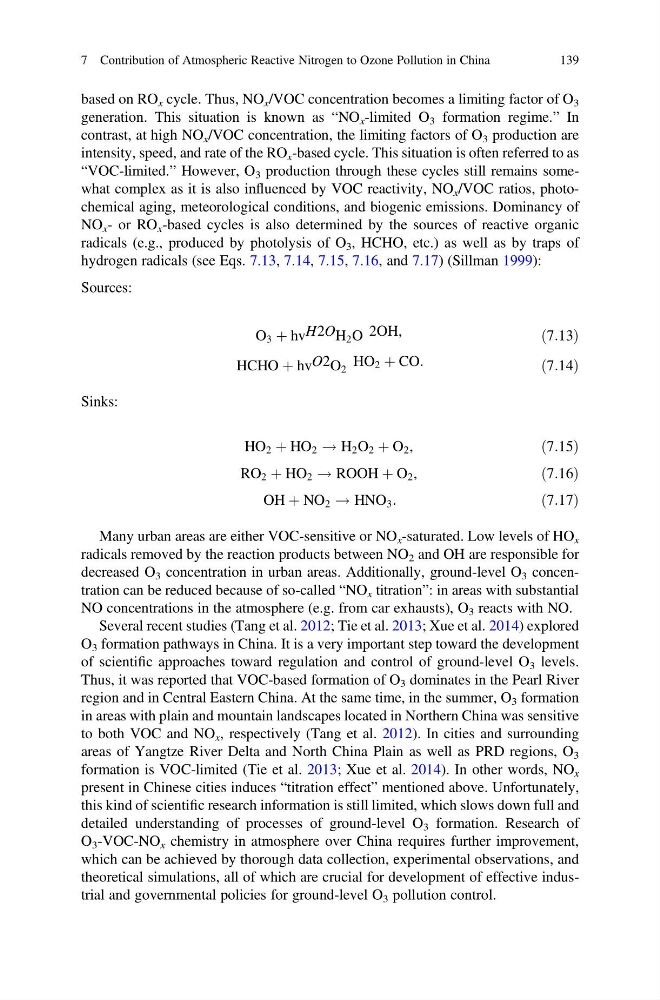
based on RO x cycle. Thus, NO x /VOC concentration becomes a limiting factor of O 3
generation. This situation is known as “NO x -limited O 3 formation regime.” In
contrast, at high NO x /VOC concentration, the limiting factors of O 3 production are
intensity, speed, and rate of the RO x -based cycle. This situation is often referred to as
“VOC-limited.” However, O 3 production through these cycles still remains somewhat complex as it is also influenced by VOC reactivity, NO x /VOC ratios, photochemical aging, meteorological conditions, and biogenic emissions. Dominancy of
NO x - or RO x -based cycles is also determined by the sources of reactive organic
radicals (e.g., produced by photolysis of O 3 , HCHO, etc.) as well as by traps of
hydrogen radicals (see Eqs. 7.13, 7.14, 7.15, 7.16, and 7.17) (Sillman 1999):
Sources:
O 3 þ hv H2O H 2 O 2OH,
ð7:13Þ
HCHO þ hv O2 O 2 HO 2 þ CO:
ð7:14Þ
Sinks:
HO 2 þ HO 2 ! H 2 O 2 þ O 2 ,
ð7:15Þ
RO 2 þ HO 2 ! ROOH þ O 2 ,
ð7:16Þ
OH þ NO 2 ! HNO 3 :
ð7:17Þ
Many urban areas are either VOC-sensitive or NO x -saturated. Low levels of HO x
radicals removed by the reaction products between NO 2 and OH are responsible for
decreased O 3 concentration in urban areas. Additionally, ground-level O 3 concentration can be reduced because of so-called “NO x titration”: in areas with substantial
NO concentrations in the atmosphere (e.g. from car exhausts), O 3 reacts with NO.
Several recent studies (Tang et al. 2012; Tie et al. 2013; Xue et al. 2014) explored
O 3 formation pathways in China. It is a very important step toward the development
of scientific approaches toward regulation and control of ground-level O 3 levels.
Thus, it was reported that VOC-based formation of O 3 dominates in the Pearl River
region and in Central Eastern China. At the same time, in the summer, O 3 formation
in areas with plain and mountain landscapes located in Northern China was sensitive
to both VOC and NO x , respectively (Tang et al. 2012). In cities and surrounding
areas of Yangtze River Delta and North China Plain as well as PRD regions, O 3
formation is VOC-limited (Tie et al. 2013; Xue et al. 2014). In other words, NO x
present in Chinese cities induces “titration effect” mentioned above. Unfortunately,
this kind of scientific research information is still limited, which slows down full and
detailed understanding of processes of ground-level O 3 formation. Research of
O 3 -VOC-NO x chemistry in atmosphere over China requires further improvement,
which can be achieved by thorough data collection, experimental observations, and
theoretical simulations, all of which are crucial for development of effective industrial and governmental policies for ground-level O 3 pollution control.
7 Contribution of Atmospheric Reactive Nitrogen to Ozone Pollution in China
139
generation. This situation is known as “NO x -limited O 3 formation regime.” In
contrast, at high NO x /VOC concentration, the limiting factors of O 3 production are
intensity, speed, and rate of the RO x -based cycle. This situation is often referred to as
“VOC-limited.” However, O 3 production through these cycles still remains somewhat complex as it is also influenced by VOC reactivity, NO x /VOC ratios, photochemical aging, meteorological conditions, and biogenic emissions. Dominancy of
NO x - or RO x -based cycles is also determined by the sources of reactive organic
radicals (e.g., produced by photolysis of O 3 , HCHO, etc.) as well as by traps of
hydrogen radicals (see Eqs. 7.13, 7.14, 7.15, 7.16, and 7.17) (Sillman 1999):
Sources:
O 3 þ hv H2O H 2 O 2OH,
ð7:13Þ
HCHO þ hv O2 O 2 HO 2 þ CO:
ð7:14Þ
Sinks:
HO 2 þ HO 2 ! H 2 O 2 þ O 2 ,
ð7:15Þ
RO 2 þ HO 2 ! ROOH þ O 2 ,
ð7:16Þ
OH þ NO 2 ! HNO 3 :
ð7:17Þ
Many urban areas are either VOC-sensitive or NO x -saturated. Low levels of HO x
radicals removed by the reaction products between NO 2 and OH are responsible for
decreased O 3 concentration in urban areas. Additionally, ground-level O 3 concentration can be reduced because of so-called “NO x titration”: in areas with substantial
NO concentrations in the atmosphere (e.g. from car exhausts), O 3 reacts with NO.
Several recent studies (Tang et al. 2012; Tie et al. 2013; Xue et al. 2014) explored
O 3 formation pathways in China. It is a very important step toward the development
of scientific approaches toward regulation and control of ground-level O 3 levels.
Thus, it was reported that VOC-based formation of O 3 dominates in the Pearl River
region and in Central Eastern China. At the same time, in the summer, O 3 formation
in areas with plain and mountain landscapes located in Northern China was sensitive
to both VOC and NO x , respectively (Tang et al. 2012). In cities and surrounding
areas of Yangtze River Delta and North China Plain as well as PRD regions, O 3
formation is VOC-limited (Tie et al. 2013; Xue et al. 2014). In other words, NO x
present in Chinese cities induces “titration effect” mentioned above. Unfortunately,
this kind of scientific research information is still limited, which slows down full and
detailed understanding of processes of ground-level O 3 formation. Research of
O 3 -VOC-NO x chemistry in atmosphere over China requires further improvement,
which can be achieved by thorough data collection, experimental observations, and
theoretical simulations, all of which are crucial for development of effective industrial and governmental policies for ground-level O 3 pollution control.
7 Contribution of Atmospheric Reactive Nitrogen to Ozone Pollution in China
139