

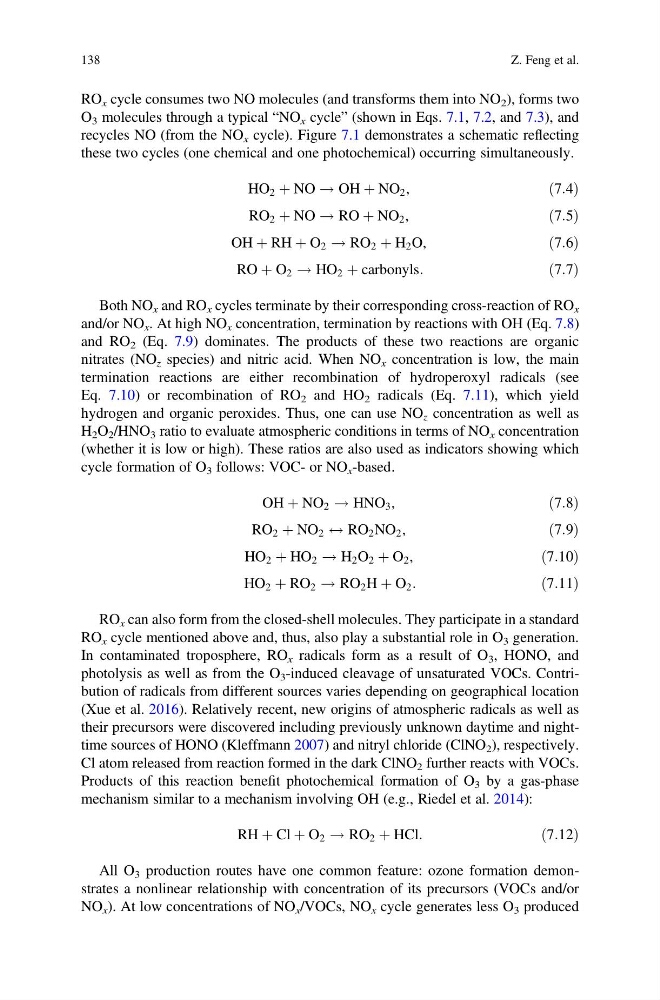
RO x cycle consumes two NO molecules (and transforms them into NO 2 ), forms two
O 3 molecules through a typical “NO x cycle” (shown in Eqs. 7.1, 7.2, and 7.3), and
recycles NO (from the NO x cycle). Figure 7.1 demonstrates a schematic reflecting
these two cycles (one chemical and one photochemical) occurring simultaneously.
HO 2 þ NO ! OH þ NO 2 ,
ð7:4Þ
RO 2 þ NO ! RO þ NO 2 ,
ð7:5Þ
OH þ RH þ O 2 ! RO 2 þ H 2 O,
ð7:6Þ
RO þ O 2 ! HO 2 þ carbonyls:
ð7:7Þ
Both NO x and RO x cycles terminate by their corresponding cross-reaction of RO x
and/or NO x . At high NO x concentration, termination by reactions with OH (Eq. 7.8)
and RO 2 (Eq. 7.9) dominates. The products of these two reactions are organic
nitrates (NO z species) and nitric acid. When NO x concentration is low, the main
termination reactions are either recombination of hydroperoxyl radicals (see
Eq. 7.10) or recombination of RO 2 and HO 2 radicals (Eq. 7.11), which yield
hydrogen and organic peroxides. Thus, one can use NO z concentration as well as
H 2 O 2 /HNO 3 ratio to evaluate atmospheric conditions in terms of NO x concentration
(whether it is low or high). These ratios are also used as indicators showing which
cycle formation of O 3 follows: VOC- or NO x -based.
OH þ NO 2 ! HNO 3 ,
ð7:8Þ
RO 2 þ NO 2 $ RO 2 NO 2 ,
ð7:9Þ
HO 2 þ HO 2 ! H 2 O 2 þ O 2 ,
ð7:10Þ
HO 2 þ RO 2 ! RO 2 H þ O 2 :
ð7:11Þ
RO x can also form from the closed-shell molecules. They participate in a standard
RO x cycle mentioned above and, thus, also play a substantial role in O 3 generation.
In contaminated troposphere, RO x radicals form as a result of O 3 , HONO, and
photolysis as well as from the O 3 -induced cleavage of unsaturated VOCs. Contribution of radicals from different sources varies depending on geographical location
(Xue et al. 2016). Relatively recent, new origins of atmospheric radicals as well as
their precursors were discovered including previously unknown daytime and nighttime sources of HONO (Kleffmann 2007) and nitryl chloride (ClNO 2 ), respectively.
Cl atom released from reaction formed in the dark ClNO 2 further reacts with VOCs.
Products of this reaction benefit photochemical formation of O 3 by a gas-phase
mechanism similar to a mechanism involving OH (e.g., Riedel et al. 2014):
RH þ Cl þ O 2 ! RO 2 þ HCl:
ð7:12Þ
All O 3 production routes have one common feature: ozone formation demonstrates a nonlinear relationship with concentration of its precursors (VOCs and/or
NO x ). At low concentrations of NO x /VOCs, NO x cycle generates less O 3 produced
138
Z. Feng et al.
O 3 molecules through a typical “NO x cycle” (shown in Eqs. 7.1, 7.2, and 7.3), and
recycles NO (from the NO x cycle). Figure 7.1 demonstrates a schematic reflecting
these two cycles (one chemical and one photochemical) occurring simultaneously.
HO 2 þ NO ! OH þ NO 2 ,
ð7:4Þ
RO 2 þ NO ! RO þ NO 2 ,
ð7:5Þ
OH þ RH þ O 2 ! RO 2 þ H 2 O,
ð7:6Þ
RO þ O 2 ! HO 2 þ carbonyls:
ð7:7Þ
Both NO x and RO x cycles terminate by their corresponding cross-reaction of RO x
and/or NO x . At high NO x concentration, termination by reactions with OH (Eq. 7.8)
and RO 2 (Eq. 7.9) dominates. The products of these two reactions are organic
nitrates (NO z species) and nitric acid. When NO x concentration is low, the main
termination reactions are either recombination of hydroperoxyl radicals (see
Eq. 7.10) or recombination of RO 2 and HO 2 radicals (Eq. 7.11), which yield
hydrogen and organic peroxides. Thus, one can use NO z concentration as well as
H 2 O 2 /HNO 3 ratio to evaluate atmospheric conditions in terms of NO x concentration
(whether it is low or high). These ratios are also used as indicators showing which
cycle formation of O 3 follows: VOC- or NO x -based.
OH þ NO 2 ! HNO 3 ,
ð7:8Þ
RO 2 þ NO 2 $ RO 2 NO 2 ,
ð7:9Þ
HO 2 þ HO 2 ! H 2 O 2 þ O 2 ,
ð7:10Þ
HO 2 þ RO 2 ! RO 2 H þ O 2 :
ð7:11Þ
RO x can also form from the closed-shell molecules. They participate in a standard
RO x cycle mentioned above and, thus, also play a substantial role in O 3 generation.
In contaminated troposphere, RO x radicals form as a result of O 3 , HONO, and
photolysis as well as from the O 3 -induced cleavage of unsaturated VOCs. Contribution of radicals from different sources varies depending on geographical location
(Xue et al. 2016). Relatively recent, new origins of atmospheric radicals as well as
their precursors were discovered including previously unknown daytime and nighttime sources of HONO (Kleffmann 2007) and nitryl chloride (ClNO 2 ), respectively.
Cl atom released from reaction formed in the dark ClNO 2 further reacts with VOCs.
Products of this reaction benefit photochemical formation of O 3 by a gas-phase
mechanism similar to a mechanism involving OH (e.g., Riedel et al. 2014):
RH þ Cl þ O 2 ! RO 2 þ HCl:
ð7:12Þ
All O 3 production routes have one common feature: ozone formation demonstrates a nonlinear relationship with concentration of its precursors (VOCs and/or
NO x ). At low concentrations of NO x /VOCs, NO x cycle generates less O 3 produced
138
Z. Feng et al.