

In normal and well-balanced environment, freshly formed O 3 immediately reacts
with NO to regenerate NO 2 (see Eq. 7.3). Thus, the whole reaction cycle shown by
Eqs. 7.1, 7.2, and 7.3 yields no by- and/or final products when no other competing
chemical species are involved:
O
3 P
À Á þ O 2 þ M ! O 3 þ M,
ð7:1Þ
NO 2 þ hv ! NO þ O
À 3 P
Á
,
ð7:2Þ
O 3 þ NO ! NO 2 þ O 2 :
ð7:3Þ
Nevertheless, molecules like HO 2 and RO 2 with very high oxidative activity are
also present in the troposphere. These radicals can effectively transform NO to NO 2
(see Eqs. 7.4 and 7.5). Without enough NO present in the troposphere, not all freshly
formed O 3 can react to decompose to O 2 . Thus, ozone starts to accumulate in the
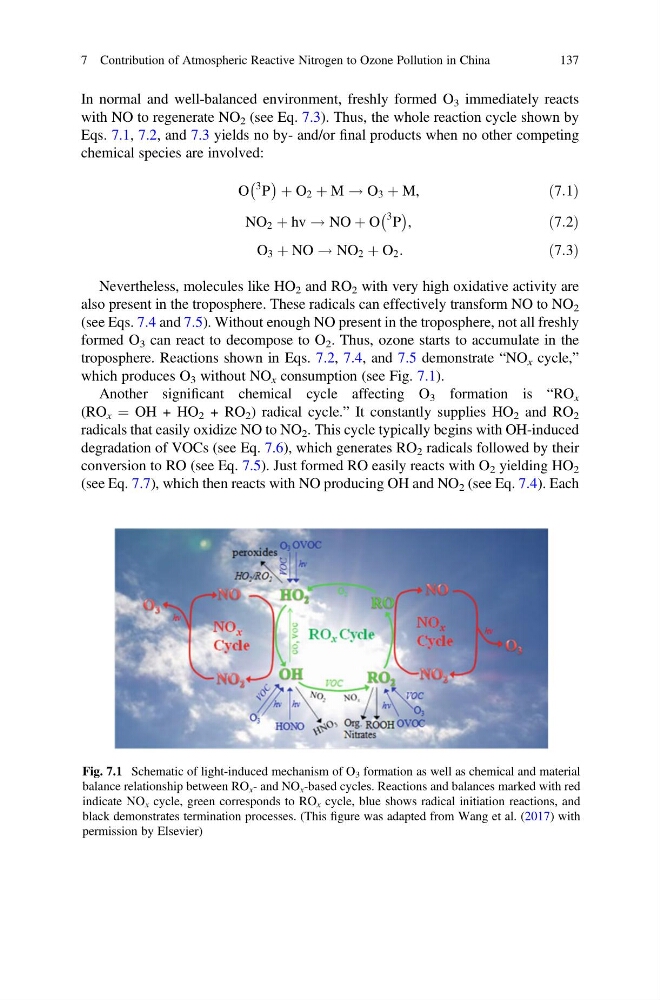
troposphere. Reactions shown in Eqs. 7.2, 7.4, and 7.5 demonstrate “NO x cycle,”
which produces O 3 without NO x consumption (see Fig. 7.1).
Another significant chemical cycle affecting O 3 formation is “RO x
(RO x ¼ OH + HO 2 + RO 2 ) radical cycle.” It constantly supplies HO 2 and RO 2
radicals that easily oxidize NO to NO 2 . This cycle typically begins with OH-induced
degradation of VOCs (see Eq. 7.6), which generates RO 2 radicals followed by their
conversion to RO (see Eq. 7.5). Just formed RO easily reacts with O 2 yielding HO 2
(see Eq. 7.7), which then reacts with NO producing OH and NO 2 (see Eq. 7.4). Each
Fig. 7.1 Schematic of light-induced mechanism of O 3 formation as well as chemical and material
balance relationship between RO x - and NO x -based cycles. Reactions and balances marked with red
indicate NO x cycle, green corresponds to RO x cycle, blue shows radical initiation reactions, and
black demonstrates termination processes. (This figure was adapted from Wang et al. (2017) with
permission by Elsevier)
7 Contribution of Atmospheric Reactive Nitrogen to Ozone Pollution in China
137
with NO to regenerate NO 2 (see Eq. 7.3). Thus, the whole reaction cycle shown by
Eqs. 7.1, 7.2, and 7.3 yields no by- and/or final products when no other competing
chemical species are involved:
O
3 P
À Á þ O 2 þ M ! O 3 þ M,
ð7:1Þ
NO 2 þ hv ! NO þ O
À 3 P
Á
,
ð7:2Þ
O 3 þ NO ! NO 2 þ O 2 :
ð7:3Þ
Nevertheless, molecules like HO 2 and RO 2 with very high oxidative activity are
also present in the troposphere. These radicals can effectively transform NO to NO 2
(see Eqs. 7.4 and 7.5). Without enough NO present in the troposphere, not all freshly
formed O 3 can react to decompose to O 2 . Thus, ozone starts to accumulate in the
troposphere. Reactions shown in Eqs. 7.2, 7.4, and 7.5 demonstrate “NO x cycle,”
which produces O 3 without NO x consumption (see Fig. 7.1).
Another significant chemical cycle affecting O 3 formation is “RO x
(RO x ¼ OH + HO 2 + RO 2 ) radical cycle.” It constantly supplies HO 2 and RO 2
radicals that easily oxidize NO to NO 2 . This cycle typically begins with OH-induced
degradation of VOCs (see Eq. 7.6), which generates RO 2 radicals followed by their
conversion to RO (see Eq. 7.5). Just formed RO easily reacts with O 2 yielding HO 2
(see Eq. 7.7), which then reacts with NO producing OH and NO 2 (see Eq. 7.4). Each
Fig. 7.1 Schematic of light-induced mechanism of O 3 formation as well as chemical and material
balance relationship between RO x - and NO x -based cycles. Reactions and balances marked with red
indicate NO x cycle, green corresponds to RO x cycle, blue shows radical initiation reactions, and
black demonstrates termination processes. (This figure was adapted from Wang et al. (2017) with
permission by Elsevier)
7 Contribution of Atmospheric Reactive Nitrogen to Ozone Pollution in China
137