

3.7
Extended Derivatives of CBPQT
4+ Ring
A number of extended “versions” of CBPQT
4+ rings were also designed and
synthesized, which acts as larger counterparts of the small Blue Box. These extended
derivatives are able to host either larger guests or in some cases, multiple guests
simultaneously.
In the year of 1996, a wider counterpart of CBPQT
4+ ring, namely, cyclobis
(paraquat-4,4
0 -biphenylene) (CBPQB
4+ ) [57], was obtained (Fig. 21), by using
ferrocene, a relatively “thicker” guest to template its formation. The two BIPY
2+
units are bridged by two 4,4
0 -bitolyl spacers, instead of the p-xylyl linkers in the
synthesis of CBPQT
4+ . The distance between the two BIPY
2+ units in CBPQB
4+ is
around 11 Å, enabling the ring to recognize two π-electron guests within the cavity,
where both of the two guests undergo donor-acceptor interactions with the two
BIPY
2+ units in CBPQB
4+ ring in an A-D-D-A manner (A, acceptor; D, donor).
This recognition behavior opens up opportunities to use CBPQB
4+ to synthesize [3]
catenanes. In fact, the [3]catenane 20
4+ (Fig. 22) containing CBPQB
4+ was even
synthesized [58] before CBPQB
4+ itself. The two crown ether rings in the 20
4+ act
as the intrinsic templates for the ring closing reaction. A few years later, [3]catenane
21
4+ (Fig. 23) containing two TTF recognition sites was obtained [59]. Both the two
TTF units in the two crown ether rings locate within the cavity of CBPQB
4+ .
Interestingly, upon oxidation of TTF units into cationic TTF
•+ radicals, the two
TTF
•+ units continue to reside within the macrocycle cavity, undergoing radicalpairing interactions. This behavior indicates that radical-pairing interactions within a
(TTF
•+ ) 2 dimer are strong enough to overcome the Coulombic repulsion between
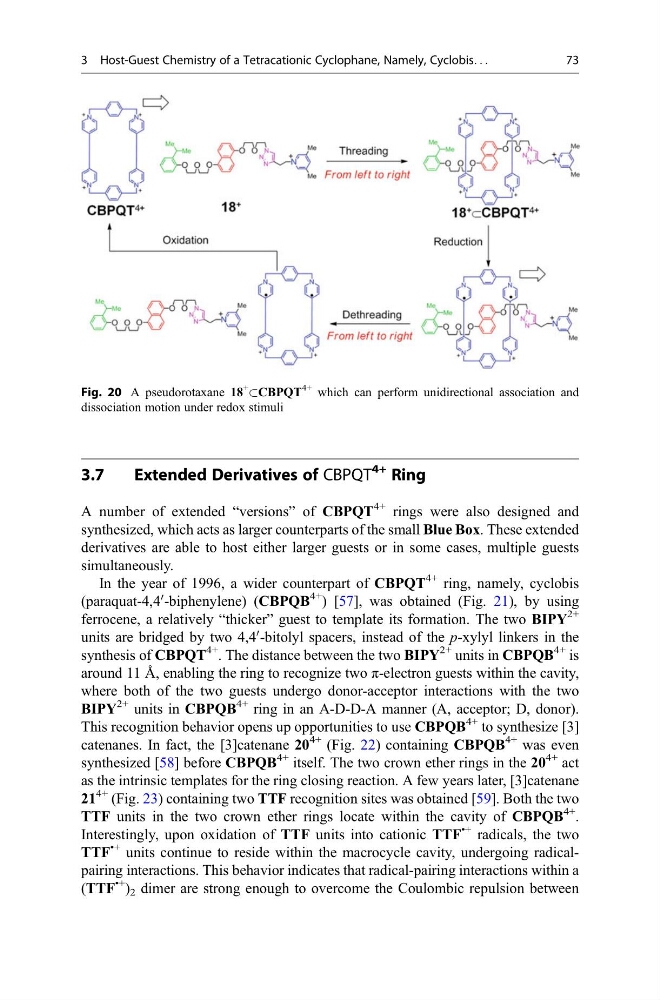
Fig. 20 A pseudorotaxane 18
+ &CBPQT
4+ which can perform unidirectional association and
dissociation motion under redox stimuli
3 Host-Guest Chemistry of a Tetracationic Cyclophane, Namely, Cyclobis. . .
73
Extended Derivatives of CBPQT
4+ Ring
A number of extended “versions” of CBPQT
4+ rings were also designed and
synthesized, which acts as larger counterparts of the small Blue Box. These extended
derivatives are able to host either larger guests or in some cases, multiple guests
simultaneously.
In the year of 1996, a wider counterpart of CBPQT
4+ ring, namely, cyclobis
(paraquat-4,4
0 -biphenylene) (CBPQB
4+ ) [57], was obtained (Fig. 21), by using
ferrocene, a relatively “thicker” guest to template its formation. The two BIPY
2+
units are bridged by two 4,4
0 -bitolyl spacers, instead of the p-xylyl linkers in the
synthesis of CBPQT
4+ . The distance between the two BIPY
2+ units in CBPQB
4+ is
around 11 Å, enabling the ring to recognize two π-electron guests within the cavity,
where both of the two guests undergo donor-acceptor interactions with the two
BIPY
2+ units in CBPQB
4+ ring in an A-D-D-A manner (A, acceptor; D, donor).
This recognition behavior opens up opportunities to use CBPQB
4+ to synthesize [3]
catenanes. In fact, the [3]catenane 20
4+ (Fig. 22) containing CBPQB
4+ was even
synthesized [58] before CBPQB
4+ itself. The two crown ether rings in the 20
4+ act
as the intrinsic templates for the ring closing reaction. A few years later, [3]catenane
21
4+ (Fig. 23) containing two TTF recognition sites was obtained [59]. Both the two
TTF units in the two crown ether rings locate within the cavity of CBPQB
4+ .
Interestingly, upon oxidation of TTF units into cationic TTF
•+ radicals, the two
TTF
•+ units continue to reside within the macrocycle cavity, undergoing radicalpairing interactions. This behavior indicates that radical-pairing interactions within a
(TTF
•+ ) 2 dimer are strong enough to overcome the Coulombic repulsion between
Fig. 20 A pseudorotaxane 18
+ &CBPQT
4+ which can perform unidirectional association and
dissociation motion under redox stimuli
3 Host-Guest Chemistry of a Tetracationic Cyclophane, Namely, Cyclobis. . .
73