

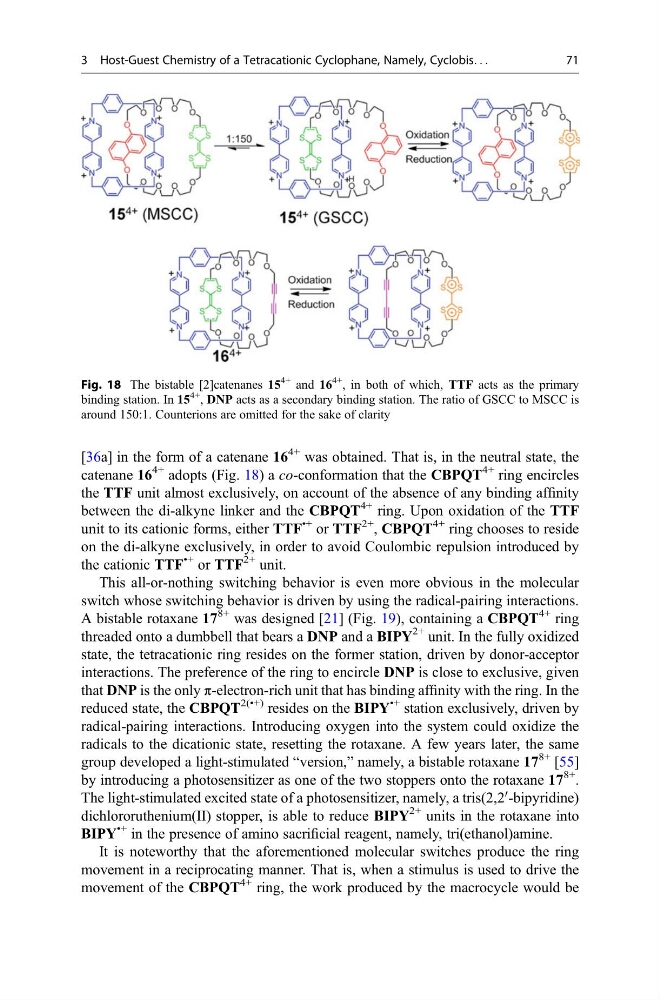
[36a] in the form of a catenane 16
4+ was obtained. That is, in the neutral state, the
catenane 16
4+ adopts (Fig. 18) a co-conformation that the CBPQT
4+ ring encircles
the TTF unit almost exclusively, on account of the absence of any binding affinity
between the di-alkyne linker and the CBPQT
4+ ring. Upon oxidation of the TTF
unit to its cationic forms, either TTF
•+ or TTF
2+ , CBPQT
4+ ring chooses to reside
on the di-alkyne exclusively, in order to avoid Coulombic repulsion introduced by
the cationic TTF
•+ or TTF
2+ unit.
This all-or-nothing switching behavior is even more obvious in the molecular
switch whose switching behavior is driven by using the radical-pairing interactions.
A bistable rotaxane 17
8+ was designed [21] (Fig. 19), containing a CBPQT
4+ ring
threaded onto a dumbbell that bears a DNP and a BIPY
2+ unit. In the fully oxidized
state, the tetracationic ring resides on the former station, driven by donor-acceptor
interactions. The preference of the ring to encircle DNP is close to exclusive, given
that DNP is the only π-electron-rich unit that has binding affinity with the ring. In the
reduced state, the CBPQT
2(•+) resides on the BIPY
•+ station exclusively, driven by
radical-pairing interactions. Introducing oxygen into the system could oxidize the
radicals to the dicationic state, resetting the rotaxane. A few years later, the same
group developed a light-stimulated “version,” namely, a bistable rotaxane 17
8+ [55]
by introducing a photosensitizer as one of the two stoppers onto the rotaxane 17
8+ .
The light-stimulated excited state of a photosensitizer, namely, a tris(2,2
0 -bipyridine)
dichlororuthenium(II) stopper, is able to reduce BIPY
2+ units in the rotaxane into
BIPY
•+ in the presence of amino sacrificial reagent, namely, tri(ethanol)amine.
It is noteworthy that the aforementioned molecular switches produce the ring
movement in a reciprocating manner. That is, when a stimulus is used to drive the
movement of the CBPQT
4+ ring, the work produced by the macrocycle would be
Fig. 18 The bistable [2]catenanes 15
4+ and 16
4+ , in both of which, TTF acts as the primary
binding station. In 15
4+ , DNP acts as a secondary binding station. The ratio of GSCC to MSCC is
around 150:1. Counterions are omitted for the sake of clarity
3 Host-Guest Chemistry of a Tetracationic Cyclophane, Namely, Cyclobis. . .
71
4+ was obtained. That is, in the neutral state, the
catenane 16
4+ adopts (Fig. 18) a co-conformation that the CBPQT
4+ ring encircles
the TTF unit almost exclusively, on account of the absence of any binding affinity
between the di-alkyne linker and the CBPQT
4+ ring. Upon oxidation of the TTF
unit to its cationic forms, either TTF
•+ or TTF
2+ , CBPQT
4+ ring chooses to reside
on the di-alkyne exclusively, in order to avoid Coulombic repulsion introduced by
the cationic TTF
•+ or TTF
2+ unit.
This all-or-nothing switching behavior is even more obvious in the molecular
switch whose switching behavior is driven by using the radical-pairing interactions.
A bistable rotaxane 17
8+ was designed [21] (Fig. 19), containing a CBPQT
4+ ring
threaded onto a dumbbell that bears a DNP and a BIPY
2+ unit. In the fully oxidized
state, the tetracationic ring resides on the former station, driven by donor-acceptor
interactions. The preference of the ring to encircle DNP is close to exclusive, given
that DNP is the only π-electron-rich unit that has binding affinity with the ring. In the
reduced state, the CBPQT
2(•+) resides on the BIPY
•+ station exclusively, driven by
radical-pairing interactions. Introducing oxygen into the system could oxidize the
radicals to the dicationic state, resetting the rotaxane. A few years later, the same
group developed a light-stimulated “version,” namely, a bistable rotaxane 17
8+ [55]
by introducing a photosensitizer as one of the two stoppers onto the rotaxane 17
8+ .
The light-stimulated excited state of a photosensitizer, namely, a tris(2,2
0 -bipyridine)
dichlororuthenium(II) stopper, is able to reduce BIPY
2+ units in the rotaxane into
BIPY
•+ in the presence of amino sacrificial reagent, namely, tri(ethanol)amine.
It is noteworthy that the aforementioned molecular switches produce the ring
movement in a reciprocating manner. That is, when a stimulus is used to drive the
movement of the CBPQT
4+ ring, the work produced by the macrocycle would be
Fig. 18 The bistable [2]catenanes 15
4+ and 16
4+ , in both of which, TTF acts as the primary
binding station. In 15
4+ , DNP acts as a secondary binding station. The ratio of GSCC to MSCC is
around 150:1. Counterions are omitted for the sake of clarity
3 Host-Guest Chemistry of a Tetracationic Cyclophane, Namely, Cyclobis. . .
71